|
| September - October
2009 : Vol.6 - Issue 5 |
Quote:
The universal brotherhood of man is our most precious
possession.
--Mark Twain
|
CONNECTiNG
How deserted, separated and divorced women survive
and live is a critical area of concern both for the
affected women and for others, particularly women's
groups and feminists, working with these women. In India
, apart from struggles around the issues of maintenance,
including those centered around Muslim women, and dowry,
not enough attention has been paid to these rights and
entitlements. The result is that more than 60 years
after independence, Indian women have no rights of ownership
of assets bought during the subsistence of marriage
unless these are in her name. There is no recognition
of the productive nature of house work and the hours
spent by women in caring for children and the elderly
and others.
The right to maintenance is an extremely
uncertain and inadequate right as it is dependant on
a womanss ability to access the court and prove her
husband's income. The law is also dependant on the discretion
of the individual judge deciding the case which in turn
is influenced by a variety of factors including gender
bias in an alarming number of cases. This is despite
the fact that certain principles have been laid down
by the Supreme Court and some High Courts that maintenance
should allow a woman & children living with her
to maintain the lifestyle she was used to during the
subsistence of marriage.
The sum awarded is usually inadequate and a woman is
often forced to live with her parents/siblings and also
be dependant on them both emotionally and financially.
Enforcing the orders of the court is another huge problem
that women face. These and other connected issues will
be discussed at the Seminar. A survey which has been
carried out amongst these women and the challenges and
obstacles that they face with the legal system and the
police etc. will also be discussed |
| --- Rima Kashyap |
Top
Stories: -
- New Direct Tax Bill affects
NGOs: No more 100% deductions on donations.
On the other hand, every NPO will automatically be
approved for 50% deductibility of donations. Deductible
donations will continue to be restricted to 10% of
Gross Total Income.
- Making a bhartha of btBrinjal:
The Genetic Engineering Approval Committee (GEAC)
of India cleared Bt Brinjal, the first ever GM food
crop in India and the first ever such GM vegetable
in the world with the Bt poison inside it, for 'environmental
release.' But Env. Minister Jairam Ramesh plans to
have public consultations across the country first.
- K. Balagopal. Founder member
of the AP Civi Rights Association passed away:
Human rights activist and lawyer, K.Balagopal who
was an inspiration to many in the civil liberties
and human rights movement in India, died of a cardiac
arrest on Oct.8.
- Radio Buldelkhand is an empowering
success!: The community and DA, jointly
manage the station. There are five community reporters
and six community coordinators. There is also a Management
Committee comprising the Sarpanch (elected village-head)
of Basova Village, doctors, farmers and Self Help
Group members.
- A solar water pumping system
has drastically changed lives of people in Jharkhand:
The eco-friendly model has not only helped villagers
grow vegetables and augment income but also revived
the community way of life.
- UK Govt. indicts Vedanta in
India: There is strong resistance going
on for past several years against mining in Niyamgiri,
a home to Dongria and Jharnia Kondhs. As the resistance
has grown stronger on the ground, it has received
tremendous solidarity responses from like-minded people
and groups across the globe.
- The People's audit of SEZs:
The People's Audits will seek to examine the impact
of the projects against stated objectives, as well
as the impact of the law on the people of the area,
and the political economy of the country.
- Children deformed because
of uranium waste: UK investigation uncovers
link between dramatic rise in birth defects in Punjab
and pollution from coal-fired power stations.
- Media:
- More News:
|
|
| |
|
Draft of Direct Tax
Code Bill affect NGOs earnings |
Tax Code Bill
2009 proposed by the Govt of India has included
provisions which have implications on the financially
sustainability and management of NGOs .It also
impacts Donors, because it has implications on
how donated funds will be potentially used.
Those who have been receiving 100% tax exemptions
to donations to NGOs under 35AC, will be deprived
of this benefit if the provisions come into effect--
No more 100% deductions on donations. On the other
hand, every NPO will automatically be approved
for 50% deductibility of donations. Deductible
donations will continue to be restricted to 10%
of Gross Total Income. In fact, part of donated
funds may have to be used by NGOs to pay taxes
to the Government.!
Those who have been supporting empowerment of
children and women by buying products made by
NGOs under their various income generating schemes,
the government proposes to tax the income generated
under these schemes.
Sources:. Section 72, read with Sch. 16. Direct
Taxes Code Bill 2009. Sign the petition to show
your objections: http://www.ipetitions.com/petition/DraftDirectTaxCodeBill2009. |
| Top
|
| |
|
Making
a bhartha of brinjal |
New Delhi: On
Oct 14, without addressing any fundamental concerns
with regard to GM foods like Bt Brinjal, the Genetic
Engineering Approval Committee (GEAC) of India
cleared Bt Brinjal, the first ever GM food crop
in India and the first ever such GM vegetable
in the world with the Bt poison inside it, for
'environmental release' (a euphemism being used
for some reason for permission for commercial
cultivation since environmental release began
years ago with open air trials!). It is reported
that the Government of India will now take a final
decision on this.
Agricultural and environmental groups all over
the country have protested against this approval
by GEAC of this toxic, unneeded brinjal, which
will take away choices from farmers and consumers
in irreversible ways,
Text of Shri Jairam Ramesh on the issue of Bt-Brinjal:
On World Food day:
"I have just received the recommendations
of the Genetic Engineering Approval Committee
(GEAC) on BT-Brinjal. I have studied the recommendations
and have decide on the following course of action.
1. The report of the Expert Committee (EC-II)
submitted to the GEAC on October 8th , 2009 that
formed the basis of the GEACs decision of October
14th, 2009 is being made public with immediate
effect. It is being uploaded straightway on the
website of the Ministry of Environment and Forests
( www.moef.gov.in).
All previous reports and studies on BT- Brinjal
are already in the public domain. Comments on
the EC-II report are being sought by December
31, 2009 and I actively encourage their submission.
2. During January and February 2010, I propose
to have a series of consultations in different
places with scientists , agriculture experts,
farmers' organizations, consumer groups and NGOs.
All points of view will be represented in these
consultations.
Strong views have already been expressed on the
Bt-Brinjal issue, both for and against. My objective
is to arrive at careful , considered decision
in the public and national interest. The decision
will be made only after the consultations process
is complete and all stakeholders are satisfied
that they have been heard to their satisfaction."
For more information, contact Kavitha Kuruganti,
Kheti Virasat Mission Jaitu, Faridkot dist., Punjab
Tel: +91-9393001550 or Selva +91-9891358457. |
| Top |
|
| |
|
R.I.P. K.Balagopal |
'As long as people are suffering, one cannot
rest in peace', words that describe Balagopal's
philosophy of life.
Human rights activist and lawyer, K.Balagopal
who was an inspiration to many in the civil
liberties and human rights movement in India,
died of a cardiac arrest on Oct.8.
Balagopal was the founder member of Andhra Pradesh
Civil Liberties Committee (APCLC) and later
of Human Rights Forum. ,He was also an advocate
who fought several cases to obtain justice for
the poor without charge. Known for his principled
stands and sharp legal mind, he lived and worked
with utmost simplicity and commitment - a comrade
and a friend whose loss is irreparable. Balagopal
was known across the country for his profound
scholarship and, more than that, fearless activism
in the arena of human rights covering a wide
range of issues.
|
| Top |
| |
SUCCESS
Radio Bundelkhand - Giving Voice to the Voiceless |
Azadpura is a village in Bundelkhand
region which faces acute water scarcity and
one problem that the women faced was a faulty
well which required urgent repairing. The women
aired this problem on Radio Bundelkhand and
within four days the concerned authority replaced
the missing wheel of the well. This is the power
of Radio Bundelkhand, an initiative of Development
Alternatives.
The purpose of setting up Radio Bundelkhand
is to work along with the villagers to use this
communication medium to create awareness, give
information, participate in local self governance
and provide entertainment - all based on requests
and feedback from the community. The audience
includes the communities in the radius of the
broadcast range - with special attention to
women, youth and the marginalised groups.
The community and DA, jointly manage the station.
There are five community reporters and six community
coordinators. The villages these reporters represent
are Azadpura, Ramnagar, Sitapur, Basova, Bagan,
Bhagwantpur, Ghatao, Jamuniya, Gujerra Kalan,
Mathrapur and Ghatao. There is also a Management
Committee comprising the Sarpanch (elected village-head)
of Basova Village, doctors, farmers and Self
Help Group members.
Until now, Radio Bundelkhand has the longest
duration of programming of four hours a day,
seven days a week, in Bundelkhandi and Hindi
amongst the government licensed community radio
stations in India. since two decades in the
Bundelkhand region.
The communities have decided that they would
like information related to employment and livelihood
opportunities, development of women, girl's
education, legal rights, farmers' issues, training,
their culture and history, how to ensure the
availability of basic infrastructure such as
water, energy and roads, development issues,
and any other information sought by the communities.
The broadcast timings in the morning and evening
have been selected by the communities, with
the women preferring the morning and the men
the evening.
The programming, based on issues and content
identified by the communities, is broadcast
in the formats which they have preferred, that
include the use of traditional Bundelkhandi
songs, folk music and nataks, discussions, reports,
commodity prices, phone-ins, experts speak,
coverage of events in villages, jokes and satire,
listeners' letters and feedback. The Wireless
Operating License was issued on July 31st, 2008
and the first transmission took place on August
15 2008 with the broadcast of the national anthem.
Reaching our communities.
The reach of the community radio is in a wide
range of approximately 5-10 kms and 25 villages
with a population of 15000 in the coverage area.
Programming Content on Radio Bundelkhand: Vandana
- Devotional songs broadcast every morning.
Khet Khaliyan - It includes the Jhansi Mandi
(unorganized market) prices for farmers so that
community gets all the information related to
agricultural products.
Bundelkhand Radio also broadcasts discussions
about agriculture issues like how to protect
seeds, crops & vegetables from insects.
Experts answer question asked by the farmers.
Bal Bandhu - Especially for school-going children.
Moral stories, poems and jokes by school children
are included. Story telling through the Radio
Jockeys is also a part of this programme.
Bundelo harbolo ke - This is about the Freedom
Fighters of Bundelkhand. Stories of the freedom
fighters & songs related to freedom fighters
are also broadcast.
Aas Paas - In this programme Bundelkhand Radio
broadcasts information on Right to Information
(RTI) and any other problem.
Mere Bundeli Mere Geet - is a listener's programme
in which they get the opportunity to listen
to their choice of songs.
Amma ke Chauki Se - In this programme community
women give their ideas on home recipes and step
by step instructions for preparing the dish.
Nuskhe Nani Dadi Ke - In this programme older
woman give tips on using home remedies or Desi
nuskhe for common ailments and diseases. Also,
give tips of using simple home remedies and
alternative herbal medicine, available from
the average kitchen shelf.
Radio Drama - On every Sunday Bundelkhand Radio
broadcasts a radio drama. In this programme
reporters discuss an issue and convey the messages
related to social issues like dowry, female
foeticide, importance of education etc.
Sathin - Sathin is a special programme for women.
Women from the community tell their story. They
discuss the struggle in their lives and success
story too. These women also share their feelings
what they want or wish for themselves.
Chhotou Kam Badou Munafou - This programme is
for those people who want to do small business.
Small entrepreneurs give tips to take up small
business.(Source-- By Indira Mansingh, Chief
Advisor, Development Alternatives).
|
| Top |
|
| |
|
The sun shines and
powers! |
A solar water pumping system has drastically
changed lives of people in Jharkhand. The eco-friendly
model has not only helped villagers grow vegetables
and augment income but also revived the community
way of life.
The four villages of Binkarva, Chichikala,
Kanabandh and Chichikhurd, in Chichikala panchayat,
Churchu block, Jharkhand, are models for the
rest of country. They showcase the collective
efforts of villagers to do something about the
lack of clean drinking water, following the
inaction of the state government.
Today, every home enjoys clean and potable water
even as flourishing kitchen gardens add to the
villagers' income. The health and hygiene of
the people of these four villages has also improved
dramatically after the installation of a solar
water pumping system in each of the four villages.
The solar water pumping system is used to operate
a DC surface centrifugal mono-block pumpset
that draws water out of boreholes. (The solar
panels must be installed in a shadow-free area)..
It is then collected in large tanks that are
mounted at a slightly higher level than the
rest of the village.
"The capacity of the tank is based on the
population and requirements of the village,"
says Sheela Hebrom from Kanabandh village. The
minimum capacity of a village tank is 2,000
litres.
Each tank is fitted to underground pipes, connected
to taps. These taps are not placed in individual
homes but at a common point between eight to
10 houses where villagers assemble to fill up
their pots and pitchers.
The system costs Rs 550,000 to install. It was
funded by Hindustan Petroleum Corporation Limited,
New Delhi, with technical assistance from the
Tata Energy Research Institute (TERI). The system
was installed by Jan Seva Parishad, with the
help of local villagers who contributed their
labour to the effort. The system can supply
40,000-50,000 litres of clean water every day.
By Moushumi Basu InfoChange, 22 September 2009.
|
| Top |
|
|
UK Govt. indicts Vedanta
Mines |
The British government has openly criticized Vedants
Resources over its treatment of local tribes in
a sacred mountain area in Orissa where it plans
to open a bauxite mine. The UK govt. ruled that
Vedanta "did not respect the rights"
pf the areas indigenous people, "did not
consider the impact of the construction of the
mine on the (tribe's) rights" and "failed
to put in place an adequate and timely consultation
mechanism". The verdict came after a nine-month
investigation into a complaint submitted by charity
Survival International against Vedanta's plans.
The complaint was dealt with a government agency
charged with promoting ethical guidelines on ethical
corporate behaviour for MNCs adopted by the Organisation
for Economic Co-operation and Development. (OECD).
The Church of England which has a stake in Vedanta
said, they would continue its investment but would
encourage "Action Aid and Survival International
to keep us informed of the perception of the impact
on the community and environment.
Since some years now, there is strong resistance
going on for past several years against mining
in Niyamgiri, a home to Dongria and Jharnia Kondhs
who draw their identity, livelihood, culture,
land from the mountain. The Supreme Court of India
gave a go ahead to the Sterlite Industries India
Ltd (an arm of Vedanta Resources Plc.) to mine
the mountain in August 2008 after a long legal
battle and defying all democratic norms of dissent,
technical reports submitted by its own body CEC
clearly saying no to mining. However, this has
not deterred the determination and strong resolve
of people on the ground to defend their source
of life and identity - the Niyamgiri mountain
and a civilization that exists around it.
As the resistance has grown stronger on the ground,
it has received tremendous solidarity responses
from like-minded people and groups across the
globe. The sense of solidarity has also grown
stronger as well with many more people and groups
coming forward to contribute to strengthen the
struggle all over the world.
A Solidarity Convention is organised in Delhi
on 10 Ocotber 2009 in New Delhi. Organized by
Lok Raj Sangathan, Kashipur Solidarity Group,
AIPWA, CPI(ML) Liberation, PSU, Peoples' Political
Front, MKSS, NAPM, NFFPFW, Delhi Platform, Kalpavriksh,
AISF, AISA, Other Media, Delhi Forum, Kriti and
other groups and individuals.
For further details please contact: Subrat 91
9868182363/ D Manjit 91 9868471143 / Asit 91 9899838159. |
| Top |
| |
|
A People's Audit of SEZs
in Maharashtra was done on September 15, 2009 at
Pen Taluka in Raigad District |
Maharashtra has
the largest number of approved SEZs in the country
to date: 204. This People's Audit, along with
an eminent panel, critically examined issues emerging
around large SEZs, of land acquisition; displacement;
corruption; environmental impact; compensation
as well as questions of development and economic
growth from different districts in Maharashtra:
Raigad, Mumbai, Thane, Nasik, Poona, Nagpur, Amravati,
Aurangabad and Chandrapur.
This effort has been jointly initiated by the
Jagatikaran VirodhiKri ti Samiti (JVKS; alliance
of several peasant organizations in SEZ areas
in Maharashtra), National Alliance of People's
Movements (NAPM),the National Campaign for People's
Right to Information (NCPRI), the Tata Institute
of Social Sciences (TISS), National Centre for
Advocacy Studies (NCAS) and the India Centre for
Human Rights Lawyers Network (ICHRLN).
The SEZ Act was enacted in India in 2005 and since,
722 SEZs have already been approved in the country
with many in various stages of approval, land
acquisition or completion as the case may be.
SEZs have invited controversy and peasant resistance
in many quarters and have become bones of contention
between the state, the developers and ordinary
citizens.
The Special Economic Zone Act 2005 deems SEZs
as "public purpose" with a comprehensive
inclusion of all types of economic activities
within the purview of SEZs,with no restrictions
on the maximum size and numbers of SEZs and a
requirement of only 50% of the proposed land to
be dedicated to economic activity.
SEZs do not have any local body representation;
nor adequate representation of labour and environmental
concerns in their administrative structure. The
Act contains provisions like section31(9) that
further remove accountability mechanisms from
the Zone Authority.
The Maharashtra People's Audit is first in a series
that will be followed by similar exercises in
Goa, Gujarat, Andhra Pradesh, Tamil Nadu, Karnataka,
Orissa, West Bengal and Delhi. The People's Audits
will seek to examine the impact of the projects
against stated objectives, as well as the impact
of the law on the people of the area, and the
political economy of the country.
|
| Top |
|
| |
|
India's generation of children
crippled by uranium waste |
Their heads are too large or too small, their
limbs too short or too bent. For some, their
brains never grew, speech never came and their
lives are likely to be cut short: these are
the children it appears that India would rather
the world did not see, the victims of a scandal
with potential implications far beyond the country's
borders.
Health workers in the Punjabi cities of Bathinda
and Faridkot knew something was terribly wrong
when they saw a sharp increase in the number
of birth defects, physical and mental abnormalities,
and cancers. They suspected that children were
being slowly poisoned. But it was only when
a visiting scientist arranged for tests to be
carried out at a German laboratory that the
true nature of their plight became clear. The
results were unequivocal. The children had massive
levels of uranium in their bodies, in one case
more than 60 times the maximum safe limit.
Staff at the clinics say they were
visited and threatened with closure if they
spoke out. The South African scientist whose
curiosity exposed the scandal says she has been
warned by the authorities that she may not be
allowed back into the country.
But an Observer investigation has now uncovered
disturbing evidence to suggest a link between
the contamination and the region's coal-fired
power stations. It is already known that the
fine fly ash produced when coal is burned contains
concentrated levels of uranium and a new report
published by Russia's leading nuclear research
institution warns of an increased radiation
hazard to people living near coal-fired thermal
power stations.
The test results for children born and living
in areas around the state's power stations show
high levels of uranium in their bodies. Tests
on ground water show that levels of uranium
around the plants are up to 15 times the World
Health Organisation' s maximum safe limits.
Tests also show that it extends across large
parts of the state, which is home to 24 million
people.
Punjab produces two-thirds of the wheat in the
country's central reserves and 40% of its rice.
The victims are being treated at the Baba Farid
centres for special children in Bathinda where
there are two coal-fired thermal plants and
in nearby Faridkot. It was staff at those clinics
who first voiced concerns about the increasing
numbers of admissions involving severely handicapped
children. They were being born with hydrocephaly,
microcephaly, cerebral palsy, Down's syndrome
and other complications. Several have already
died.
Indian authorities appeared determined to bury
the scandal. Dr Carin Smit, the South African
clinical metal toxicologist who arranged for
the tests to be carried out in Germany, said
that the situation could no longer be ignored.
-- millions are at high risk and every new baby
born to a contaminated mother is at risk."
"The government should investigate it because
if our child is affected it will also affect
future generations," he said. "What
are they waiting for? How many children do they
want to be affected? Another generation?
India's reluctance to acknowledge the problem
is hardly unexpected: the country is heavily
committed to an expansion of thermal plants
in Punjab and other states. Neither was it any
surprise when a team of scientists from the
Department of Atomic Energy visited the area
and concluded that while the concentration of
uranium in drinking water was "slightly
high", there was "nothing to worry"
about. Yet some tests recorded levels of uranium
in the ground water as high as 224mcg/l (micrograms
per litre) 15 times higher than the safe level
of 15mcg/l recommended by the WHO. (The US Environmental
Protection Agency sets a maximum safe level
of 20mcg/l.)
Meanwhile, smoke continues to pour from the
power station chimneys and lorries shuttle backwards
and forwards, taking away the fly ash to be
mixed into cement at the neighbouring Ambuja
factory. Inside the plant last week, there was
ash everywhere, forming drifts, clinging to
the skin, getting into the throat.
Ravindra Singh, the plant's security officer,
said that most of the ash went to the cement
works, while the rest was dumped in ash ponds.
It would be more efficient to burn better quality
coal that left less ash, he said. Every day
the plant burned 6,000 tons of coal. He had
no idea how much ash that generated, but the
stream of lorries to take it away was continuous.
Tests on ground water in villages in Bathinda
district found the highest average concentration
of uranium ? 56.95mcg/l in the town of Bucho
Mandi, a short distance from the Lehra Mohabat
ash pond. Such a concentration of uranium means
the lifetime cancer risk in the village was
more than 153 times higher than in the normal
population. Tests on ground water in the village
of Jai Singh Wala, close to the Bathinda ash
pond, showed an average level of 52.79mcg/l.
People living there said they used the ash to
spread on the roads and even on the floors of
their homes.
Scientists in Punjab including Dr GS Dhillon,
a former chief engineer with the irrigation
department, is convinced that the uranium has
come from the power stations and accuses the
authorities of failing to control the ash ponds,
which he believes have contaminated the ground
water.
Their concerns are bolstered by a report from
the Kurchatov Institute in Moscow, Russia's
leading state organisation for nuclear research,
published last month in the Russian Academy
of Sciences' Thermal Engineering journal. The
report's author, DA Krylov, raised serious doubts
about the safety of coal-fired thermal power
stations (TPSs), concluding that radiation from
ash residues and from chimney emissions built
up around coal-fired power plants and posed
an additional risk to those living and working
in the area.
A previous report in the magazine Scientific
American, citing various sources, claimed that
fly ash emitted by power plants "carries
into the surrounding environment 100 times more
radiation than a nuclear power plant producing
the same amount of energy", adding: "When
coal is burned into fly ash, uranium and thorium
are concentrated at up to 10 times their original
levels." (Source-Gethin Chamberlain, Bathinda,
August 30 2009,The Observer
http://www.guardian.co.uk/world/2009/aug/30/india-
punjab-children-uranium-pollution. If you
have any questions about this email, please
contact the guardian.co.uk
user help desk: userhelp@guardian.co.uk.
|
| Top |
| |
|
|
MEDIA |
Films:
Thodi Si Zameen, Thoda Aasmaan (A Bit
of the Earth, a Bit of the Sky)
Documentary film: 8 mins.
Director: Shashi Ghosh Gupta, Producer: Arun
Gupta).
The film is a peek into the world of street
entrepreneurs, who lead their lives in the shadow
of constant threat. The film looks at the problems
faced by them, in a sympathetic yet quietly
intimate manner. Phuphabhai is a tailor who
mends clothes, sitting under a tree, to provide
a life of dignity to his family. While Mukeshbhai
refurbishes sofas, struggling to keep his home
(which is the road itself) fires burning
Click on: http://www.youtube.com/watch?v=lmEHoDr4jRI
(YouTube) or http://www.vimeo.com/6718687
(Vimeo)
Angry Monk
By Luc Schaedler;
Documentary; 90min)
In Tibet - the mystical roof of the world, Gendun
Choephel, the errant monk who left the monastic
life in 1934 in search of a new challenge, is
the only one not to toe the line. A free spirit
and multifaceted individual, he was far ahead
of his time and has since become a seminal figure,
a symbol of hope for a free Tibet. A rebel and
voluble critic of the establishment, Gendun
Choephel kindled the anger of the Tibetan authorities.
The cinematic journey through time portrays
the life of this unorthodox monk, revealing
a face of old Tibet that goes against popular
cliche.The film offers a fascinating insight
into a country whose eventful past is refracted
in the multiplicity and contradictions of everyday
life. An outsider who was always open to new
things, he eventually became a stranger in his
homeland and homeless in foreign lands - a wanderer
between worlds.
Contact: Tel.: +91.9967021592, Email: upport@friendsoftibet.org.
-------------------------------------------------------------------
Iljodu (the Incompatible)
Dir. MS Sathyu
Prod. By Reliance Big Entertainment
Kannada, starring Meera Jasmine
The film focuses on a young photo journalist's
brief encounter with a 'Basavi' (a tribe in
Karnataka) at the altar of the village deity
to 'save' people hit by a devastating epidemic
and the treatment, Sathyu adds is that "for
those who believe no explanation is necessary,
and for those who do not, no explanation is
possible." Information from "a Swiss
NGO that found out though a survey that there
are about 1000 Basavis in Bellary district who
have been forced to become prostitutes"
was what led Sathyu to make a story on the Basavis.
The Latent City
when art excavates the city
A film by Krishnendu Bose
58 min/English with subtitles/2009
Delhi. 2500 years old. The city transforms.
The water turns black. The trees turn yellow.
The city turns a foggy green. And the poor turn
to dust. The city is transforming to become
more efficient and modern. Selected artists
are invited to this city. In its transformative
moment. To create art, in the everyday. 48 degrees
Celsius. The first public art ecology project
in India is shaped. For 10 days in December
2008.
A film re- constructs the art. Using snatches
of artist conversation. Splicing their politics
and performance. A video re-presentation, is
sliced in between the chronicle of the disappearing
city. Nudges us to re-examine the latent citizenry.
Urges to re- imagine the future of our cities.
Through the 'eye glass' of public art.
Contact: Krishnendu Bose, Member of IUCN Commission
on Education and Communication, Earthcare Productions,
B-91, Defence Colony, New Delhi, India. Tel.
Off. (91-11) 24334171, 24332005, Cell- +91-9811843111
Website: www.earthcarefilms.com.
-------------------------------------------------------------------
Living Ganga - Agony of the Ganges
(HSBC) Film, 52 min, India -
Dir. Sudhesh Unniraman, 2008
Produced by M/s AIM Television Pvt Ltd. Lead
by Mr. Iqbal Malhotra
By the end of the second millennium, as the
Aryans spread southward to cover the entire
Indo-Gangetic plain, the Ganges became their
most sacred river. Of all the places along the
Ganga, Benares is perhaps the oldest living
city in the world. Because of the overwhelming
reverential impact of the Ganges on hundreds
of millions of Hindus, a real-life paradox today
haunts the citizens of Benares. For how long
can they continue to ignore the gap between
the ritual purity of the river and its actual
level of cleanliness? Today, this divide is
so wide that combined with global warming and
climate change, it threatens the very life of
the river and its source, the Gangotri glacier..
The film was screened at the Hazel Wolf Environmental
Film Festival, Washington and was awarded the
prestigious Best Environment Film Citation at
the Mountain Film Festival Peru this year.
-------------------------------------------------------------------
Neerundu Nilamundu (Mission Possible)
by Bala Kailasam
This film is about a group of engineers working
in the water sector in Tamilnadu who are engaged
in such a mission. The film traces their journey
to 2003; how it started in the 'The Tamil Nadu
Water Supply and Drainage Board (TWAD)' and
showcases exemplary stories of individual transformation
leading to institutional transformation. The
narration is from the point of view of an engineer
from the Agricultural Department (AED) undergoing
training by a couple of TWAD engineers who share
their experience with unbelievable passion.Contact:
Bangalore Film Society, George Kutty @ 9448064513;
Visthar, Shyam Khalil @9845442453; The Other
Media, Santhosh Kumar @ 0944652999.
-------------------------------------------------------------------
'DAMaged'
by Subrat Kumar Sahu/ English, 73 minutes
DAMaged is what they say, to describe their
life today! ...The state says 'development'!
This film picks the Upper Indravati Hydropower
Project (built with a huge World Bank loan),
in its attempts to rake in the 'development
debate' that is conspicuously missing in public
spaces today. Claiming to permanently end 'poverty'
in Kalahandi (Orissa), instead, it has uprooted
almost 50000 indigenous people, mostly adivasis
and dalits, who had a traditional and sustainable
model of growth and rich civilizational ethos.
The project has turned a 'sustainable economy
of inclusive prosperity' into the 'farcical
sport of growth statistics'. The film exposes
how such projects (and now Vedanta's mining
ventures) are, in fact, horrific tools of large-scale
economic and 'cultural genocide'...However,
as it goes, people no longer take things lying
down... So, those who had originally inherited
the earth and kept the natural order inviolate
for millennia are now out on the streets in
attempts to protect their lives, livelihoods,
identities, and dignity.
Film Festivals
Green Theatre Festival
India's first green theatre festivalwas held
at Udaipur, Rajastan on 29 Sept - 2 Oct 2009
featuring over 20 performances related to the
environment and lifestyles / relationship with
nature. Contact: The Peoples' Institute for
Rethinking Education and Development, Udaipur,
Rajasthan. Tel: 91-294-245-1303, Web: www.swaraj.org/shikshantar.
|
|
Human
Rights film festival in solidarity with Sharmila
Irom
About 140 organisations have given a call to initiate
solidarity actions on the eve of the tenth year
of the hunger fast by Sharmila Irom against the
rule of the Armed Forces Special Powers Act (AFSPA)
in Manipur state. Protests, one-day symbolic fasts,
film festivals, posters, letters to the Chief
Minister of Manipur and Prime Minister as well
as solidarity poems by students in different parts
are being planned in many places. The central
idea behind the campaign is to support not just
Sharmila Irom's demand to repeal AFSPA in Manipur.
Ultimately, there is a need to remove such repressive
laws wherever they are in place, in the entire
north east, Jammu and Kashmir, Chattisgarh, etc.
Many groups have expressed an interest in organising
film festivals on human rights in solidarity with
Sharmila Irom during the period November 2-6,
2009. A package of relevant films is available
to any group that is interested in organising
such an effort.
Send requests for films to insafdelhi@gmail.com
and solidarity@manipurfreedom.org
with your programme details. Packages will be
couriered to you from following address.
INSAF national secretariat 124-A/6, First Floor,
Katwaria Sarai, New Delhi-110016 Ph: +91-11-65663958,
Telefax:+91-11-26517814 E-mail: insafdelhi@gmail.com.
Please send your announcements and reports of
your actions to solidarity@manipurfreedom.org
so that they can be viewed by a larger audience.
Soldiers in Sarong by Lokendra
Arambam. Duration - 45 minutes
"Sarong" -women traditional wear. Manipur,
a small state in north east India is in deep political
and social turmoil. The impact of armed conflict
and the confrontation between the State and Non
state actors were most acutely felt by the women.
Their lives are testimony to the impact of violence
on traditional societies forced into the painful
threshold of modernity.
Tales from the margin by Kavita
Joshi English Duration - 23 minutes
A travel to the remote, strife torn corner of
India. It documents the extraordinary protest
of Manipuri women for justice. The film also focus
on the everyday lives of women and human tragedies
in Manipur ( India).
Sharmila - the iron lady by a
Delhi-based national television channel,CNN- IBN.
A 30 minute story on Iron Sharmila. Her struggle
and the cycle of violence in the State of Manipur.
True lies in Manipur by CNN-
IBN - 30 minutes story on the fake encounter in
July 23, 2009 and the aftermath of the expose.
Redefining Peace by K.P Sasi Duration
- 58 Minutes
About1000 women were nominated for the 2005 Nobel
peace prize by net work of women movements and
organizations across the globe. Of which 91 women
were from India. The film tells the story of the
struggle and contribution of these 91 women, who
in their own ways redefine the definition of Peace.
Sharmila Irom is one among the list.
Jashn-e-azadi (How we celebrate
freedom)by Sanjay Kak Duration - 138 minutes Amidst
the everyday violence and ever-present fear in
Kashmir, there are no easy answers to such questions.
Where truth has been an early victim, all language,
speech, poetry, even cinema, becomes inadequate
to describe what we know and feel here. So we
reshape our curiosity, and point ourselves at
what we can see, what we are allowed to see.
Development flows from the barrel of the
Gun by B. Toppo and Meghnath Duration
- 55 miniutes. This film presents and examines
orchestrated state violence against indigenous
and local peoples when they protest against development
projects on their lands. The film strengthen their
thesis by documenting examples from all over India
- Orissa, Jharkhand, Madhya Pradesh, Gujarat and
Chhattisgarh.
Prisoners of Conscience Zameer ke Bandi
(1978, 45 mins, B&W)
On political prisoners in India before, during
and after the State of Emergency in 1975-77.
An important historical record of a traumatic
period in India's recent political history, Prisoners
of Conscience focuses on the State of Emergency
imposed by Indira Gandhi from June 1975 to March
1977. During the Emergency the media was muzzled,
over 100,000 people were arrested without charge
and imprisoned without trial. But political prisoners
existed before the Emergency, and they continue
to exist even after it is over.
-------------------------------------------------------------------
We Care Filmfest
Entries are invited for We Care Filmfest 2010
on various issues of disabilities recognized by
Persons with Disabilities (Equal Opportunities,
Protection of Rights and Full Participation) Act
1995 of chapter 1 point non2(h)(i) and the National
Trust Act-1999.
The PWD Act-1995 issues include: blindness,
low vision, leprosy-cured, hearing impaired,
locomotors disability, mental retardation, and
mental illness.The National Trust issues are:Cerebral
Palsy, autism, mental retardation & multiple
disability.
Categories for competition and Entry fee in
INR :
i. Upto one Minute - Rs 500
ii. Upto five Minutes - Rs 500
iii. Upto 30 Minutes - Rs 1000
iv. Upto 60 Minutes - Rs 1000
The entries should be on the rights of Persons
with Disabilities as set out in the UN Convention
on the Rights of Persons with Disabilities (UN
CRPD). All films and documentaries must have
English and/or Hindi subtitles. Format required:
DWD Deadline: 11 December 2009. Prize money
worth Rs 3.20 lakhs. Contact:The Director, -
We Care FilmFest, C/o United Nations Information
Centre, 55, Lodi Estate, New Delhi-110003(India).
Tel.+919811012065, +919899472065. Email : wecarefilmfest@gmail.com,
websites: www.wecarefilmfest.net.
-------------------------------------------------------------------
6th International Children's Film Festival
The 6th International Children's Film
Festival will be hedld in Hyderabad on November
14 - 20, 2009. Contact: http://www.cfsindia.org/req-
accreditition.htm
|
|
6th
Kolkata Short Film Festival
The 6th Kolkata Short Film Festival 2009 to be
held on 6 to 12 December 2009 aims to break the
myth that short films are 'just' documentaries,
or annual reports of institutions or events, and
that they lack creativity; that good stories can
not be told in a short time. KSFF also provides
1) a platform for upcoming filmmakers to showcase
their short films, 2) Create awareness about excellent
short films, 3) encourage youngsters to make short
films with creativity and excellent and 4) to
create a data base of good short films in and
around the country.
Deadline: 30th October 2009. Entry fee for those
who submit on or before 30th October 2009: INR
100, between 1-15 November 2009, a late fee of
Rs 100. for each film wil be charged. Contact:
Chitrabani, 76, Rafi Ahmed Kidwai Road, Kolkata
- 700 016
Tel: (033) 2265-3108, Fax: (033) 2226-2423. E-mail:
cbcal@chitrabani.com,
joe@chitrabani.Com
Nandan, West Bengal Film Centre, 1/1, A.J.C Bose
Road, Kolkata - 700 020. Tel: (033) 2223 1210,
2223-0970, Fax: (033) 2223-5744.
Online Film Festival
You are invited to participate in an online film
festival, 'Spirit Enlightened' which will be live
from December 09 to July 10.‘Spirit Enlightened’,
aspires to trace the spirit that has led the humanity
through centuries & civilizations and is in
the making of our future. The festival hopes to
explore with you, 'That' which envelops to infuse
& evolve the individual as well as collective
being, expands our vision of time as well as place,
enlivens our hearts, and enlightens our species
to transcend the present state of being for the
mystical new - the next state of supramental self.
Films may be on: Evolution of consciousness, Spirituality,
Culture of religion, Enlightened leaders, Philosophies
& politics and Timeless creative expressions.
For participation kindly fill the online form
and send film/DVD. Multiple entries are welcome.Deadline
for receiving the film is 1st week of November,
2009. Fill the individual form for each film and
submit at:
http://www.cultureu
nplugged.com/festival/submit.php
Contact: Culture Unplugged Studios, Tel (+91 020)
65002520, +91 976 539 1242
Website: studio.cultureunplugged.com
India | USA I UK | New Zealand
[News]
Discovery Award for Konkan Film
In a statement, the Toronto International Film
Festival (TIFF) said, 'The Prize of the International
Federation of Film Critics (FIPRESCI Prize) for
Discovery is awarded to Laxmikant Shetgaonkar
for 'The Man Beyond the Bridge'. The 96-minute
film (Paltadacho Munis), which Goan filmmaker
Laxmikant Shetgaonkar made with assistance from
the National Film Development Corporation (NFDC).
Lauding the Konkani film, the statement said:
'Far from the sensory overload of India's big
cities, this film explores smaller but enduring
dilemmas, drawing together keen environmental
sensitivity with a nuanced view of village dynamics.
'A widowed forest ranger Vinayak develops an intimate
relationship with a mentally ill woman, risking
becoming an outcast. Director Shetgaonkar, immersed
in the culture of the region, tells his tale with
grace and attentiveness, taking the villages traditions
and beliefs seriously, while casting a jaundiced
eye on those who exploit them.''
Video Short Contest
Create a video short that completes the phrase
"Democracy is….."
Videos can be any style: fiction or documentary,
animated or live action. no longer than three
minutes. in English or have English subtitles.
Contestants should be 18 years or above. They
may enter anonymously, but anonymous winners cannot
collect the grand prize. Deadline: 31JANUARY 31,
2010. The Prize is an all-expense- paid trip to
Washington, New York and Hollywood to attend gala
screenings of the winning videos, gain exposure
to the U.S. film and television industry and meet
with creative talent, democracy advocates and
government leaders. See contest site for a complete
list of rules: www.videochallenge.america.gov.
Photo Contest for Corporates
IBLF has launched the "Human Rights issues
in a Business Context". Companies are invited
to submit photographs depicting a human rights
issue in a business-operating context, within
any of the eight categories: 1) Collective bargaining,
2) Diversity in the workplace, 3) Health and Safety,
4). Migrant workers. 5) Privacy, 6) Supply and
distribution chains, 7) Women in executive management,
and 8). Work-Life balance.
The winning photographs will be used in the revised
version of the Guide to Human Rights Impact Assessment
and Management (HRIA), which will be published
in early 2010.
As the eight winning entries will be included
in the final Guide to HRIA, this is an ideal opportunity
for companies to positively showcase their efforts
in addressing human rights issues within their
business operations, in a visual manner. Deadline:
13 November 2009. Please refer to the Terms and
Conditions on
http://www.guidetohria.org/wiki?wiki=NSPQWM43315
1&sub=1&top= NFTMG1334731.
-------------------------------------------------------------------
Women Playwright's Conference
The 8th Women Playwright's Conference will be
held in Mumbai, India, from 1st to 7th November
2009 at University of Mumbai, Vidyanagari Campus,
Kalina, Mumbai 400098, under the joint auspices
of Stree Mukti Sanghatana (SMS) and the Academy
of Theatre Arts, University of Mumbai. An apex
committee comprising of Jyoti Mhapsekar, Sushama
Deshpande and Waman Kendre has been appointed
to further the work of the conference.
The seven days will see a rich blend of discussions,
seminars, roundtables and panel discussions besides
numerous play readings, skill workshops and performances
from various states of India as well as some international
performances.
"Women Playwrights International" comprises
all women working in the theatre irrespective
of race, class, age, ethnicity, religion to endeavor,
encourage and assist the development of their
works and enrich global culture. Since 1988, Women
Playwrights International (WPI) has organised
an International Women Playwright's Conference
almost every three years in different parts of
the world.Contact: Jjyothi Mhapsekar, Stree Mukti
Sanghatana (Women's Liberation Organization),
31, Shramik, Lokmanya Tilak Colony, Rd. No.3 ,
Dadar (E), Mumbai 400 014. Tel. /Fax: (91)-22
- 24174381. E-mail: wpi09mum@gmail.com
Websites: www.wpinternational.net,
www.streemuktisanghatana.org.
|
| BOOKS |
Women's
Studies in India- A Reader
Ed. By Mary E. John
Pgs. 657 Rs. 599/-
Publ: Penguin India
This Compendium of articles by feminists gives
an exhaustive overview of what concerns women's
studies, through sections on : New Beginnings,
Politics, History, Development, Violence, Law,
Education. Health, Household and Family, Caste
& Tribe, Communication & Religion, Sexualities,
Literature and Media. Contributors range from
Vina Mazumdar, Madhu Kiswear, Alok Mitra, Kamala
Bhasin, Vandana Shiva, Flavia Agnes, Nandita Haksar,
Anita Ghai, Devaki Jain, Brinda Karaqt, Ruth Manorama,
Janaki Nair, Susie Tharu, Kalpana Sharma amongst
others and a host of women’s organizations
from all over the country. A very thorough look
at all the issues women in India face at the moment.
"A Family for Every Child"
Edited by Shibani Jain and Published by Catalysts
for Social Action (CSA). 200 p
Available at www.csa.org.in.
A compilation of articles with perspectives on
adoption in India, this book presents stories
from the adoptive heart , but beyond that it gives
an overview of the laws etc related to adoption,
parenting concerns and also discusses "the
search for closure" concluding with a list
of organizations in the field of adoption. Catalysts
for Social Action (CSA), is a social
welfare organization dedicated to the cause of
child welfare focusing on Adoption by getting
adoptive parents and adoption agencies to meet.
CSA is supported by Kale Consultants Ltd., a reputed
Software House in Mumbai, India.
Kathai Aruvi Tamil Story Cards with Aseema......
Kathai Aruvi, the magical 100 Tamil story cards
library in a bag is now available with Aseema.
Kathai Aruvi story cards were produced by Chatnath
Trust to make Tamil reading attractive for children
by making each story separately in a laminated
card. So 100 children can read at the same time
and each card can be exchanged with another 100!.
The 100 cards come neatly put in a jute bag. The
library can be neatly put away and the lamination
makes it easy to be handled by a group of rough
kids. A bagful of 100 attractively illustrated
(in colour) cards is available for Rs.600. Anyone
interested in buying it or sponsoring it for rural
schools is welcome to contact us. Contact: Email:
aseema123@yahoo.com.
< http://us.mc544.mail.yahoo.com/mc/compose?to=aseema123%40yahoo.com>
or call Vasantha Parthasharathy 9841009927.
Using ICT to Develop Literacy
UNESCO ICT in Education Programme publication.
December 1, 2006
The Foreword states "This booklet aims to
provide a concise overview of the literacy issue
and explain how ICT [information and communication
technology] can be used to enhance literacy education
and contribute to achieving the Literacy Decade
goals. It focuses on five areas where ICT can
be utilized in literacy education: enhancing learning;
raising access to literacy education; training
of teachers; localizing content; and creating
a literacy-conducive environment.
The authors argue that being able to read, write,
and calculate in today's world is often not enough.
They state that developments in technology are
changing what it means to be a literate person.
They offer examples from literacy and technology
programmes that show how literacy and ICT education
can be mutually enhancing. Contact: UNESCO Asia
and Pacific Regional Bureau for Education, Mom
Luang Pin Malakul Centenary Building, 920 Sukhumvit
Road, Prakanong RoadBangkok10110, Thailand. Tel:
(66 2) 3910577, Fax: (66 2) 3910866 Website: ikm@unescobkk.org,
bangkok@unesco.org.
Digital Activism Survey Report 2009
Authors: Katharine Brodock, Mary Joyce,Timo Zaeck
DigiActive, July 1, 2009
DigiActive is an all-volunteer organisation dedicated
to helping grassroots activists around the world
use the internet and mobile phones to increase
their impact. The group conducted a survey from
late mid-February to mid-April of 2009, collecting
122 responses through an open online form and
then carrying out 3 rounds of qualitative and
quantitative analysis. Their aim in gathering
this international demographic data was to get
a picture of "digital activists": people
who use digital technology as part of grassroots
campaigns for social and political change. The
original data set is available for download separate
from the report (see below); DigiActive welcomes
comments at: survey@digiactive.org.
JeevikA [Life Free of Bondage] - Jeeta
Vimukti Karnataka
[Bonded Labour Liberation Karnataka].
On 03-09-2009, the Government of Karnataka
published 10,000 copies in Kannada of "An
Action Plan for the Rehabilitation of Bonded
Labourers in Karnataka 2008, containing also
Brief and yet Comprehensive Explanations and
Guidelines on Identification and Release of
Bonded Labourers and Prosecution of Offenders"
and 1,000 copies of the same in English with
a view to distribute them to all the officials
concerned as also the activists and some departments
not only in Karnataka but also in the country.
Effective implementation of any legislation
depends mainly on suitable policy guidelines
applicable to the implementing agencies.
The present action plan is a handy tool in hands
of the officials in Karnataka to implement the
Act effectivley. It can also prove to be a powerful
means in the hands of activists to lobby with
the government.
A "Training Manual on Bonded Labour"
in Kannada and English (Rs. 100 per copy) and
another compendium of very important reports
and articles on Bonded Labour titled,"Understanding
and Eradicating Bonded labour" (Rs. 500)
as also two handbills in Kannada giving simplified
versions of the Act, SR Sankaran's Guidelines
and AK Chakravorty Committee's Recommendations
and 15 wallposters on bonded labour in Kannada
are availabe. The priced volumes could be sent
byVPP on request and other material could also
be sent by post. Contact: Kiran Kamal Prasad,
Coordinator - JEEVIKA, 1289, ISEC Road,Nagarabhavi
Post, Bangalore 560 072.Telefax: (080) 2321019,
Mobile: 9008487287.
|
|
Handbook
on monitoring and evaluation of human resources
for health.
WHO, 2009
This Handbook offers health managers, researchers
and policy makers a comprehensive and standard
reference for monitoring and evaluating human
resources for health. It brings together an analytical
framework with strategy options for improving
the health workforce information and evidence
base, as well as country experiences to highlight
approaches that have worked. This publication
enhances understanding of human resources for
health and contributes to the growing body of
tools and applied research designed to address
the challenge of measuring and improving health
workforce outcomes, strengthening health systems
and, ultimately, improving population health.
This Handbook is the result of a collaborative
effort between the United States Agency for International
Development (USAID), the World Bank and the World
Health Organization (WHO).
Learning through Art
Jane Sahi and Roshan Sahi
Eklavya, Rs 250/-
For orders mail to pitara@eklavya.in
www.eklavya.in
This book perceives art as an active way of learning
and aims at helping teachers to integrate art
activity into school life. The activities are
designed to include all children and enrich regular
lessons of language, math and environment studies.
Contact: Eklavya, E-10, BDA Colony, Shanker Nagar,
Shivaji Nagar, Bhopal - 462 016. Tel.(755) 255
0976, 267 1017, 255 1109 (R) 246 5397. www.eklavya.in.
|
|
Cultural
policing in Dakhsina Kannada: a Report
The Kannada edition of the PUCL_K report was released
at Institute of Agricultural Technologists, on
Oct. 3 by A. Prakash. The book published by PUCL-K
costs Rs 50 and is available at PUCL offices
-------------------------------------------------------------------
Into a Warming World
Centre for Environment Education (CEE)
The Indian edition of State of the World 2009
report by Worldwatch Institute, USA, focusing
on Climate Change was released in Pune on 6th
October, 2009. The State of the World has been
a benchmark for discussions on various issues
of sustainability and the annual volume acts as
a platform to launch further discussion, study,
and research .
Contact: Tasneem Balasinorwala, ph: 9850918042,
email: just.tasneem@gmail.com
Amar Karan, ph: 9028532347, email: amar.karan@ceeindia.org
Sanskriti Menon, ph: 9822455250, email: sanskriti.menon@ceeindia.org
-------------------------------------------------------------------
What Did You Ask at School Today?
Kamala Mukunda
The skill of being able to ask the "right
questions" is far more important than giving
the right answers,says, veteran teacher and author
Kamala Mukunda. As she pored over research papers
on child psychology, and the psychology of learning,
she started summarising each research document
in short articles, sans the jargon. The book has
its genesis in these well-written and well-received
articles.
The morality of the students depends a lot
on the kind of values that the school practises.
If the school gives students a sense of belonging
and safety, and a chance to explore the environment
on their own, then students grow up with a better
sense of self.
-------------------------------------------------------------------
Purush Spandana (Marathi)
Men Against Violence & Abuse (MAVA)
Price: Rs.80/-, courier charges extra
This is the 101st year of the Marathi Diwali
Ank (special Diwali issue - rich cultural tradition
in Maharashtra) . And we bring to you a very
special issue of "Purush Spandana"
('Men's Expressions') , containing first-hand
write-ups by men from various walks of life
on a wide range of matters related to relationships,
gender and sexuality).
"To enlighten, and not only entertain"
has been the spirit of the Diwali Anks. This
years theme is on 'Friendship' . The issue analyses
the various dimensions of the theme in very
many ways: Male-Female, Male to Male Friendship,
Friednship between Father-Daughter, etc.
It has contributions from writers and professionals
like Awdhoot Paralkar, Mukund Taksale, Dr. Chandrashekhar
Phansalkar, Shriniwas Hemade, Dr.Manoj Bhatawdekar,
Sanjeev Chandorkar, Kumar Nawathe, Prashant
Kothadiya, Dr.Suresh Chandwankar and Rajeev
Kalelkar. Introduction to the deep, Selfless
Friendship between noted writer late Vijay Tendulkar
and grassroots human rights activist Udgam Vikasant,
fresh perspective on 'Friendship and Comradeship'
from progressive thinker -Marxist Go Pu Deshpande
and absorbing interviews with young playwright
Sachin Kundalkar and film-actor Atuk Kulkarni
form key highlight of this special issue.
The issue also has fresh writings and experiential
sharings by youths (rural and urban) like Meet
Tara Dnyaneshwar, Yayati Purohit and Kaustubh
Joglekar and some excellent poems on the theme.
There are thought-provoking write-ups on Examining
Friendship through Orkut, Face-Book and other
means of modern technology.
The issue is available at leading bookstalls
in Mumbai and Pune. In Mumbai, it is available
at Ideal Book Depot, Dadar, Majestic - Dadar,
Jawahar - VileParle, Majestic - Girgaum &
Thane. Contact Harish on 9870307748.In Pune,
the issue is available at Utkarsh Book Depot,
near Garware Corner; Akshardhara exhibition,
Bajirao Road. Contact Amol on 9271264011 / 9764005627.
Community Based Disaster Risk Mitigation
All India Disaster Mitigation Institute (AIDMI),
Ahmedabad has published its latest issue of
Vipada Nivaran Newsletter on 'Community Based
Disaster Risk Mitigation'. The following are
the contents of this issue.
|
 |
Community Risk Management in the Bihar Floods
2007 response |
|
CBDRM as a Disaster Reduction Approach is
on a Tipping Point |
|
Communities at the Base of Disaster Risk
Management |
|
The Local and National Capacity Building
Trainings of AIDMI |
|
Through Advocacy to Policy and Social Change |
|
Microfinance Helping the Members of a Community
to Develop Business |
|
Learning about Disaster Risks as a Means
to Community Empowerment |
|
The Importance of Livelihood Security to
Strengthen Communities |
|
Safer Livelihood Practices in Tamil Nadu
after the 2004 Tsunami |
|
National Disaster Preparedness should Integrate
Communities'Initiatives Example of Bangladesh |
|
Resilient Communities Resulting from Successful
CBDRM Implementation |
|
Basic Knowledge about Hazards will Help
you Know What to do? |
|
Contact: Pradeep Vyas, Learning Resources,
bestteam@aidmi.org
or vipadanivaran@vipadanivaran.net
Similar newsletters in Gujarati and English are
also available
-------------END-------------------
----------------
Gethin Chamberlain, Bathinda
Sunday August 30 2009
The Observer
http://www.guardian.co.uk/world/2009/aug/30/india-punjab-children-uranium-pollution |
| Top
|
|
| |
|
More News |
Flood relief
After the terrible floods of Karnataka and Andhra
Pradesh in October, many NGOs began relief activities
in the region. For those who would like to contribute
relief packages to Andhra and Karnataka, here
is a list of items required: Dry ration- Rice,
pulses, biscuits, packed eatables, Water purifier
tablets, Basic medicines, Sarees & Children
clothing,* Tarpaulins and thick plastic sheets,
Bed sheets, Blankets & Mosquito nets, Export
surplus / Cotton cloth for making sanitary napkins,
Stoves, cooking and water storage utensils/buckets,
Lanterns, candles, matchbox, torch & batteries,
Feeding bottles, ropes,* all kind of usable
clothing & footwear. (For the list of collection
centers, please log on to www.goonj.info).
Logistical support of any kind is also
needed:* Transport support to reach
the material to effected areas, Space for collection
centers, Facilities for local pickups , Transportation
of material from different cities to GOONJ processing
centers in a few cities.
Contact ruchikagoonj@gmail.com
or Tel.- 011-26972351, 41401216 E-mail- mailgoonj@gmail.com
for numbers and names in other centres in India.
Others collecting relief are:
|
| 1. |
Community Health Cell, 85/2, Ist Main, Maruthi
Nagara, Madiwala, Bengaluru - 560068
(Contact Persons: Pushpa 9449070223) |
| 2. |
Janarogya Andolana Karnataka, C/o CHC, Madiwala
(Contact: Obalesh 9740524128) |
| 3. |
Headstreams: (contact: Naveen Thomas 9342858056,
080-25200318) |
| 4. |
Association for India's Development (AID
India). (Contact: Guru - 9845294184; Prasanna
- 9916937280) |
| 5. |
Ms. Malarvizhi ActionAid India, Bangalore
at 9845537401
or Landline: 080-25586701, 080-25586583, 080-25586682.
Rural Reconstruction and Development Society
(RRDS) Contact GANGI REDDY
PROJECT DIRECTOR,Mobile: 099899 88008, 094402
73310,Off: 08624 - 222589 |
|
"Women
politicians debate issues"
Bangalore: A mock parliament held on
Oct. 21 by the National Alliance of Women jointly
with Women's Voice gave aspiring women politicians
got a chance to hone their debating skills. The
mock parliament was structured like a Parliament
with opposition parties. The exercise is being
held across the country to allow women with skills
to participate in decision making. Ruth Manorama,
president of NAWO said 40 women leaders for various
parliamentary constituencies in Karnataka participated.
Of these, 28 will participate in the Women's Parliament
to be held in Delhi from Nov. 2-5. At least 500
women leaders from across India are expected to
attend... to discuss pending Bills like the Women's
reservation Bill, Communal Violence Bill, Domestic
Worker's Bill etc.
Women and Guns in Manipur
Manipur: To offer financial and emotional support
to women who had lost their men-folk in the state's
political conflict. The Manipur Women Gun Survivor's
Network has been founded by 34 year old Bimalakshmi
Nepram. 'There's hardly a familyin Manipur who
doesn't have a drug abuser", her niece died
when she stepped on a mine and her mother s part
of a women's group which patrols the streets to
protectr their husbands from detention! The MWGSN
now has a 60-strong network of Manipuri women.
According to Nepra, "over 400 men aged between
19 and 40 are shot dead every year leaving behind
widows who have to borrow moey to survive. A study
of small arms in Colombia and Guatemala led to
the realization that Manipur had a similar problem
and that drugs and guns are linked-- something
her field trips confirmed. She works from Delhi
because she says, NGOs and social work are part
of the problem in Manipur... if you see a new
house in Manipur it either belongs to a militant
or to an NGO." As secretary general of Control
Arms Foundation of India, a Delhi-based NGO she
feels she doesn't need to make MWGSN one too.
Used Newspapers can change lives
Chandigarh: Old, discarded newspapers have changed
the lives of about 50 slum kids in Chandigarh
when an NGO Theatre Age, inspired people to donate
newspapers to held finance their education. 600
families contribute to the effort which also harnesses
acting, singing and dancing talents of the kids.
The 51 slum kids generate Rs 18-20,000 every month
by selling old newspapers from Chandigarh, Mohali
and Pachkula. After a decade of working with kids,
they have been given 4 rooms at the Government
High School in Sector 24 where one room contains
computers and books; another into a kitchen where
kids take turns to cook; one has a sewing machine
for the girls. The slum kids- shoeshine boys,
rag pickers and labourers study from 3-6 p and
then begin rehearsing. The children have gone
onto colleges, jobs and theatre.
Integrating child care
Bangalore: Organisations that offer child care
services for women in the unorganized sector are
being integrated so that they offer a common criterion
of crèche services, health, education or
nutrition. None of the organisations, which are
a mix of NGOs and state-run programmes have established
networks for their needs- a lacunae which the
Karnataks State Commission for Protection of Child
Rights is trying to do through a task force. Acts
that make provision for mandatory crèche
facilities by private companies include the Factories
Act, 1948, Plantation Labour Act 1951, Mines Act
1952, Contract Labour (Regulation and Abolition
) Act 1970, Inter-state migrant workers Act 1980,
Building and Construction Workers Act (Regulation
of Employment and Conditions of Work) 1996 and
the National Rural Employment Guarantee Act 2005.
Available for Conferences :
The Free Tree Conference and Training Centre of
the CIEDS Collective in Kolar is 60 kms aways
from Bangalore and includes a conference hal,
workshop spaces and ceandand simpe residential
accommodation for 30 people amid rock sculptured
landscapes.
If you would like to roganised seminars, conferences
or workshops or need some time off contact"
George Kutty, CIEDS Collective, Bangalore email:
freetreecommune@gmail.com
or tel: 080 25493705, 9448064513.
Helpline for Blood
Bangalore: The Comprehensive Trauma Consortium
and Sankalp's Helpline for blood 94800 44444 has
been receiving 15-20call per day ever sine its
launch two months ago. The helpline networks with
50 lood banks in Karnatka. Blood groups that are
rare are stored and they have become the centre
for blood donation drives in and around the city.
Ortho surgeries forkids
Bangalore: The Sparsh Vachana was inaugurated
on Oct 19 by actor Salman Khan and went on to
do over 20 complicated surgeries every day on
children who had physical ortho defects. Over
100 children benefited from the Sparsh Hospital
programme. Many organizations contributed to the
effort.
OBIT
The first Indian woman diploma, Chonira
Belliappa Muthamma, who fought for the
rights of women in government service did inNew
Delhi on Oct. 14 at the age of 85.
Muthamma was the first woman to join the Indian
Foreign Service in 1949 and the first Indian wamn
career diplomat to become Ambassador / High Commissioner.
In 1979she took he government to the Supreme Court
when she was denied the post of foreign secretary.
She fought against gender-bias and published a
collection of essays: Slain by the system- India's
real crises in 2003. She had to face al the prejudices
against women in Indian society. Earlier there
was a rule that a woman officer who married had
to resign.. she wrote in her bood that "I
cannot hep but conclude that my tenure with the
ministry was one long tussle with an anti-women
bias."
World Palliative Care Day-Oct 10
Bangalore: Awards
This year's Senior citizen award given by Harmony
was won by an illiterate woman who once was beaten
for trying to read. She learnt to memorize and
then swallow the papers she memorized so as not
to get caught. The last straw of humiliation for
this child bride came when her mother in law wanted
to kill her 4thchild, a girl. So she ran away
from the home with the baby, stayed at the railway
platform and then one day as she looked after
the orphans on the platform left her daughter
at a Trust home. She survived and then went to
live with tribals in Chikhaldhara in 1986 and
two years later he established Sapta Sindhu, an
ashram for widows and children. She has nurtured
1042 kids so far and her daughter armed with a
masters in Social work helps her. In February
this year she was invited to the Vishwa Maathi
Sahitya Sammela in the US- and flew for the first
time. And now one of her adopted sons has chosen
her life story as the subject for his Ph.D.
FAP (Fight Against Poverty)
Bangalore, Two different types of events were
conducted by NEON on on Oct 16, 17 towards the
Fight Against Poverty programme. On the first
day, a sports event for the children of the free
school of Sindhi Seva Samiti was held and later
250 lunchboxes with sweets for diwali were contributed
to a rural school. where 300 satchels had also
been donated. On the second day, to bring people
to awareness about the present climate crisis
and the need to eradicate poverty. a fair with.
Musical, dance and play performances were held
for over 1000 particpants.
Contact :Abhisheka, Sharath, Keerthana,Kashyap
Tel. 9980160022/+91 80 40901761.
EMAIL: makingawarness@yahoo.com.
www.neonilluminates.webs.com
See More Events.
World Alzheimer's Day
Mumbai: On the occasion of World Alzheimer's Day
on Sept. 21 ARDSI (Alzheimer's & Related Disorders
Society of India) Greater Mumbai and Mumbai Chapter
in association with Silver Inning Foundation planned
a Ten-Day Programme to create awareness about
Dementia and Alzheimer's. All over India ARDSI
and its networking organisations held awareness
campaigns.
Dementia is a progressive brain dysfunction ,
it is a brain disorder which results in a restriction
of daily activities and in most cases leads in
the long term to the need for care mostly in 60
+ age group. There are many forms of dementia,
the most common one being Alzheimer's disease.
The disease knows no social, economic, or ethnic
boundaries.While there is no cure for most causes
of dementia at present, there is great deal of
advice, support and information available from
Alzheimer's associations like Alzheimer's and
Related Disorders Society of India ,Silver Inning
Foundation and Nightingale Trust.
On 18th Sep  Gerontology Seminar 'Lets
Add Quality Life to Their Years' was held for
Nursing Students organised by L.T.College of Nursing
,S.N.D.T Women's University ---part of two full
day seminar from 17th Sep to 18th Sep 2009 from
8am to 4.30pm
On 19th Sep - A Street Play performed as a Sensitizing
Programme at the OPD ,Nair Hospital, and on 21st
Sept. a Special Service for Dementia in Mumbai
was launched by Silver Inning Foundation.
City Leprosy Project completes 33 Years
of Service
Mumbai: At a simple but significant function,
Bombay Leprosy Project (BLP) observed its Foundation
day on Sept. 11.
Dr R Ganapati, the Founder Director BLP and currently
serving as the Director Emeritus mentioned that
the institution was established with other leading
members like Dr Wardekar and Dr P Kapoor to undertake
field work on a massive scale to implement cost
effective ways of controlling leprosy. Documentation
of several operational research studies published
by BLP led to recognition in the national and
international circles and BLP began to be looked
upon as a model to be emulated in similar situations.
BLP's collaboration with K J Somaiya Medical College
has benefited in reaching specialized services
to leprosy patients and is a model of collaborative
activity. BMC Hospital Starts Specialised Leprosy
Services.
Bombay Leprosy Project (BLP) made a breakthrough
in integrating its specialised services into the
municipal health delivery system. On 11th August,2009,
yet another 'Extension Centre' of BLP was started
at the Shatabdi Hospital, Borivali to cater to
the large number of patients from Northern suburbs
seeking expertise of staff with vast experience
in leprosy.
To commemorate the 34th anniversary of Bombay
Leprosy Project, a seminar was organized on Oct.
6 on "Some Recent advances in Leprosy with
reference to treatment of leprosy and reaction
management" as a part of the Continuing Medical
Education program and our activities in the leprosy
relief work mainly with the objective of improving
the quality of life of leprosy patients.
The seminar covered mainly the role of newer drugs
in leprosy management.
bombayleprosy@mtnl.net.in"
< bombayleprosy@mtnl.net.in>
-------------------------------------------------------------------
|
|
The
B'lore twitter
Bangalore: In order to help Bangalore's underprivileged
children, the Twitter community of India's IT
hub came out in the open to tweet for a cause
on Sept. 11.
The event christened "Twestival" or
Twitter festival saw Twitter users of the city
come together to raise money for needy children
at the Kyra theatre. A performance by rock band
Swarathma, mesmerizing acts by Nakul Shenoy, psychic
entertainer and a stand up comedy show by Papa
CJ and Aron Kedar were part of the event.
The money raised in the event was donated to "Dream
A Dream", working for needy children, which
has 1500 street children on its rolls now. The
festival has also come up with a cheeky slogan:
Tweet, meet and give.
"The idea behind the festival is to help
underprivileged children who are struggling to
get their daily food and education." Bangalore
is among 200 places across the world to host the
festival on the day. Other Indian cities which
were part of the event are Delhi, Chennai, Mumbai,
Kolkata, Hyderabad and Pune.
Twestival was first started in London, when a
group of Twitter users met at Trafalgar Square
in September last year.Now, the festival is held
twice a year worldwide, during February and September.
While the February event is dedicated to a global
cause, the September event takes up a local cause.
iVol celebrates Divali with ukids
iVolunteer Bangalore celebrated Diwali with
around 40 children who are either orphans or
slum dwellers (Surabhi Foundation) and Destitute
Girls/Women (Government Reception Centre for
Women and Children)
Surabhi Foundation runs three residential schools
and two Non-Residential schools at various locations
in Bangalore and Anekal taluk for underprivileged
kids 6-13 years of age of both sexes. Those
are Marasuru Anekal taluk (Non Residential School),
Shikari Palya near Electronic City (Residential
School), Doddamavalli near J.C.Road (Residential
School) and Bangarappa nagar (Both Residential
and Non Residential) . Surabhi Foundation is
also running a Transit Home at Hongasandra near
IIMB for runaway children, Rag pickers, beggars
etc.
Tata Steel to set up 300 m hospital
in Orissa
As part of its corporate social responsibility
(CSR), is setting up a 6 million ton integrated
greenfield steel plant at Kalinganagar in Jajpur
district, and a hospital near its rehabilitation
colony at Gobarghati, The project will be completed
over next 2 years with the first phase commissioning
slated next month. The hospital building is
under construction over 4 acres of land and
the civil construction of the project is almost
over. Costing about Rs 300 million the hospital
is expected to benefit the families affected
by the Tata Steel`s project at Kalinganagar
and also the people in periphery villages.
Various health services related activities like,
rural health check-up programs, health camps
during epidemics and awareness building activities
for people on health issues are proposed to
be planned reports (Source Economic Times).
LEGAL
Delhi High Court Rejects Bayer's Plea
for Patent Linkage
The Delhi High Court today rejected an attempt
by Bayer Corporation, a multinational pharmaceutical
company, to sanction the patent linkage system
in India through a court direction. While holding
that unpatented (generic) drugs are not spurious
drugs, Justice Ravindra Bhat held that this
petition was an attempt to tweak public policy.
While dismissing the petition, the Court also
held that this is a vexatious and luxury litigation
which should be discouraged and imposed cost
of approximately Rupees 6 lakhs to be paid by
Bayer Corporation to Respondents - Union of
India and the Cipla Ltd.
CPAA had filed an intervention application to
be added as a party, which was allowed by the
Delhi High Court Tosylate. CPAA had urged that
the introduction of patent linkages in India
would have adverse public health consequences.
India does not recognise a patent linkage system.
If introduced, the patent linkage system would
have seriously impacted the early entry of generic
drugs into the market. Contact: Lawyers Collective
HIV/AIDS" aidslaw1@lawyerscollective.org.
Legal Aid Clinic for NGOs"
Public Concern for Governance Trust (PCGT) on
Oct.9 launched a 'Legal Aid Clinic for NGOs'
which will be run by PCGT through its team of
lawyers who have volunteered to extend their
services.
The Legal Aid Clinic is a platform to interact
with other NGOs and to understand as well as
resolve the legal and other issues confronted
by them. The Clinic seeks to assist NGOs, civil
rights groups and charitable organizations in
fulfilling various statutory and legal obligations
imposed on them under a diverse set of legislations,
to improve the level of governance.
Since NGOs stand at the forefront in tackling
issues relating to governance, it is imperative
that they be given a platform in resolving legal
issues that arise in the course of their work.
Contact: legalaid@pcgt.org.
LEGAL
Gram Nyayalayas Act to take effect on October
2
New Delhi: More than 5,000 village courts,
aimed at providing inexpensive justice, set
up under the provisions of the Gram Nyayalayas
Act, 2008, will start functioning from Gandhi
Jayanthi. This was announced by the Central
government.
The Act has been enacted to establish Gram Nyayalayas
(GNs) at the grassroots level for providing
access to justice to the citizens at their doorstep.
The GNs will provide inexpensive justice to
people in rural areas. It will be a court of
the Judicial Magistrate of the first class,
and its presiding officer (Nyayadhikari) will
be appointed by the State government in consultation
with the High Court.
The GN will be established for every Panchayat
at the intermediate level or a group of contiguous
Panchayats at the intermediate level in a district
or where there is no Panchayat at the intermediate
level in any State, for a group of contiguous
Panchayats. The Nyayadhikaris, who will preside
over these GNs, are strictly judicial officers
and will drawthe same salary and derive the
same powers as the First Class Magistrates working
under High Courts.
The GN will be a mobile court and exercise the
powers of both the criminal and civil courts.
The seat of the GN will be located at the headquarters
of the intermediate panchayat, they will go
to villages, work there and dispose of the cases.
It will try criminal cases, civil suits, claims
or disputes which are specified in the First
Schedule and the Second Schedule to the Act.
They will follow summary procedure in criminal
trial and exercise the powers of a civil court
with certain modifications and follow the special
procedure as provided in the Act.
The GN will try to settle the disputes, as far
as possible, by bringing about conciliation
between the parties and for this purpose, it
will make use of appointed conciliators.
HC takes serious view of child adoption,
will issue guidelines
Mumbai: In an order that might
make adoption of children by foreign couples
stricter, the Bombay High Court has said that
it will soon frame guidelines to ensure that
such kids do not develop behavioural problems
after they are given in adoption abroad.
"Psychiatric screening should be made compulsory
for kids before they are given in adoption to
couples abroad," observed justice DY Chandrachud
while appointing Additional Solicitor General
D J Khambatta as amicus curiae (friend of the
court) to assist in framing guidelines.
"Many children who are placed in guardianship
of parents abroad have had a disturbed childhood.
Unless adequate psychiatric evaluation is carried
out prior to placement of a child in guardianship
and even thereafter, the child may develop serious
behavioural problems," the judge observed.
The judge also sought help from Asha Bajpai,
Professor, Tata Institute of Social Sciences,
to give her expert opinion in formulating guidelines
for adoption of children by couples abroad.
The court was hearing a petition seeking medical
costs from a foreign couple and a adoption agency
for a girl who was repatriated to India and
given psychiatric treatment after she developed
behavioural problems in her home abroad. (Oct
11, Source PTI).
Medical help for tribals
A doctor couple Dr Ashish and Kavita Satav,
have devoted their lives to run a hospital for
the Korku tribals of Melghat, Maharashtra, through
the NGO, Mahan, If you would you like to support
them contact: mail2nimesh@gmail.com.
-------------------------------------------------------------------
International Day of Climate Action
*
Eight weeks away from the all important UN negotiations
at the Conference of Parties in Copenhagen.
there seems to be a broad consensus on limiting
temperature increases to two degrees Celsius,
but there is still no consensus on how to reach
that goal.
*On October 24, about 2000 organizers are organizing
actions in about 148 countries to walk, march,
cycle, plant trees etc.
(www.350.org
/ oct24). Visit www.iycn.in
/ oct24, contact Surendran at suren@iycn.in
or 011 4679 2246.
-------------------------------------------------------------------
Action demanded on land Acts
New Delhi: While land continues to be snatched
from tribal people and farmers to be given to
industrialists there is no initiative of land
distribution to the landless people. Forest
Rights Recognition Act was also implemented
after Janadesh 2007 but tribal people are not
getting the rights over the possessed forest
land because of the lack of concrete policy
guidelines to implement this act. That is why
this historical act became only a Government
declaration. Three thousands Satyagrahi are
coming from all over India to join this Sathyagraha
before Parliament on October 29, 2009.
Contact: Ekta Parishad, Gandhi Bhawan, Shymala
Hills, Bhopal, Madhya Pradesh. Ph: +91 755 422
38 21.
Cry to restore democracy in Manipur
Manipur: A series of mass protests
in the state followed the shocking murder of
Chungkham Shanjit and Thokchom Ongbi Rabina
Devi at a market place in Imphal town and in
broad daylight on 23rd July 2009 in a fake encounter
by Manipur Police Commandos. Instead of responding
to the democratic and legitimate demands of
its people for justice and action, the state
government led by Okram Ibobi Singh has replied
with brute force and imposed curfew in the state,
and tried to cover-up the story in the State
Legislative Assembly.
Meanwhile, several activists of the All Manipur
United Clubs Organisation (AMUCO) and the Apunba
Lup as well as environmental activist Jiten
Yumnam have been detained under various draconian
Acts like the NSA and UAPA. It is almost impossible
to find legal assistance for those arrested
in the state today. On Sept 24, a mass protest
was organisedvoutside Manipur Bhavan in New
Delhi which demanded the immediate and unconditional
release of all activists arrested in relation
to the protests since August 2009 and drop all
charges against them.
• That police personnel responsible for
the extra judicial execution of Chungkham Shanjit
and Rabina Devi in July 2009 are punished without
any further delay
• Ensure that due process of law is followed
with those arrested
• Repeal Armed Forces Special Powers Act
(AFSPA), 1958 and end the atmosphere of impunity
that prevails in Manipur
• Adopt a democratic and political approach,
rather than military, in resolving the crisis
in Manipur
• Please endorse the memorandum and fax
/ email a copy to Prime Minister Manmohan Singh
at 91-11-23019545 and manmohan@sansad.nic..in.
Committee for Peace and Democracy, Manipur,
Delhi Forum, Indian Social Action Forum (INSAF),
Intercultural Resources (ICR), Focus on the
Global South, National Alliance of Peoples Movements
(NAPM), New Socialist Initiative, The Other
Media, Saheli and other concerned groups.
RTI
Under the banner of Orissa RTI Coalition, civil
society organizations in the state have conducted
several workshops to promote greater use of
the Right to Information Act. RTI clinics have
also come up to address citizens' basic information
needs and help them file applications.
|
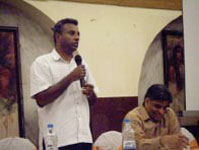
|
|
UN Millennium Campaign
Director Salil Shetty (L) and Orissa State
Information Commissioner Jagadananda / Photo
credit: Orissa RTI Coalition. |
|
 |
In Bhubaneswar
Around 20 participants attended a training of
trainers session on Right to Information, delivered
and organized by Centre for Youth and Social Development
and Orissa Soochna Adhikar Manch, in Bhubaneswar
in August.
The participatory sessions gave the delegates
an opportunity to deepen their understanding and
knowledge on the RTI Act and its rules with a
special focus on sections such as Section 4 on
proactive self-disclosure.
There was also a very practical session on the
important aspect of question framing for RTI applications
which the participants found particularly helpful
in relation to completing RTI applications.
Earlier, when Salil Shetty, Director, UN Millennium
Campaign had visited Bhubaneswar to have a dialogue
with a group of civil society organizations.
In his address, he highlighted three central components
that according to him should be a critical part
of the initiatives to achieve the MDGs: mobilization
of youth in monitoring government social welfare
schemes and programmes at the grassroots level;
implementation of RTI as a tool for every citizen
and appropriation of technology in disseminating
the information and maximizing the reach of communications.
Orissa RTI Coalition is a network of 12 organisations
formed in February 2009 to collectively join efforts
in raising awareness on power of information and
initiating hands-on support in marginalised communities,
assisting citizens to assert their rights and
to access the tool of RTI.
As a result of the discussions, working groups
were formed that will join efforts in developing
action plans on the following themes: campaign,
research and strategy, call centre, community
media, internal strengthening and knowledge management.
RTI clinics
Please use these readymade formats to file formal
complaints against Information Commissioners by
suitably modifying highlighted portions, filling
in the blanks or striking out options that are
not applicable. Refer to the Checklist of offences,
and copy-paste from five Most Applicable Offences.
Standard Draft of COMPLAINT LETTER against individual
Information Commissioners: http://www.box.net/shared/rh4u7ftbzn.
LIST OF OFFENCES commonly committed by Information
Commissioners: http://www.box.net/shared/9anbn50ook.
ADDRESSES to send your complaint letter: http://www.box.net/shared/v5rps0ho10.
|
|
 |
An RTI clinic in Balangir/ Photo
credit: Orissa RTI coalition
ADHAR, a local NGO launched its
RTI Clinic pilot initiative in March 2009,
with a three-day RTI training organised for
36 representatives from 18 villages of two
Gram Panchayats - Rathakhandi and Bhudipada.
Two youth representatives were mobilized from
each village and 36 volunteers, including
eight disabled persons from the Balangir Disability
Network, were involved.
ADHAR's RTI clinics are managed by a lead
volunteer. In Bhudipada Gram Panchayat, Banamali,
a physically disabled person manages the centre.
The clinic is open every day, including Sundays,
from 9-11 a.m. and supports community members
in understanding their information needs,
identifying the relevant Public Information
Officer (PIO), completing RTI applications
and knowledge on the obligations of public
authority and how to follow up applications. |
|
Volunteers
have distributed leaflets and the mobile phone
numbers for volunteers so that the communities
are aware of the RTI clinics. 60 RTI applications
on various issues, including PDS, NREGA, water
supply, and school building construction have
been filed.
In one case the Public Authority responded to
a request with complete and immediate action to
avoid filing of an RTI application.Contact: rtiodisha@gmail.com
9777677068.
Snehalaya celebrates annual function
The Annual function was held in Snehalaya on 23rd
and 24th Aug. went well and the building work
for the new School within Snehalaya campus is
progressing satisfactorily targeted to complete
by June 2010. Details as well as the Souvenir-
2009 with all the updates and information can
be downloaded from http://gchvols.pbwiki.com.
63 children reside in Snehalaya, mostly disabled
and or sick including HIV, CP, Epilepsy etc. handcrafted
greeting cards and many other gift items made
by or with the help of our children in Snehalaya,
are available on
http://gchvols.pbworks.com/SouvenirShop.
-------------------------------------------------------------------
JAMSHEDPUR: As a part of its Corporate
Social Responsibility (CSR), the department of
Integrated Customer Services (ICS), JUSCO, organized
a cancer awareness camp in collaboration with
Maa Saroda Cancer Help Line Ashar Aaalo (Vision
of Hope) to provide free check-up to the needy
and thereby offer moral support to them and their
families.
nearly 200 people at the camp attended . The members
present on the occasion included Shakti Sharma,
chief education, JUSCO, Soma Sinha of Maa Saroda
Cancer Help Line, Sumit Kr Das Gupta, head, ICS,
JUSCO, Subhashish Chakraborty, manager, CSR, JUSCO,
and JUSCO Seva champions. Contact:SSESS - Society
for Socio-Economic Studies & Services.
Calcutta - 700102.
Tel : 033- 25914439 (10.30am - 5pm)
skgssess@yahoo.co.in
Photography contest
SamanBachpan Abhiyan is launching a National Photography
/ Painting contest titled "Equal/Unequal
Childhood-India 2009" to raise voice against
unequal opportunities for children. The idea is
to involve artists, across India to create an
art production on the issue of Equal Opportunity
in Childhood to highlight the need for providing
special focus to issues related to Equal Opportunity
in Childhood. Awarded and selected entries would
be displayed at a National level exhibition to
be organized along side the award function.
Last date for sending in your entries is 16th
November 2009. The entry forms etc on www.samanbachpanindia.org.
PRIZES (one each for photography and painting)from:
Rs. 50,000/- and citation to Rs. 1,500/- )
Entries to Goa-CAP, C/o Dorothy Fernandes, H/No
83/1, Opposite Chicalim Church Chicalim, Vasco
Da Gama, Goa - 403711 Mobile: 09730103604, 09820679662
Email: equalindia2009@yahoo.com.
Saman Bachpan Abhiyan is a campaign about raising
voice against unequal opportunities for children.
The campaign believes that each child should get
equal opportunity for development as a matter
of constitutional right. For more details on the
campaign please visit.
We Farm CSR project
In a first for the corporate sector, the "We-Farm,
Radhapuram" project is being undertaken by
Suzlon Foundation (SF), in collaboration with
the National Positive Women’s Network (PWN+),
in Chennai.
The PWN+ identified women in and around Radhapuram
to undertake collective income-generating activities
and share produce not only to earn their livelihood
but also to boost their self-esteem and empower
them to deal with life's challenges.
Their efforts led to the setting up of the Thirunelveli
District Positive Women's Network (TPWN+), of
which Mugil has been elected president.
The SF has made available 46 acres of land along
with existing assets, including 152 grown coconut
trees, a farm house with metered electric connection
and a pump set to PWN+ to use for three years.
The agreement was signed on April 26, 2009. One
month later, the women began their work.
In June they harvested 1,700 coconuts. The women
are encouraged to use organic fertilisers made
out of five substances obtained from cows - dung,
urine, milk, curd and ghee. This mixture is kept
in a container and stirred twice a day for 22
days, after which it becomes organic manure free
of chemicals, explains Ravikularaman Ramasamy,
SF's CSR manager.
"Because of their HIV status, we tell them
to first consume whatever they grow themselves
and then sell the produce, as good nutrition is
essential for them to build their immunity,"
he points out.
Each of the 20 women came to the project with
a seed capital of 2,000 rupees while SF’s
contribution for the first year is one Lakh rupees,
to be given in quarterly installments.
Acting as facilitator between the PWN + and SF
in this key initiative towards building women's
resource rights is a national women's NGO, Sathi
All for Partnerships (SAFP), based in Delhi.
"We approached Suzlon, state agencies and
UNIFEM (United Nations Development Fund for Women)
with the idea of increasing women's resource base
in three states of Delhi, Tamil Nadu and Kerala,"
says SAFP director Shivani Bhardwaj. "The
Radhapuram experiment is the first ever private
and public agreement that forms a key step towards
building a women's resource zone."
The deliberations led to the SF offering two plots,
of which 46 acres were allotted for the project
and 43 for a similar initiative involving tribal
women in the same district.
Shalom cares for AIDS patients
Delhi: The SIM International Shalom Delhi project
steps into HIV homes with home-based care staff
making regular visits to the homes of families
enrolled in the program. They partner with other
NGOs to provide medical, material, social, support.
The program targets widows, single adults, and
families who have minimal support from their extended
family. It serves families in Delhi, Ghaziabad,
and Gurgaon.
Shalom Delhi targets Delhi's satellite city of
Faridabad with a prevention/awareness program.
The program runs in schools for 1-3 months, teaching
kids about basic hygiene and health care as well
as AIDS-related issues.Other prevention programs
target adolescents and truck drivers. It also
runs the Shalom Critical Care Center.
'BRAILLE MITRA' by Modular
Pune. This is a software that can instantly convert
ANY INDIAN a language and English soft copy to
Braille and a device with which visually challenged
can read it line by line. You just need to attach
a pen drive to this device- you don't even need
a PC. One 2GB pendrive can hold upto 1000 books!
I saw a reading demo with a Visually challenged
girl reading with this device faster than I could
read from the book!
Now what needs to be done is publishers and authors
giving the rights to convert their books to Braille.
They can just share the soft copy for such conversion.
All authors till now have given the rights free
of cost.
Write to the Jt. MD of Modular Infotech on
rrjoshi@modular-infotech.com*
Ganeshutsav and RTI in Mumbai
It was a brilliant move to reach the great
and eager crowds at the Ganpati festival at
the pandals and give them an insight into RTI.
And PCGT's ever enthusiastic young workers got
the permissions required to set up RTI stalls
with the various pandal organizers all over
the city.
The programme from Aug. 27 to Sept. 2 began
with a stall at 12th Khetwadi Ganesh Mandal
put up by volunteers from Ganesh Mandal. at
10th Khetwadi Ganesh Mandal. By 5 pm two volunteers
from the Mandal, on 29th August, 2009.
Stall was erected at Ganesh Galli, Lalbaugh-
thebiggest Ganpathi pandal in Bombay possibly,
The crush of crowds at the pandal forced the
volunteers to stand if they were to speak and
they managed to speak to around 700 people who
wanted information about the RTI till 9:30 pm.
Then there was a Stall at British Imperial Trust
(BIT) on Aug 30; on 31st August, the RTI stall
moved to Chinchpokli .
In the Govandi area PCGT put up stalls at the
Ganesh mandals at several places with the enterprising
volunteers and workers of Apnalaya,
who are active in the Govandi area.
RTI Stalls were set up at the Samata Nagar Savajanik
Ganeshutsav Mandal; the Sarvajnik Ganeshutsav
Mandal, at Baiganwadi ; the Ram Mandir Ganeshotsav
Mandal. wheretwo students of Government Law
College joined the stall and at Jagruti Seva
Mandal,. Contact PCGT 022-23647642.
-------------------------------------------------------------------
OBITUARIES
Founder of the North East India Harm
Reduction Network, NEIHRN, Mr. Kamad passed
away on 4th October 2009 at around 6:45 am.
Mr Kamad was one of the torch-bearers in the
field of drug use and harm reduction and an
ardent activist working for the welfare of people
especially for those impacted by drug use and
HIV.
Contact:North East India Harm Reduction Network,2nd
Floor Bishmilla Bhavan, Near Care Foundation,
Chassad Avenue, Brighter Academy Road, Imphal
West - 795001, Manipur State, India.
World non-violence day
About 1,460 NSS Students from 76 colleges of
University of took the pledge to work for peace
and non-violence on the occasion of International
Non-Violence Day.
"I shall endeavor to resolve all differences
through dialogue and constitutional means and
I shall strive to establish WORLD-PEACE... ",
about 1,460 students of N.S.S. Unit, from 76
colleges of University of Mumbai joined hands
with the millions of people all over the world
to take this pledge on 2nd October - International
Non-Violence Day.
Bombay Sarvodaya Mandal, N.S.S. Unit of University
of Mumbai and World March for Peace and Non-Violence
had jointly organized the mega event at Convocation
Hall, University of Mumbai, Fort Campus.
The main theme of this programme was to raise
awareness of non-violence, tolerance, full respect
for all human rights and fundamental freedoms
for all, democracy, development, mutual understanding
and respect of diversity among the young generation.
Students carrying placards and banners stating
'No More Violence, Peace is our Mission' marched
from Churchgate & CST followed by Gandhi
bhajans & peace songs.
|
|
TISS
receives US$18.2 mn to tackle AIDS, TB & malaria
in India
Bangalore:The Tata Institute of Social Sciences
(TISS) has received a grant of US$ 18.2 million
under the Global Fund to Fight AIDS, Tuberculosis
and Malaria (GFATM) Round 7 to enhance capacities
of institutions of higher learning in HIV/AIDS
Counselling and undertake capacity building
of counsellors under the National AIDS Control
Programme. -- 'Saksham',
Saksham is a partnership between 40 academic
institutions in over 25 states of India. Which
will work closely with the National AIDS Control
Organization, State AIDS Control Societies,
non-government organizations, representatives
of Positive People's Networks and corporate
agencies to enhance the overall quality of HIV/AIDS
counselling and counselling training programmes
in India.
A fast for repealing AFSPA enters 10th
year
Imphal: On Nov.2, 2009, Manipur poet and activist
Irom Sharmila, will enter the 10th year of her
hunger strike demanding the repeal of the Armed
Forces Special Powers Act (AFSPA).Introduced
in 1958 the AFSPA grants the Indian military
special powers throughout North-East India to:
•Arrest citizens and enter their property
without warrant;
•Shoot and kill anyone on mere 'suspicion';
•Enjoy immunity against legal action.
Under the cover of the Act the Indian armed
forces have indulged in killing, torture, enforced
disappearances and rape, bringing much misery
to the people of Manipur. According to the government
appointed Justice Jeevan Reddy Commission ‘the
Act has become a symbol of oppression, an object
of hate and an instrument of discrimination
and high-handedness.’ The United Nations
Committee on Racial Discrimination has urged
the Indian government to repeal the law.
On 2 November, 2000 Irom Sharmila Chanu, a Manipuri
poet decided to go on a hunger strike after
the Indian Army massacred ten civilians in Malom,
Manipur. On 6 November 2000 she was arrested
by the police and charged with attempt to commit
suicide under section 307 of the Indian Penal
Code.. She is routinely released every year
only to be re-arrested again. This ritual has
been going on for a decade now.
In solidarity with her local civil society,
particularly the women, have been on a relay
hunger strike since December 10, 2008. On the
occasion of her struggle entering the tenth
year, they are poised to celebrate her resilience
as a "Festival of Hope, Justice and Peace".
Sharmila's struggle is not just to defend the
human rights in Manipur, but in reality it is
reshaping the very foundations of democracy
in India. To celebrate Sharmila's courage and
resilience as her struggle enters the 10th year
We call upon all people's movements, women's
organisations and human rights forums to initiate
actions from 2 to 6 November 2009 .Write to
solidarity@manipurfreedom.org.
PEOPLE
Dr. Chandrakant Puri has taken over
as Professor-Cum- Director of the Centre for
Study of Social Exclusion & Inclusive Policy,
SNDT Women's University, which is sponsored
by the University Grants Commission, New Delhi
from September 1, 2009. He can be contacted
on Tel : 91-22-26608198 Cell :9819056444 E-mail
: csseipsndt@gmail.com
/ chandrakantpuri@yahoo.co.in
Visit on : www.csseip-sndt.org.
-------------------------------------------------------------------
|
|
WEBSITES
The Chandigarh, India-based non-profit service
and advocacy organisation DadaDadi
is using short messaging service (SMS) and other
technologies in an effort to ensure the safety
of elderly people living alone in the city.
Contact Jorawer Singh Chandigarh. Tel: 91 9888
9888 47 Contact: DadaDadi website <joe@dadadadi.org>
Care@dadadadi.org
Hamari Suraksha has joined hands with Mumbai
Police to launch a website to register senior
citizens, domestic help workers such as servant,
driver, cook, health care providers including
doctors and nearest hospitals. http://www.hamarisuraksha.com
/ presently launched the following services:
Senior Citizen Registration.
Registration of Senior Citizens and their domestic
help worker, Servant, driver, cook, cleaner,
milk man and others, Senior Citizen's Tenant
Registration, when you rent your house or apartment,
must register your tenant: Tenant Registration;Volunteer
Registration, the site will register volunteers
who will provide services to the senior citizens:
providers and volunteers.
Now you can see agricultural production in a
completely new Gapminder Graph. With data from
FAO, and 700 indicators to show how agricultural
production has changed over the last 45 years.Go
to: Gapminder http://gapminderfou
ndation.createse nd5.com/t/r/l/hyhtkt/ muksihy/r.
Gapminder has expanded the dataset on the number
of children per woman (total fertility rate)
to cover the period 1800-present for almost
200 countries. That means you can now follow
the demographic transition for almost all the
world's countries in Gapminder World. Go to:
Children per Woman in Gapminder World (1800-2008)
http://gapminderfou
ndation.createsend5.com/t/r/l/hyhtkt/muksihy/y.
www.congoshongo.com,
is a brand new initiative from iCONGO. a unique
retailing concept to promote NGO products and
the artisan communities. It aims to provide
ready market and visibility for these products
mainly through online retail, and later through
franchise outlets and "shops in shops"
with support from retail ventures for face-2-face
consumer experiences. Launched by Indian Confederation
of NGOs (www.icongo.in)
in association with Net Assets Private Limited,
an ecommerce and phone & buy retail company.
The CONGO SHONGO mission is to create progressive
market supply chains to promote products made
by NGOs, through a business 2 Consumer (B2C)
and Business 2 Business (B2B)- global retailers
and distributors model. They also plan a toll
free line and an outbound call centre operation
as support to drive sales.
|
|
Young
Leaders' Forum -The Indian Merchants' Chamber
in association with Society for Service to Voluntary
Agencies (SOSVA held the Tenth Dr. Mabelle Arole
Memorial Address on "The World is Warming
Let us keep a Cool Head" on October 9, The
Keynote Speaker was Dr. Madhav Gadgil
- Noted Environmentalist and Padmashri and Padma
Bhushan Awardee, founder of Centre for Ecological
Sciences at Indian Institute of Science, Bangalore.
And winner of the Environment Prize in 2003.
Joy of giving week
One of the most ambitious giving events in India
began from Sept. 27toOct 2 when GiveIndia launched
their Joy of Givng week all over the country.
The idea made a small beginning but has entered
the consciousness of many citizens and over the
years is bound to grow.
In Chennai there was a Battle of the Buffet,'
where several five star hotels presented a tasty
spread, for donors for Rs 5,000, at Chennai Trade
Centre on October 1. "The entire amount will
be donated to one of the 80 NGOs on our list.
An all-India campaign to "Donate books, Receive
Books" was started by Karmayog ( www.karmayog.org/donatebooks)
to enable any person from across the country to
connect with and donate books to any public library,
school, college, hospital, NGO, Trust, etc. contact
Nikhil on 9819685838 or Rohit on 9920431933.
( http://www.joyofgivingweek.org)
India's first green theatre festival was held
from Sept 29-Oct 2 in Udaipur featuring over 20
performances related to the environment and lifestyles/relationship
with nature, hosted by several local groups and
communities. The Peoples' Institute for Rethinking
Education and Development,Udaipur, Rajasthan,
Tel: 91-294-245-1303.
Web: www.swaraj.org/shikshantar.
Exhibition about conflict zones
Association for India's Development < http://www.aidindia.org>,
in partnership with many other groups, is hosting
events across the US and India to raise awareness
about the crisis in Chhattisgarh.One of the central
themes for these events is a traveling exhibition
of Javed Iqbal's < http://www.lightstalkers.org/javed-iqbal>
photos. Javed is a photo-journalist who has toured
extensively in southern districts, and brought
back powerful depictions of the conflict zone.
He has played an important role in uncovering
the truth behind some of the "encounters"
Check the Chhattisgarh photo exhibit.
< http://picasaweb.google.com/tsengupta/CGExhibit?authkey=Gv1sRgCLnko-PI4uSABg&
feat=directlink>
Environment Ministry invites discussion
The minister for environment and forests, Jairam
Ramesh has invited comments from the States, civil
society, and other stakeholders regarding the
design of an appropriate institutional structure
for best addressing the growing environmental
challenges. So click here < http://www.envfor.nic.in/mef/NEPA%20-%20Discussion%20Paper.pdf>
if you wish to participate and provide online
feedback to the ministry on the available options
for a National Environment Protection Authority
(NEPA) and to create a mechanism that would be
responsible for monitoring and compliance of environmental
standards.
The ISO26000 Draft International Standard (DIS)
on organisational responsibility is now available
for public comment here
< http://isotc.iso.org/livelink/livelink/fetch/2000/2122/830949/3934883/3935837/ISO_DIS_26000_Guidance_on_Social_
Responsibility.pdf?nodeid=8385026&vernum=0>.
ISO has been working on a standard for organisational
responsibility for over 5 years. The standard
is likely to be influential across much of the
world. Contact Kristina Sandberg < kristina.sandberg@sis.se>
OBIT
Remembering K.Balagopal - Campaigner for the Human
Rights Movement
K.Balagopal, the synonym for the human rights
movement in Andhra Pradesh passed away suddenly
on October 8th at 10.00 PM of a peptic ulcer.
His death at the age of 57 has left everyone
associated with human rights and democratic
movements in a state of shock. Activists and
supporters of the human rights movement are
still finding it difficult to accept the reality
of his death.
He was elected to the post of the General Secretary
of APCLC in 1985 and carried out that responsibility
for 15 years. He took up the leadership of the
organization when the repression on the Naxalite
movement had just begun. In the process of exposing
fake encounters he visited every nook and corner
of the state. He expanded the organization from
its confined location in a few cities to every
small town in the state. Inspired by his activist
practice, numerous young people were attracted
to the organization. In order to inculcate the
consciousness of human rights in muffasil areas
he identified issues that are specific to each
district and worked through them. By enabling
the district activists to articulate the local
rights issues, he shaped the organization in
such a way that wherever a violation of rights
took place, they would raise their voice against
it. Even though many civil liberties leaders
such as Gopi Rajanna, Dr.Ramanatham, Jaapa Lakshma
Reddy and Narra Prabhakar Reddy were killed,
he did not lose heart. Instead, he tried to
infuse courage among the fellow activists. He
remained unfazed in the face of direct repression
too. Arrested under TADA, he spent three months
in Warangal prison but always believed that
it is quite natural for activists to be arrested
or imprisoned. His response to attacks on his
person exemplified his democratic temperament.
When he was attacked by ABVP activists in 1984,
kidnapped by the Khammam police in 1989, fatally
attacked in Kottagudem in 1992 and even mauled
in the presence of National Human Rights Commission
in 1993, he refused to pause even for a day.
Speaking to the media after he was released
by his kidnappers, he suggested that they should
focus more on the repression of the rural youth,
rather than on him.
Balagopal's success lay in making the Andhra
Pradesh Civil Liberties Committee stand by the
people of Andhra Pradesh, especially in opposing
the repression unleashed by the state government
in the name of containing naxalism. His efforts
in developing APCLC into a pioneering organization
in opposing state violence in India are unparalleled.
Working relentlessly, he sought to extend the
civil liberties activism and practice from the
confines of urban intellectual debates onto
a much broader basis. When Dalits were attacked
during the initial years of Telugu Desam regime,
his was one of the first democratic voices to
be raised. During the anti-Mandal agitation
he wrote the first analytical essay in support
of reservations for backward castes from a human
rights perspective and thereby widened the horizons
the human rights movements.
He envisaged a broad based and autonomous human
rights movement which would be accountable to
the people. Due to the differences of opinion
emerging from such a reflection, he left APCLC
to form Human Rights Forum (HRF) with a few
comrades. Over the last ten years, HRF's growth
from 32 member organization to an active and
energetic 300 member strong organization owes
a lot to the untiring efforts of Balagopal.
His vision lay in creative alignment of human
rights theory with practice and in cultivating
among common people a spirit of commitment to
social responsibility and faith in democratic
values.
After joining the civil liberties movement Balagopal
wrote numerous analytical commentaries on various
social and political phenomenon in Andhra Pradesh.
To conduct public inquiries into human rights
violations all over the country, he established
Indian People's Human Rights Commission along
with Nandita Haksar and Sebastian which served
as the basis for the establishment of the National
Human Rights Commission. Balagopal is known
to people of Kashmir, Manipur, Chattisgarh,
Tamilnadu and Karnataka which saw extensive
human rights violations in recent times. He
visited these states many times with other civil
liberties organizations and brought out several
reports.
Despite rising to immense heights in the human
rights movement he chose to live a simple and
ordinary life. He practiced what he believed
in his everyday life. He did not have any life
outside the movement. From 1981 till his last
breath, he used all his energies in struggles
for justice for poor people and protecting their
rights. For rural people his name is synonymous
with 'rights'. Intellectuals consider him as
a thinker who advocated human rights norms to
evaluate the democratic quotient of any social
and political phenomenon. He stood out as an
intensely committed lawyer in a profession increasingly
beset with corruption. He not only provided
a moral compass to peoples' lives but also diligently
carried out the responsibility of warning them
about impending threats to public interest.
'As long as people are suffering, one cannot
rest in peace', words that describe Balagopal's
philosophy of life too.
pratham.nishant@gmail.com
"NGO initiates a course in banking"
WITH an aim to help find jobs for youngsters
from low-income group 'Pratham', has initiated
a three months course in Banking, financial
services and insurance industries. Pratham conducted
a study of sectors that provide more job opportunities
in various cities of Maharashtra. There are
many openings in the banking sector of banking
and finance in Mumbai and therefore Pratham
started the learning center in collaboration
with Deustsche Bank.
The NGO also has a team of volunteers who conduct
camps and door-to-door awareness programme about
the jobs opportunities in this field in the
slum and lower middle class areas of city of
Bhandup, Mulund, Kanjur Marg, Vikhroli etc.
The Course provides basic practical and theoretical
knowledge of banking, share markets, mutual
funds, capital markets and insurance sector.
To give them an overall idea, Pratham works
on communication, presentation, writing, typing
and computing skills. Candidates are also provided
training in English speaking and Soft skills
to build their confidence level.
Deutsche Bank provides financial help along
with guiding with the curriculum as per the
requirement of the sector. The bank also assists
the NGO in arranging corporate visits and orientation
programmes and guest lecture by their executives.
This training program is provided to the deserving
candidates at a very nominal fee.
www.prathambhandup.blogspot.com.
Fresh Graduates in need of a job-based training
contact: Pratham Learning Center.
Bhandup (west).Mumbai Phone: 259464404/ 65271315.
World Alzheimer's Day, 21st Sept,
Mumbai: Many events were planned across the
country to create awareness and bring
together concerned individuals and organizations.
in Delhi, Mumbai, Banglore, Kolkata and Hyderabad.
http://weforpeople.com/2009/09/world-alzhiermers-day
In Mumbai the Silver Innings Dementia Support
Group, and Related Disorder Society of India
(ARDSI) has already reached out to 657 families.
-- clinical psychologists provide free consultation
on the phone to seniors , pay a visit to the
home of an Alzheimer's patient and chalk out
the future course of treatment in consultation
with the family. Contact Mobile: 0091 9819819145
Website : www.silverinnings.com.
Neighborhood Empowerment- A People's
Movement.
Indian Development Foundation(IDF) has 17 such
Gurukuls spread out in India with only locals
supervising the effort for 2-3 hours of volunteer
work in their neighbourhoods.
IDF has 2 Gurukuls in tribal villages away from
Jaipur for the past 4 years. Similarly there
is an Empowerment Class for rag-picking children
of Jaipur city and their transformation is*
unbelievable. *
MP-MLA-Corporator funds are good to initiate
and support such schemes.
Principals of schools and school managements,
business houses, local shopkeepers, religious
institutions and individuals may come forward
to support such a novel scheme. The whole effort
has to be secular without politics getting into
it.
Despite the official claims, thousands of children
do not have access to basic education. This
IDF experiment has yielded excellent results
over the past 7-8 years starting with a class
in the tribal village of Tamnath near Karjat
and now in many states including one in Assam.
IDF can be a partner for sharing know-how .For
details write to Dr Narayan <idfmumbai@gmail.com>
or me <idfark@gmail.com>
Indian Development Foundation (IDF), Mumbai
Tel: 022 - 2876 2008/ 2876 3008 Cell : +91 98200
97905
Email : idfark@gmail.com.
Another 'Mother Earth store launched
Mumbai: 'Mother Earth' launched a 5000 sq ft
store at SOBO Central, Haji Ali, Mumbai on Oct.1.
Initiated by Industree, nominated amongst the
top 50 social entrepreneurships in India and
the Future Group they earlier launched the unique
endeavour in Bangalore. Industree, a social
entrepreneurship, combines its years of experience
in the developmental sector, with the retail
acumen of the Future Group, to address issues
of environmental as well as social sustainability.
Mother Earth is positioned
as India's first complete 'green' store with
a wide range of carefully selected merchandise,
that helps build environment and social sustainability
under home, apparel and food items. Mother
Earth sources from rural producers
and Fair Trade partners and encourages green,
artisanal skills, which provide non farm based
incomes to its rural masses.
It is a one stop shop for all requirements of
an aware buyer, looking for better healthier
alternatives for themselves and their families.
From organic and natural foods, home and personal
care to gifts, home decor and apparel. To enable
this, Industree has partnered with leading Indian
NGOs and Fair Trade partners such as SEWA, SASHA,
CFM, ANT, SADHANA, SAHAJ, DARAM, that work across
states in India, to bring the rich mix of ethical,
well designed merchandise to the discerning
customer.
Mother Earth helps, the aware
customer buy low carbon footprint merchandise
hence contributes to the 'greening' of India
and combating climate change.
Earth will be having 'green'
pledges signed at The SOBO Central Atrium, driving
home the message of sustainable consumption
into the hearts of the Mumbaikar.. The Mother
Earth trend of selling home composters,
having a pickup for recycled tetrapacks and
e-waste is being repeated at the Mumbai store.
www.motherearth.co.in.
Rural sisterhood Zindabad!
Bangalore: An 11-state study conducted from
Oct. 07 to Dec.08 by Delhi-based, Swanchetana
found that rural victims of sexual abuse are
beginning to fight back in their own way. Using
data collected by state police forces and NGOs
working with rural victims of sexual violence,
the researchers noted that 85% of urban women
express sadness and guilt describing their experience,
the rural women expressed rage! When a woman
of the fishing community was raped, the women
spread their stale catch outside the house of
the attackers and the police, who finally had
to lodge a case. Women are empowered when they
form a collective and the collective haranguing
by the women, while being 'fun,' is consistent
and persistent.
Fund raising through scraps
Mumbai: Residents from Dombivli and Kalyan are
contributing for animal care and welfare every
month through selling scrap and unused newspapers
and donating the amount to Plant and Animals
Welfare Society(Paws).
Seema Prabhu and her family from Dombivli (W)
say "Scrap material and old newspapers
fetch around Rs200, it is also reasonable to
offer small sums every month." PAWS began
with the initiative in early 2008. Volunteers
collected scrap from residents in selected localities
of Dombivli and Kalyan. The initiative was conceptualised
by three young volunteers of Paws. One among
them Saurabh Chaughule, a mechanical engineering
student and Paws fund raising committee member
said, 'We would go door-to-door and collect
the newspapers, but initially we found hardly
any positive response.” But determined
to continue the programme, they persevered.
Today almost 20 families are regular contributors
under this initiative. Sonali Bagade, 25, a
masters of social work student and member in-charge
of campaign awareness said, "We initially
began by convincing residents from different
localities. The word-to-word publicity got around.
We are hopeful that it grows further."
Oswald Braganza, 55, a resident of Kalyan West,
feels that animal care is being neglected by
the municipal corporation In Dombivli PAWS along
with international rabies experts celebrated
the third annual World Rabies Day on Sept.28
by organizing a free anti-rabies drive for 100
stray dogs in Thakurli-Dombivli area. Contact
Nilesh Bhanage +91 9920777536 www.pawsasia.org.
EOTO introduces mobile library (pix)
Mumbai: Working with 50 primary school students
in the Zilla Parishad school at Dhamote, near
Nerul, and with the Dhamale Memorial Trust in
six schools in Vikamgad Taluka in Thane, EOTO
introduced a mobile library which would travel
to all the tribal schools of Palghar.
|
|
Palliative
care in the slums of TN
Chennai: When death is inevitable, the last days
at home can be traumatic. It is at this stage
that Dean Foundation in Chennai
steps into provide whatever succour they can to
the patient and their families. A drip, an injection
to lessen the pain, a nurse, the Foundation attempts
to reduce the suffering of the terminally ill
patient. Their aim is to "improve the end-of-life
quality of the patient. The services are offered
free and the Foundation takes doctors and nurses
to the huts and alleys of the poor. A film, Rainbows
at Sunset directed by V.Ramanathan on the work
of the Dean Foundation won an award.. See reelshow
International website http://www.reelshowint.com/student-portfolios/rainbows-at-sunset.html.
Voices from the Waters-09
Bangalore's annual nternational 'Water film festival'
Voices from the Waters was inaugurated by the
Bhoomi Thai Balaga (Friends of Mother Earth) who
sang an invocational song about Water. The films
were shown from Sept 4-6 at the YWCA Koramangala
and at the Alliance Francaise. Among the Indian
films shown were Holy Water by Lotta Ekelunnd
about the Cola companies depleting and polluting
the environment; Sujan Bandhu by Viplab Majumder
; Chilla Bank by Akanksha Joshi tracing the 4-decade
view of a banyan tree on Chilka Lake from the
times when there was no export bazaar on its banks
to the time maybe when there will be no lake!Jala
Tarangani, produced y the students of Christel
House, India which wove the notes of music with
the music of the river; Barren Dreams by Anwar
Chowdhury capturing the lives of children living
on an island in the middle of the Jamuna river.
"Living Water" the piece de resistance
of the festival explored the Indian religious
context of water i.e. Preservation is communion,
while 'Deeply Superficial by Vineet Rai is a chronicle
of the many meanings the waters of the Ganga hold...
its veneration and its filth and those who are
out to save it from those who want to make money
from it. Contact: Bangalore Film Society Bangalore.
Tel:080-25493705, 9448064513.
Economic Rights of Single Women
Mumbai: As part of a larger project on the financial
status of separated women being done by the Economic
Research Foundation in Delhi (with support from
IRDC), and the Women's Legal Forum, held a seminar
on the 'Economic Rights and Entitlements of Separated
and Divorced Women in India' on Aug 22 at the
YMCA International.
Although data census shows that the separated
female population is 7.3% of the total female
population, there is in fact, no real data on
the subject with estimations of desertions, abandonment
etc estimated in the range of 20-35%. The objective
of the seminar was to examine the laws and government
policies which concern these women and to evaluate
their status. Among the issues discussed were
the right to marital property, recognition of
household work as 'productive, the Forest Rights
Act etc. Among those who discussed these issues
were Adv. Kirti Singh, Prof. Maithreyi Krishnaraj,
Dr, Flavia Agnes, Dr. Vibhuti Patel, Kiran Bhatti
with regional inputs from fellow activists and
advocates from the various regions. Contact:
Insitu Housing in Slums report (pix)
Bangalore: In a documentation of the 750 slums
in Bangalore, not all of which are 'recognised'
AVAS (Association for Voluntary Action and Service)
interventions in urban programmes for the slums,
are trying to create viable, affordable and replicable
insitu housing models to resolve the land and
shelter problems of the slum dwellers. It has
impacted 18 communities directly at a micro level
and its sustainable models have become the icons
influencing housing policies for the urban poor.
The report on 'Affordable Housing for All', was
submitted to a High level task force of the Govt.
of India.
The AVAS experience, replicable and viable, is
evident in the Hoskerahalli slum;Wahab Garden;
Sudhamanagar; Parsi Garden slum in Bandavyanagar;
Vyalikaval Chowdiah MRS Palya; amongst others.
Contact AVAS Bangalore, Tel: 080-23614227 email:
< avas@vsnl.com>
Fishworkers Against ASEAN-India FTA
Ernakulam: Several Major Fisheries Trade Unions
organized a convention on Sept. 24 at Ernakulam,
under the banner of the Kerala Fisheries Coordination
Committee, to oppose the recently signed ASEAN-India
Free Trade Agreement, with an unanimous demand
for "No fish imports" and called for
a march to Parliament on Nov. 11 against it.
The Agreement between India and 10 South East
Asian nations signed on August 13th this year
aims to allow the import of several fish products
at lower tariffs into India. This would grossly
impact the employment and incomes of over ten
lakh traditional fish and allied workers in
Kerala. Fishworkers in Kerala are already dealing
with the pressure of rising investment and maintenance
costs, and are unable to deal with even a one-rupee
fluctuation in price.
Friends society blood donations
Vadodara: VIIth Voluntary Blood Donation Camp
for the Year 2009-10 was conducted successfully
on Sept. 17 at M/s. Eclipsys Corporation, where
their 44 employees donated blood.
In the above camp, many of them had donated
blood for the first time. With above, they have
contributed 244 units to Blood Bank, S.S.G.
Hospital in the year 2009-10. Contact Anuj Agrawal"
jaya.anuj1@gmail.com.
Mumbai, Sep 22 The Bombay Stock Exchange has
partnered with Plan, an NGO working for child
rights, to help sensitise people to invest in
girl children for the nation's economic growth.
The BSE also launched a report "Because
I am a Girl" today, which focuses on the
economic empowerment of the girl child. It was
also released simultaneously in 15 countries,
including at the Sydney and Dutch Stock Exchanges.
BSE CEO and Managing Director, Madhu Kannan,
who released the report with ICICI Securities
CEO, Madhabi Puri-Buch and Plan India Member
of the Governing Board, Raj Nooyi, said "the
BSE was privileged to partner with Plan and
start a social responsibility programme for
the girl child."
The organisation will continue to release such
reports on the state of girl child till 2015,
which would be the 20th anniversary of 1995
Beijing Conference on Women.
(Box)Details of NGO Co-ordinators all over India
are available at our Helpline no. 98203 39608.
India to receive Rs 130 cr aid from
Germany
New Delhi, Sep 16 (PTI) India will
receive Rs 130 crore (19.4 million Euro) aid
from Germany for viable loan-based financing
of natural resources and conservation initiatives
taken up in rural areas.
An agreement was inked by the National Bank
for Agriculture and Rural Development (NABARD)
and Germany's Development Bank KfW as part of
financial cooperation between both the nations,
a German embassy statement said here.
The assistance to be given for the Umbrella
Programme for Natural Resource Management includes
15 million Euro as standard loan and 4.4 million
Euro as grant, for which NABARD is the executing
agency.
The Umbrella programme aims to demonstrate viability
of loan-based financing for management of natural
resources and conservation initiatives in rural
areas.
Indo-German bilateral development cooperation
focuses on three priority areas, environment,
energy and sustainable economic development,
to facilitate inclusive growth, reducing poverty
and meeting millennium development goals.
India's denotified tribes demand a life of dignity
Living in precarious conditions, India's denotified
and nomadic tribes are subject to maltreatment
and abuse by all and sundry. Highlighting their
inhuman existence, a convention held in the
national capital brought together many of these
floating communities to demand basic rights
of food and shelter from the government.
|
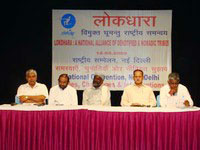
Speakers at the Convention / Photo credit:
Mahipal Singh Rawat/ OWSA |
New Delhi:
They have no address, no landholdings, no
citizenship documents - in fact, no identity
proof of the usual sort available to other
citizens. Their children remain out of school
and the women struggle for dignity.
Even after 62 years of independence, a large
section of the country's denotified tribes
(DNTs) and communities continue to remain
out of the census list, as they are not
registered as primary residents. The last
community-wise census of these tribes was
done during the colonial rule in 1931.
Since then, only projections have been used
to arrive at an estimate of their population.
While some of these communities are classified
as Scheduled Tribes, Scheduled Castes and
Other Backward Classes (OBCs), others do
not find mention in any of these categories. |
|
To highlight
the peculiar problems faced by these invisible
communities and suggest measures to integrate
them into the mainstream, a national convention
was organised in New Delhi earlier this week by
Lokdhara, a national alliance of denotified and
nomadic tribes. Denotified tribes include various
communities, which were unjustly notified as 'criminal
tribes' under the Criminal Tribes Act, 1871 by
the British government. Following independence,
all of these were 'denotified'. |
 |
A still
from the doumentary by Anand Kasambe/ Photo
credit: Mahipal Singh Rawat/ OWSA. |
|
The event also
showed a short documentary by Anand Kasambe, an
activist with Lokdhara, depicting the plight of
these nomadic tribes.
Some of these included pastorals and hunter-gatherers
like Dhanagars, Kathiawadis; entertainers and
religious performers like Dombaris (acrobats),
Bahurupias (strolling actors), Saperas (snake
charmers), Gosavis (ascetics); and service nomads
like Shikalchi (blacksmith), Vadar (stonecutters),
Kunchikorna (monkey trainers), Chapparband (roof-thatchers),
etc.
Speaking to OneWorld South Asia, Pallavi Renke,
Maharashtra State President, Lokdhara said: "One
of the major problems being faced by the DNTs
is a continuing stigma of criminality attached
to them, which has made them vulnerable to frequent
police harassments merely on the grounds of suspicion.
Apart from having to face the stigma of criminality,
these communities had been driven away from their
traditional occupations and were being prosecuted
under a plethora of new laws in the name of forest
conservation, wildlife protection, cruelty to
animal, prevention of beggary, and so on. |
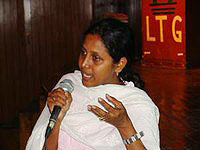 |
Pallavi
Renke / Photo credit: Mahipal Singh Rawat/
OWSA |
|
Taking note
of their socio-economic conditions and to suggest
measures for their all-round upliftment, a report
by the National Commission for Denotified, Nomadic
and Semi Nomadic Tribes was submitted to the prime
minister last year.
This report observed that these communities across
the country were seen dwelling in temporary shelters
or tents on vacant lands. They had no permanent
addresses and hence had got no land allocation
for housing purpose.With no proof of residence
or property ownership certificates, they were
not in a position to avail ration cards and had
not been included in the BPL (below the poverty
line) list. They also faced a lot of trouble in
getting the caste certificates and therefore no
access to government welfare schemes.
"Why is it taking so long to implement the
recommendations of the report?" Manasi
Singh, OneWorld South Asia.
a clinic for ailing entrepreneurs!
Pune First, a group of small and medium entrepreneurs
from Pune, has been meeting once every week for
the last 15 years to discuss matters pertaining
to their businesses. It is now all set to launch
a clinic for small entrepreneurs--Entrepreneur's
International, a non-profit trust. The clinic
will be operational within two months' time. The
concept is similar to a doctor's clinic. If an
entrepreneur has any problem, query, questions
or anything she would like to know, the clinic
will help address it," says Rajendra Bam,
an entrepreneur who is a member of the club.
A visitor will be charged a nominal fee and consultations
will be by appointment. Ranade explains that the
clinic will work on certain pre-decided days of
the week for some hours, and will also leave no
stone unturned to help the person in need."
There are three clubs under Entrepreneurs International:
Pune First, with the other two operating in Pimpri
and Baramati. Pune First also arranges discussions,
seminars, workshops, sessions designed to help
members of the group, and visits to various business
units. Contact: http://www.weentrepreneurs.org.
Conf Held
Meet on climate change highlights challenges
JAIPUR: Experts and concerned citizens of the
state met on Sept. 17 to discuss the need to take
the issues of global warming and carbon emissions
to the masses and generate an informed debate
in the run-up to the UN Climate Change Conference
in Copenhagen in December this year.
The participants in the one-day workshop on Climate
Change and Challenges Ahead' here included 83
journalists and representatives of 30 civil society
organisations. The participants expressed concern
over the dangerous fallouts of global warming
such as land inundation, flooding, droughts, decline
of bio-diversity, loss of livelihood and agrarian
distress. They highlighted the role of media in
creating awareness of these emerging disasters.
The Jaipur-based Centre for Community Economics
and Development Consultants Society (CECOEDECON)
organised the workshop in collaboration with stakeholders
such as Oxfam, PAIRVI and One World South Asia
with the support extended by Unicef and UNFPA.
The Rajasthan Rural Development and Panchayati
Raj minister Bharat Singh inaugurating the workshop.
Member of the Prime Minister's Economic Advisory
Council, Prof. V S Vyas, addressing the inaugural
session said wheat production had declined significantly
in India, which was earlier the world leader in
this foodgrain.
The experts, who addressed the inaugural session,
were the CECOEDECON chairman and former judge
of Rajasthan High Court, Justice V S Dave, BBC
India editor Sanjeev Srivastava, Unicef Rajasthan
State Head Samuel Mawunganidze, UNFPA state programme
coordinator Sunil Thomas Jacob, and editor, Jansatta,
New Delhi, Om Thanvi.
The Green Jobs Fair
New Delhi: From 24th to 26th Sept at the India
Habitat Centre Lawns, The Green Jobs Fair was
held to- Make students and job seekers aware of
the real and growing careers available in the
sector, Demonstrate to key employers in the country
that some of the best students and employees are
seeking careers in this space, Make Vice Chancellors,
university leaders, and government officials aware
of the potential of this sector and the urgent
need to provide education that supports it.
The Green Jobs Fair had Display
stalls where organisations marketed their green
careers, Talks by individuals who have built careers
in sustainability in a variety of fields, A public
and private session with government officials
and various Vice Chancellors to talk about the
need for Green curriculum. Contact information
: greenjobs@climateprojectindia.org
022- 3222 3320 refer to www.habitatsforum.org/greenjobs. |
|
Environment
Support Group in collaboration with Karnataka
State Council for Science and Technology held
a workshop on 'Urban Lakes as Ecological, Cultural
and Public Spaces for Decision makers, Media,
NGOs, Teachers, Students and the Public on Sept.
26.
Presently less than 60 of 260 tanks exist in built
Bangalore, and most are heavily polluted or drained.
As a direct result of encroachment of lakes and
its canal networks, Bangalore's neighbourhoods
get easily flooded even in a short rain frequently
resulting in loss of life and property.In this
workshop protecting and conserving lakes and examine
their efficiency, especially ongoing efforts at
privatising lakes.contact: Environment Support
Group, Bangalore _Tel:91-80-26713559 /60/61 <tel:91-80-26713559
/60/61>_ Email: bhargavi@esgindia.
<mailto: bhargavi@esgindia.org
/ nandini@esgindia.org
Website: www.esgindia.org
< http://www.esgindia.org>
The Tamilnadu-Pondicherry State Parliament of
Children organized on Sept. 26 Ministry wise deliberations
by Child Ministers from various districts on Participatory
governance, Education, Health, Environment, Culture
and Art, Sports, Gender and Child Rights/ Human
Rights starting with an election and Rally by
child parliamentarians, Swearing-in Ceremony for
new State-level Child Ministers. The workshop
was held on Sept. 26 & 27, at St .Francis
School, Uyyankondan, ,on Sept. 28 at Bishop Heber
College, Trichy. Contact: ANUGRAHA,Tamilnadu E-mail:
ncnworld2000@yahoo.com,
www.ncnworld.Org.
CIVIC Bangalore organised a discussion on a study:
'Local Welfare in a Global Context: Slums and
Urban Welfare in Karnataka's Development' by Dr.
Supriya Roy Chowdhuri, Professor, Centre for Political
Institutions, Governance and Development, Institute
for Social and Economic Change. On Sept. 23 at
Ashirvad, Contact: CIVIC Bangalore Tel. 80-22110584
Email: info@civicspace.in.
Towards an Alternative Indian Climate Policy:
Copenhagen and beyond, a seminar was held on Sept.18
in New Delhi org. by The Delhi Science Forum and
the Centre for Science, Technology & Society
of the Tata Institute of Social Sciences, Mumbai
following a Workshop in Mumbai "Breaking
the Climate Deadlock: towards a New Climate Policy
for India''contact:Delhi Science Forum, Tata Institute
of Centre for Policy Research. Ashoka Trust for
Social Sciences Research in Ecology & Environment
(ATREE).
-------------------------------------------------------------------
Making Missions Measurable
A workshop for the NGO sector. The outcome
of the workshop will be a) the development of
a tool to help each organization to track milestones
in relation to their activity plans and mission,
(b) strengthening organizational systems to
use the tool as an internal assessment process.
The workshop will be facilitated by Manjulika
Vaz of OrganAid, anorganization enablerFor more
details, contact Manjulika Vaz at manjulika_vaz@
yahoo.com or call 098457 27821.
iVolunteer Institute of Volunteer Management
(IIVM) is back with it's Volunteer Management
Workshop for 2009 in all cities where they have
a presence.A 2 day Workshop in Delhi on 13th
and 14th October 2009 and.29th and 30th October,
2009 in Bangalore.The two day workshop is being
conducted to assist & provide value addition
to NGOs to gain a better understanding of the
methods and skills involved in setting up systems
that would help them make effective use of volunteers
in their respective organizations. Contact Archana,
Bangalore.Tel: +91-80-41466568,Cell: +91-99803
50180.
Excella Orbit, a division of Sambodhi Research
& Communications Pvt. Ltd. Held a training
programme on Training of Trainers on
Design & Delivery of Trainings and Monitoring
& Evaluation of Development Projects
in New Delhi between October 06-10, 2009 &
October 21-23.
Trauma Therapy in Women' a workshop for the
general public and staff was held on Oct. 5
at MLT, KEM Hospital The speakers for this workers
included expects viz. Dr. S.R. Parkar (Hod &
Professor of dept. of Psychiatry), Ms Aparna
Joshi Bapnu trust & Adv. Ujwala Kadrekar
(Lawyer's collective).Contact Dr Shubhangi R.
Parkar ,Department of Psychiatry,Chief: Bombay
Drug de-addiction center, G.S.Medical College
and King Edward Memorial hospital,Parel, Mumbai
TELEFAX: 0091 22 24186662.
Tel off 0091 22 65208363 /24136051ex t 2015.
The Water Community of Solution Exchange had
its Second Annual Forum in Kolkata. -- the most
important national event for the water and sanitation
sector. From 28-30 October, 2009.. About 150-200
participants attended the Forumincluding practitioners
on water, governance, resource management, sanitation
and drinking water in India from the government,
private sector, donors and the UN, Contact:
nitya jacob <nityajacob@gmail.com>
One Day Workshop on CSR and Cause Related Marketing
Organised by MindView at Bangalore on Oct. 28.An
Informal Interactive Workshop inviting the participants
to share their own insights and experiences
to learn from each other, highlighting the business
benefits at being a responsible business.For
iCongo contact: Snigdha Narain snigdhamjn@googlemail.com
.This workshop is in Support of "Silver
Innings" ,a social entrepreneur organization
working for the cause of Elderly. Contact Mr.Kumar
P, MindView, Email: register@mindview.in,
Website: http://www.mindview.in.
Paths leading to Copenhagen
The Civil Society Coalition on Climate Justice
and Equitable Development comprising several
NGOs and institutions, such as Centre for Education
and Development, Youth for Unity and Voluntary
Action (YUVA), Institute for Community Organisation
Research (ICOR), Xavier Institute of Social
Research, etc, organised a one-day event on
24 October 2009 in Mumbai. It included the following:
a Public Hearing on Impact of Climate Change
- "Voices from Mumbai's Margins",
where people gave testimonies of the problems
they face on issues of agriculture, coastal
environment and fishing, waste dumping, water
woes, flooding of slums, migrants and the homeless,
unorganised sector, and the impact of commercial
development on semi-urban agricultural areas
(such as Vasai) on the poor; a panel of jurors
made note of the problems. The testimonies were
followed by a panel discussion on "Climate
Change, Urban Issues and Equity" which
included climate change and water, transport
and energy, and domestic and international policies
on climate change. The event also included a
eco-painting workshop, a youth forum, video
screenings, a street play, exhibition and sale
of books and ways of reducing carbon emissions
(through organic urban agriculture, biogas generation
from wastes, etc). Regional meetings for different
agro-climatic zones will be held at Pondicherry,
Ranchi, Bhubaneshwar, Jaipur and Uttaranchal
leading to a National Hearing of People's Voices
on Climate Change at New Delhi during 11-13
November, where government officials connected
with climate negotiations will also be present.
All these are part of a process to carry the
"voices" and "perceptions"
of people, who are the least responsible for
climate change but are its worst victims and
whose voices are never heard at national and
international climate negotiations and policy-making,
to Copenhagen (Denmark) where final negotiations
to renew the Kyoto climate agreements (whose
initial term ends in 2012) will be held from
6-18 December 2009. (From Lakshmi Menon)
Survey for NGOs
The Civil Society and Outreach Unit of the United
Nations Secretariat' s Division for Social Policy
and Development invites all NGOs, that work
in the area of social and financial development,
to take part in a Survey on the Impact of the
Global Crises on Civil Society Organizations
and their Constituencies. The web-page for the
Survey on our DSPD Website is available at:
http://www.un.org/esa/socdev/ngo/unsurvey-
globalcrises.html.
The results of the study will be published
for advocacy use of CSOs and also made available
at the Forty-Eighth Session of the Commission
for Social Development.
|
| |
| Top
|
|
| |
|
|
|