|
| January - April
2009 : Vol.6 - Issue 1/2 |
Quote:,
“Sankalpa parimitam drusyam” (the will determines
one’s vision) Upanishads |
Top
Stories: -
- People's Manifesto:
A total of 230,943 people have participated in the
process of drawing up a set of demands to be included
in the manifestos through public consultations and
hearings organised in 100 constituencies from eight
states.
- A people's party?:
Mooted by well known columnist Kuldip Nayar, People's
Politics Front has been formed to build a political
alternative in the country so that people's issues
can be brought to center-stage.
- Women demand equal share:
Education for Girls enforced by law, enactment of
the Women's Reservation Bill and the stronger implementation
of the Domestic Violence Act are three key demands
that have emerged recurrently in the Local Manifestos.
- An UN Agency for Women:
"We have an agency for children, we
have an agency for health, we have an agency for sexual
and reproductive rights, we've got agencies for all
kinds of things, but not for women who need one, and
I think the time has come.
- Taking back the Night:Women's
groups in Bangalore submitted a Memorandum to the
DPG , Karnataka in connection with the recent attacks
against women in the name of 'culture' in Karnataka
and particularly in Bangalore.
- Love in the time of moral policing:
Who gives people the right to be moral policemen?
Twoprofesswors from TISS ask questions and provide
the answers.
- Monsanto's Bt Cotton Kills
the Soil as Well as Farmers: A recent
scientific study carried out by Navdanya, compared
the soil of fields where Bt-cotton had been planted
for 3 years with adjoining fields with non GMO cotton
or other crops.
- FCRA Report 2006-7:
The report that gives details of Contributions received
by NGO's under the Foreign Contribution Regulation
Act 1976.
- Media:
Films
- Other stories:
|
|
| |
|
People's Manifesto |
New
Delhi: Several groups and civil society
organisations have come together to bring out
the People's Manifesto with an objective to engage
people in setting up the agenda for the country
for next five years.The exercise is being presently
carried out in 365 out of 547 parliamentary constituencies
spread over 27 States and two Union Territories.
By far, a total of 230,943 people have participated
in the process of drawing up a set of demands
to be included in the manifestos through public
consultations and hearings organised in 100 constituencies
from eight states - Andhra Pradesh, Bihar, Haryana,
Gujarat, Uttar Pradesh, etc. |
 |
They were presented
before political parties and candidates
vying for those seats.
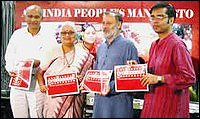
Colin Gonsalves, Mohini Giri, Gauhar Raza
and Amitabh Behar (from left to right) releasing
the People's Manifesto/ Photo credit: WNTA
An initiative of Wada Na Todo Abhiyan (WNTA),
a national campaign for governance accountability,
the All India People's Manifesto is the
first of its kind in the electoral history
of independent India. |
|
Some of the constituencies where the exercise
was taken up included Rae Bareilly, Chapra,
Lucknow, Vaishali, Hajipur and Dausa represented
by the Congress President Sonia Gandhi, Railway
Minister Lalu Prasad Yadav, former Prime Minister
Atal Behari Vajpayee, Minister for Rural Development
Raghuvansh Prasad Singh, Dalit leader and former
Minister Ramvilas Paswan and young Congress
MP Sachin Pilot respectively.
National Centre for Advocacy Studies and WNTA
convener Amitabh Behar said: "This effort
aims to inspire people to engage with the national
elections as an opportunity not only to cast
their vote, but also shape the future that they
want for themselves and for the country."
Lysa John from WNTA pointed out that the demands
were reflective of the baseline of poverty and
as basic as hand pumps, edible oil, sugar, electrification,
housing for dalit and other vulnerable social
groups, etc.( OWSA).
Charter of the People 2009.
The Centre for Legislative Researchand Advocacy
(CLRA), in consultation with civil society organisations
from across India, has prepared the Charter
of the People 2009-- a 20-point development
plan for India.
Executive Director of CLRA Vinod Bhanu explained
the rationale for the need for such a charter:
"It is an attempt to help bridge the gap
between people and the political parties and
highlight the issues of human development that
need to be urgently addressed, he asserted.
The Charter recommends that urgent steps be
taken to eradicate poverty and hunger. The other
demands include smooth passage for the Right
to Education Bill; comprehensive laws to deal
with sexual harassment of children; combating
HIV/ AIDS, tuberculosis, malaria and other diseases;
police, prison and judicial reforms; increased
budgetary allocation for health and education;
and proper mitigation measures for climate change.
These 100 local manifestos have already been
given to the heads of all major political parties.
The All India People's Manifesto will also go
online "through an integrated framework
of web tools aimed at mobilising youth and netizens
to voice their demands via video, SMS and a
host of other social networking sites."
|
| Top
|
| |
|
For the
people by the people, finally! |
Lucknow: The
democratic process may finally find expression
politically if the newly constituted forum of
social activists taking up people's causes has
its way.
Called the People's Politics Front
(Lok Rajniti Manch), it held its first national
convention at Lucknow at the Ganga Prasad Memorial
Hall in Aminabad. The convention saw a huge turn
out of supporters from UP and its surrounding
states including Kushinagar, Agra, Hardoi, Sitapur,
Sultanpur, Faizabad, and even Samaspur Bihar and
New Delhi. The Lok Rajniti Manch was formed recently
to provide a pro-people clean alternative to the
dominant money and muscle power oriented politics
has Kuldip Nayar, Rajinder Sachar, Medha Patkar,
Aruna Roy, Prashant Bhushan, Banwari Lal Sharma,
Brahma Dev Sharma, Swami Agnivesh, Yogendra Yadav,
Ravi Kiran Jain, Samsher Singh Bhisht, etc. associated
with it. Its first national convention was held
in Lucknow on Mar. 5/6 and the Lucknow unit of
the Manch formally launched with a people's campaign
for voter awareness and to discuss support to
possible candidates.
Mooted by well known columnist Kuldip Nayar, People's
Politics Front has been formed to build a political
alternative in the country so that people's issues
can be brought to center-stage.
Says Nayar, "The aim is to bring organizations
working for people's causes at grass root levels
under one forum. The vision I have for PPF is
to see it take the shape the Green Party did in
Europe. There is so much that is not right with
the political scene in the country today so the
effort of PPF will be to expose the dominant model
of mainstream political parties which rely on
muscle power, money power and unscrupulous ways
for winning elections so that this practice can
be rejected. We don't have a symbol or a flag
but our presence will be felt and soon."
But while the PPF will participate in the electoral
process their involvement will be just that of
a supporting hand to contestants wanting to fight
the elections. This will be done by fielding candidates
from the masses itself.
Explains Dr Sandeep Pandey, Magsaysay Awardee
and a well known social activist, "We will
provide a platform to local leadership who have
earned the love and trust of the people by taking
up their causes. If they wish to contest the elections
PPF will support them in every way. Therefore
instead of having a party president we will have
a presidium which will reflect the people's views
and choices. Today those who call themselves `daliton
ka neta' have crores to spend on their b'day celebrations
but don't bother about several thousands who are
starving. This system will have to change and
PPF can provide that forum for change."
A fact which most candidates who will be contesting
from the platform being provided endorse. Like
28 year old Neel Kamal, a electoral candidate
from Misrik Sitapur who is up against BSP's Ashok
Rawat and BJP's Ram Prakash Rawat. But he is confident
that he will be victorious as the issues he will
pick up are people's problems."Mera koi muddaa
nahin hai sirf logo ki awaaz ko uthana hai. I
will voice their concerns, their pains and their
problems and if they feel I am right they will
support me."
Members of Project Vijay, a youth organization
formed by students of Lucknow, Allahabad and Bundelkhand
University as well as IITians , who have taken
up cudgels against corruption and the corrupt
are all for the PPF.
"The candidates who win will be representing
PPF in the Rajya and Lok Sabha. They will have
the support of activists like Medha Patkar, Aruna
Rai, Rajendra Sacchar, Yogendra Yadav and many
more who are members of PPF."
People's Politics Front has been formed to build
a political alternative in the country so that
people's issues can be brought to center-stage
and the dominant model of mainstream political
parties which rely on muscle power, money power
and unscrupulous ways for winning elections can
be rejected. Contact: Arvind Murti, 9839835032,
Keshav Chand, 9839883518, SR Darapuri, 9415164845,
Dr Sandeep Pandey / Arundhati Dhuru, Ph: 0522
2347365, M: 9415022772, email: ashaashram.
Under the joint banner of People's Action for
Employment Guarantee (PAEG) and National Campaign
for People's Right to Information (NCPRI), representatives
from various political parties made presentations
on their agenda prior to general elections in
the country. |
 |
Participants in the
meeting questioned representatives from
various political parties and reminded them
of their promises. Voters wanted to know
how the political parties would address
issues related to the economic recession,
increasing urban poverty, scarcity of resources,
job security, etc.
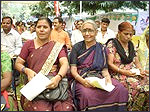
Aruna Roy(centre) / Photo credit: OWSA
Social activist Aruna Roy said: "A
space has been created in the society where
everyone has the right to question on employment
and wages." She commented that there
was no need for the poor to die in poverty. |
Highlighting on the state of urban employment,
Roy expressed despair on the government's failure
to fulfil its promise of employment guarantee
scheme for the urban areas.
|
 |
Annie Raja, general
secretary, National Federation of Indian
Women, brought forward some demands for
political parties that could possibly be
incorporated in their election manifestos.
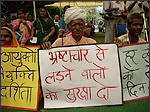
People demanding protection from corruption/
Photo credit: OWSA
One of the participants demanded that the
new government must pass the Lokpal bill
for greater accountability and transparency
in administration. The demands for establishment
of public grievance commissions in every
state and a law to protect whistle blowers
were also raised. |
|
Jean Dreze,
eminent economist and activist raised questions
on the government's decisions to link minimum
wages with consumer price index and freeze wages
in states, in spite of the opposition from Rojgar
Guarantee Parishad.
While the Congress party leader Dr. Sudharsana
Nachiappan stated that his party would make efforts
to take forward the employment guarantee scheme,
the Bhartiya Janata Party's Prakash Javedekar
said that judiciary and corporate sector need
to be made more responsible.
He added that urban poverty should be dealt with
a much more holistic approach.
Communist Party of India's D. Raja told that his
party wants education, healthcare, housing and
employment to be made fundamental rights.
All the party representatives were unanimous in
their demand for increasing the number of workdays
guaranteed under the NREGA and bringing corporate
sector under the purview of the RTI.
The event ended with a hope that their demands
would find space in the election manifestos of
all major political parties and that the new government
would ensure better credibility and transparency
in governance.
Delhi: A "Jan Manch" on Employment Guarantee
and the Right to Information was held in New Delhi
on 21 March 2009, in anticipation of the Lok Sabha
elections. Representatives of all political parties
were invited to present their party's position
on these two crucial issues, and to respond to
public demands or queries. The event was convened
under the joint banner of People's Action for
Employment Guarantee (PAEG) and the National Campaign
for People's Right to Information (NCPRI). A draft
charter of basic demands on employment guarantee,
and Right to Information was distributed .Contact
janmanch09@gmail.com
< janmanch09@gmail.com>
Jaago Re! One band, 5 cities,
a million youth- All coming together for music
with a difference to be the difference. Bangalore-based
rock band, Thermal And A Quarter (TAAQ) in co-ordination
withJanaagraha and Tata Tea played in cities all
over India to tell young votes to "Shut up
and vote." The "free" concerts
were held on Mar.20 at Open Air Theatre, IIT Madrasi;
Mar.23 at Presidency College - Kolkata; Mar.25
at Pragati Maidan, - New Delhi; 27th MARCH 7 pm
D.Y.Patil College, Mumbai; 28th MARCH 7 pm St.Joseph's
College of Commerce - Bangalore. |
| Top |
|
| |
|
Women's Manifesto
demands Equal Share of Power and Resources |
On International Women's Day a call to prioritize
the women's agenda in their election manifestos
- as outlined in the Women's Manifesto that
has emerged through the first phase of the All
India People's Manifesto initiative being co-ordinated
across 27 States and 2 Union Territories by
Wada Na Todo Abhiyan was made
to all political parties.
Education for Girls enforced by law, enactment
of the Women's Reservation Bill and the stronger
implementation of the Domestic Violence Act
are three key demands that have emerged recurrently
in the Local Manifestos that have been released
across 100 parliamentary constituencies so far,
and with the involvement of more than 2.3 lakh
people.
Equally significant are the range of measures
that have been proposed to strengthen the economic
role and participation of women : making the
accordance of Farmer Status for women engaged
in agriculture, the creation of assets for women
a pre-requisite for all developmental programs
and enforcing the equal participation of women
not only as beneficiaries and as decision makers
in the committees set up to oversee public programs.
The Women's Manifesto has emerged from the local
level and therefore reflects the realities and
expectations of the people of India. Collectively,
the demands present a composite and completely
do-able national agenda for women which no political
party can afford to ignore.
|
| Top |
| |
|
UN Women's Agency |
United Nations Mar 3 (IPS)
- After being blind for years to the needs and
rights of women, the United Nations is finally
well on its way to create a "fully-resourced"
women's agency, says Stephen Lewis, the former
U.N. Special Envoy for HIV/AIDS in Africa. A
long-time vocal advocate for women's rights,
Lewis helped promote the creation of a billion-dollar
gender institution, saying it is reasonable
to ask for such an amount considering that the
agency will deal with issues affecting half
of the world's population, and that the funding
is just a third of that given to the U.N.'s
children's agency UNICEF and a quarter of the
U.N.'s Development Fund's (UNDP) budget.
"We have an agency for children, we have
an agency for health, we have an agency for
sexual and reproductive rights, we've got agencies
for all kinds of things, but not for women who
need one, and I think the time has come,"
he told IPS correspondent Nergui Manalsuren.
The proposal calls for a new "gender architecture"
, including the consolidation of three existing
U.N. entities - the U.N. Development Fund for
Women (UNIFEM), the Office of the Special Adviser
on Gender Issues and the U.N. Division for the
Advancement of Women - under a single new U.N.
agency. > March 06, 2009, Inter Press Service
News Agency.
|
| Top |
|
| |
|
Take Back The Night! |
Responding to recent attacks against women
in Bangalore -seven attacks in the last ten
days, many individuals and organisations have
come together to form FEARLESS KARNATAKA or
Nirbhaya Karnataka to reclaim public spaces
and promote safety for all.
In the wake of a series of attacks in Mangalore
(the latest one was reported on February 24,
2009), women have been targeted in the name
of morality, culture and "public decency".
In Bangalore, the reasons for the attacks have
been on similar lines - during the attacks,
the girls were insulted for wearing jeans, sleeveless
shirts and speaking English. We believe that
the attacks in Bangalore then are a continuation
of those that took place in Mangalore and coastal
Karnataka regions - even though the identity
of the attackers (and the organizations they
belong to) could have differed. Team Maraa 080-4148-8264.
|
|
Women's groups in Bangalore submitted a Memorandum
to the DPG , Karnataka in connection with the
recent attacks against women in the name of
'culture' in Karnataka and particularly in Bangalore,
asking him to take effective action to ensure
safety and security to women on March 7.
On 8.03.09 evening women met in the neighbourhoods
where these attacks took place, street theatre
performances by Maraa were made in the Indiranagar,
Ulsoor, (Jasmeen 9886840612 blanknoise@gmail.com),
Vasanthnagar (Madhumita 9986067231 madhumita.rajan@gmail.com,
Ratna 9886863343 ratnappender@gmail.com),
Cunningham Road( Aarthi 9741496259 acarwilldo@yahoo.co.in);:
CMH Road, Ekta 9880755875 forekta@gmail.com,
Hemangini 9008644245 hemanginig@gmail.com),
Rest House Road, Zainab Bawa 9945473641 bawazainab@gmail.com.
It was a celebration of the night, an affirmation
of our right to move freely without threat and
fear of violence, with performances, video projections,
music and movement and a Blank Noise clothes
exhibit to be launched at the venue, seeking
to defy the notion that women "ask for
it" by dressing in certain ways.--
Contact Alternative Law Forum Bangalore Phone
22868757/22865757.
|
| Top |
| |
|
|
Love in the time of moral
policing |
The moral police hate love and
love hate. Anjali Monteiro and K P Jayasankar
provide answers to who needs moral policing,
how much and why.
|
 |
The moral police are
everywhere. Crawling out of the woodwork
into our public spaces. In our legislative
assemblies, in our board rooms, in court
rooms, on the streets, in colleges, in cinemas
and cyber cafes, gardens and pubs, even
in police stations. Alas, and perhaps in
our heads too. The rabid Sri Ram Sena or
the Shiv Sena or the Bajrang Dal foot soldiers
who demonstrate their love for 'Indian culture'
by molesting girls wearing jeans and vandalising
Valentine's Day celebrations are unfortunately
only the tip of the iceberg. They are supported
openly and tacitly, by many 'honourable'
others, ranging from chief ministers and
health ministers to members of the National
Commission for Women.
So many people in our country are in a state
of moral panic over 'western' culture, pub
culture, cyber culture and the many other
'degenerate' cultures that are polluting
the sacred body of our |
|
Mother India and her pristine, fragile 'Indian
culture', all of which call for more and more
policing. Here are some Frequently Unasked Questions
(FUQs, no pun intended) about moral policing in
India.
Question 1: Who needs policing?
Not impressionable young women and girls, but
unimpressive young men and desperate old politicians
who cannot handle the fact that people think.
They want to manipulate people and some young
men are malleable.
Question 2: What needs policing?
Everything, but particularly all sites and signs
of 'modern' 'western' culture, from greeting cards
to cell phones, from pubs to cyber cafes: moral
panic always hovers over frontier technologies,
behind the doors of the unknown. And those who
are ignorant of these.
Why do we need policing?
The answer is simple: because 'Indian Culture'
is fragile, over the last thousands of years It
has survived.
What is 'Indian culture'?
Indian culture is as elusive as Indian food. --
the chilly first came to India with the Portuguese
from South America not so long ago? And who defines
it? Many of our 330 million Hindu Gods have spent
the prime of their lives unclothed; Khajuraho
and Konarak now badly need saffron fashion designers.
Why do the moral police indulge in policing?
To get attention... and our media play into their
hands.
Question 6: Who gives the moral police the right
to police?
When the captains of industry cosy up to a champion
of ethnic cleansing, when a leading television
news channel gives an award to a staunch defender
of the politics of hate, one begins to understand
how deep and pervasive the rot is.
The normalisation of hate politics, the selective
amnesia of the middle class - all these add up
to strengthening the power of the moral police.
Question 7: What of love in the time of moral
policing?
The moral police hate love and love hate. While
the militant ones are easy to spot, the 'soft'
ones are insidious.
They begin to define the realm of the 'normal'.
They censor our films, define dress codes, and
make laws to control the Internet, all in the
name of decency and order, of protecting the vulnerable
and preventing social chaos.
While we must protest, firmly and loudly, against
gross violations like Mangalore and Meerut, can
we begin to speak fearlessly against the little
everyday violations, the covert ways in which
our spaces for love and freedom are encroached
upon? And above all, we must never forget: Ayodhya
and Mangalore are both manifestations of the same
politics of hate and intolerance that we must
resist till our last Valentine's Day.
(The authors are professors at Tata Institute
of Social Sciences, Mumbai)
Bangalore; The Karnataka State Unit of
Lok Satta was launched on Feb.5 by Dr. Jayaprakash
Narayan, the National Coordinator for Lok Satta
-- Mr. Surendra Srivastava, founder of the Maharashtra
Chapter of Lok Satta Andolan was present. Tel
: (080) 2228 1234, 2228 1800, Ajit Phadnis,Karnataka
State Unit, Lok Satta Party ,Mobile No: 99015
04901. |
|
Women's
commission to probe assaults
The National Commission of Women has formed a
committee to probe the assault on some young women
in a Mangalore pub last week.
New Delhi: Terming it as a very unfortunate
incident, the National Commission of Women (NCW)
formed a 2-member committee -- a lawyer and a
social activist-- to probe the assault on some
young women by members of a self styled moral
brigade in a pub in Mangalore last week.
"The commission is aghast at the kind of
behaviour of the so called moral police with the
young women in Mangalore. It was a very unfortunate
incident, both illegal and not permissible. We
have taken suo motu cognizance of the same,"
NCW Chairperson Girija Vyas said.
On Saturday, a group of 40 activists of the Sri
Rama Sena barged into the pub Amnesia - The Lounge
in Mangalore. They bashed up a group of young
women and men, claiming the women were violating
traditional Indian values. The girls were punched
and their hair pulled by the self-styled moral
brigade.The incident has invited sharp reactions
from all quarters. The police have so far arrested
27 of the 40 member group, including Sena state
Vice-president Prasad Attavara. |
| Top |
| |
|
Monsanto's Bt Cotton Kills
the Soil as Well as Farmers |
Global Research,
February 24, 2009
i-sis.org.uk
Biosafety refers to ensuring that GMO's do not
harm the environment or health. The soil, its
fertility, and the organisms which maintain the
fertility of soil are a vital aspect of the environment,
especially in the context of food and agricultural
production.
A recent scientific study carried out by Navdanya,
compared the soil of fields where Bt-cotton had
been planted for 3 years with adjoining fields
with non GMO cotton or other crops. The region
covered included Nagpur, Amravati and Wardha of
Vidharbha which accounts for highest GMO cotton
planting in India, and the highest rate of farmers
suicides (4000 per year).
In 3 years, Bt-cotton has reduced the population
of Actinomycetes by 17%. Actinomycetes are vital
for breaking down cellulose and creating humus.
Bacteria were reduced by 14%. The total microbial
biomass was reduced by 8.9%.
Vital soil beneficial enzymes which make nutrients
available to plants have also been drastically
reduced. Acid Phosphatase which contributes to
uptake of phosphates was reduced by 26.6%. Nitrogenase
enzymes which help fix nitrogen were reduced by
22.6%.
At this rate, in a decade of planting with GM
cotton, or any GM crop with Bt genes in it, could
lead to total destruction of soil organisms, leaving
dead soil unable to produce food.
The ISAAA in its recent release has stated that
there are 7.6 mha of Bt-cotton in India. This
means 7.6 mha of dying soils.
The government of India is trying to grant approval
to Bt Brinjal without Bio safety studies on impact
on Soil organisms. The European Commissión
is trying to put pressure on GMO free countries
to introduce Mon 810.
The Navdanya study the first that has looked at
the long term impact of Bt cotton on soil organisms
is a wake up to regulators worldwide. It also
shows that the claims of the Biotechnology industry
about the safety of GM crops are false.
To get a copy of the report and for further information,
please contact -Navdanya A-60, Hauz Khas New Delhi
- 110 016
Phone : 91-11-26535422 / 26532124 Email : vandana@vandanashiva.com
|
|
| Top |
|
| |
|
FCRA Report 2006-07 |
This report is release by the Ministry of
Home Affairs and gives details of Contribution
received by NGO's under the Foreign Contribution
Regulation Act 1976.
1. Highest receiver of such contribution is
Tamil Nadu Rs 2244 crs, Delhi Rs 2186crs and
Andhra Pradesh Rs 1,211 crs.
2. When looked at city wise Chennai
received highest contribution at Rs 928 crs,
Mumbai Rs 891crs and Ranchi Rs 653 crs.
3. Largest donors are the USA Rs2971crs, Germany
Rs 1650 crs and UK Rs 1425 crs.
4. List of foreign donors is topped by Misereor
Postfech Germany Rs 1243 crs, World Vision International
USA Rs 469 crs and Fundacion Vicente Ferrer
Spain Rs 399 crs.
5. Ranchi Jesuits Ranchi Jharkhand received
the highest contribution Rs 621 crs, followed
by Sonthome Trust of Kalyan near Mumbai Rs 333
crs and Sovergein Order of Malta Delhi Rs 301
crs.
To know more read the report - http://www.mha.
gov.in/fcra/ annual/ar2006- 07.pdf or see attached
file.
|
| Top |
| |
|
|
MEDIA |
Films:
Poison On The Platter
Dir. Ajay Kanchan
Prod. Mahesh Bhat
This documentary aims to spread the
message on the harmful impact of GM foods on
human health and environment. The combinations
are bizarre - gene from pig in rice, from fish
in tomato and from fire fly in peas. The label
is Genetically Modified Food and they spell
disaster. As filmmaker Mahesh Bhat puts it:
"They open the floodgates and let poison
into our blood." The documentary throws
light on why BT brinjal is harmful. It is believed
to have the potential to unleash unknown diseases.
Potatoes, tomatoes, brinjal, mustard, cabbage,
cauliflower, corn, rice and a whole lot of other
crops are already under various stages of field
trials. contact Mr Supran Sen of the Producers'
Guild <guild@filmtvguild.in>
"Boliya pitaier soholi sootal"
(Assamese and Bodo)
directed by Altaf Mazid.
The film depicts a situation on the India-Bhutan
border, 650,000 of the Bodo ethnic majority
divert the course of the Pagladia River to 116
villages through 13 embankments. They are taking
the river home from a rerouted course created
in the 1920's. The film portrays this community's
collective action... about the prayers offered
to the river gods, the simplicity of village
life, male bonding and camaraderie. It's about
life without water, and at the same time life
that resolves around water every moment. It's
about an India that still exists quietly somewhere.
Altaf Mazid 94351-93663.
"Arzoo"
26 mins.,Dir Shashi Gupta
Which essays the amazing transformation of a
young woman Sulekha Ali, post Gujarat communal
riots of 2002. Arzoo is a story of courage,
knowledge, empathy and love. It is about an
inspiring work in progress...The film has been
uploaded on YouTube in three parts - "shashiarun"
<shaghosh@gmail.com>
Rabba hun kee kariye (Thus departed
our neighbours)
A film by Ajay Bhardwaj
Rabba Hun Kee Kariye trails a shared history
of Punjab that was torn asunder in the fateful
year of 1947. It captures feelings of guilt
and remorse about the genocidal violence on
the Indian side of Punjab. These informal tales,
almost like folklore, are strewn across the
memory-scape of Punjab's countryside. Through
this documentary these long suppressed experiences
become accessible in public domain for the first
time Contact Pramilla Chhabra / K.K. Kohli 2462-1685/
98107-23979 ajayunmukt@yahoo.com.
Sangha Majha Bapala (Tell My
Father)
directed by Soumitra Bhattacharya
15 mins.
CCDS presents its latest documentary film, ,
on the child rights movement building up in
more than 60 villages in Latur district of Maharashtra.
These are drought-prone villages from where
dalit labour migrate to the lush green sugarcane
fields of western Maharashtra. Often, the dalits
take their children with them to work the fields.
But not any more. Now the children are demanding
that they be allowed to go to school. They are
asking why the entitled scholarships are not
being granted to them, why they cannot eat the
midday meal alongside the rest of the children.
View this video.
http://infochangeindia.org/Infochange-Media-Fellowship-Video.html.
Goa Goa Gone
Directed by Kurush Canteenwala
22 mins/ India/ 2008
Mining is the second-largest industry after
tourism in Goa. As mining activity is intensifying
across the state, so is the opposition to this
unregulated industry by local residents. This
film explores the impact of mining on people's
livelihood in Goa - one of the world's 12 biodiversity
hotspots.
I Want My Father Back
Directed by Suma Josson
70 mins/ India/ 2007
Produced by SALT FILMS
In Hindi & Marathi, with English subtitles
Farmers have been committing suicide in Vidarbha,
Maharashtra, as in many other parts of India.
The film looks at the reasons behind these suicides,
beginning with the fall-out of the Green Revolution
and the impact it had on the soil and input
costs for the farmers. The other sections in
the film include the changing traditional methods
of farming especially with regard to seeds,
the debt-loan trap faced by farmers, the further
fall in prices of commodities owing to globalization,
and the devastating effects of Bt. seeds. Since
the past two years Bt. Cotton seeds are being
sold by the Multinational Company Monsanto.
These genetically modified seeds have created
havoc in Vidarbha. The film raises these issues
through conversations with ordinary farmers
and activists. The filmmaker also speaks to
some farmers who have been practicing organic
farming.
"..don't leave me now."
- Slum Sanitation in Mumbai.
Girish Menon
The director would be happy to screen/distribute
my film to any interested NGO or government
bodies or individual stakeholders.
Contact girish_menon@yahoo.com
or 98204 24070.
The film can be viewed online at http://girishmenon.com/films.html
and DVD copies are available at a nominal fee
of Rs. 500/-
|
| 7th Festival
of film documentaries |
Film South Asia,
the festival of South Asian documentaries, calls
for entries for the seventh edition of its biennial
festival being held in Kathmandu, Nepal from 17-20
September 2009. Documentaries made in and after
January 2007 are eligible for the competitive
section. Deadline for entries:
31 May 2009 (for films made between January 2007
to April 2008) Final submission deadline
for entries: 30 June 2009 (for films
made after April 2008). Details and entry forms
are available at
www.filmsouthasia. org.
For further information contact:Upasana Shrestha,
Co-Director, Film South Asia Secretariat, G.P.O.
Box 24393, Patan Dhoka, Lalitpur, Nepal, Tel:
+977 1 5552141 email: fsa@filmsouthasia.org,
www.filmsouthasia.org. |
| Street
Play on the Girl Child |
Population First
(PF) in collaboration with the Experimental Theatre
Foundation (ETF) has launched a theatre based
awareness program on the PC-PNDT Act. The Program
seeks to widen understanding among all stakeholders,
particularly the youth, the service providers,
NGOs and community-based organizations. The street
play on girl child will be enacted in various
locations in Mumbai from 12 - May 15, 2009. It
is aimed at approximately 100 Doctors, Nurses,
Students, community members per performance. Contact:
Ms. Pallavi Bandodkar, Population First, Shetty
House, 3rd Floor, 101 M. G Road, Mumbai 400 023.
Tel. (022)-22626599 / 07 / 97691 75999. Email:
info@populationfirst.org.
Shifting Prophecy
Duration: 30 minutes
Dir. Merajur Rahman Baruah
The film explores the emergence of a rural Muslim
women's movement in Tamil Nadu and their staggering
struggle engaging with the questions of gender
violence, linking with the issues of poverty,
survival, and women's rights thus locating Muslim
women's concerns within a larger civic and political
discourse. The film delves into the prophecy of
the Muslim women, who believe in freedom, justice,
humanity and democratic principles. They have
formed the world's first women Jamat & are
constructing a women's mosque to counter gender
biases and patriarchal social order. Contact:
Baruah Mobile No.0091-9810880596.
King of India
107 min
Dir. Arvind Sinha
This film documents the lives of child performers
who are wandering performers on the streets, pavements,
fun-fairs, carnivals, markets, grounds, bridges
and railway platforms of Kolkata. It focuses on
a 6 or 7 year-old boy named Raja Hindustani, after
the popular Amir Khan hit because, his parents
say he was born the day the film Raja Hindustani
was released. Together with his older brother
Toofan and sister Jyotsna, he performs to the
accompaniment of a cheap dholak that has seen
better days.
The family is a migrant from Chhatisgarh, who
claims to be a descendant of the 'Nats' of Rajasthan,
but lives in a tent-like temporary shanty in the
suburbs of Kolkata Today, the Nats are outside
the caste system, and considered untouchables,
although the medieval Rajputs they claim to be
descended from were famed warriors. For several
months each year, hundreds of wayside performers
like this family make the chaotic and colourful
metropolis their temporary home. "In the
big city there is a ready audience for their entertaining
skills. But they live in conditions that even
the most primitive municipality should not approve
of," says Sinha.
Online Archive
The following organizations: Oil21 from Berlin,
the Alternative Law Forum from Bangalore, and
three organisations from Bombay: Majlis, Point
of View and ChitraKarKhana (CAMP) have developed
an online archive, http://pad.ma.
At the moment Pad.ma contains some 150 hours of
video and over 92,500 annotations (text entries).
They see Pad.ma archive as a way of opening up
images, meanings and effects that are present
in video footage and its production process: resources
that conventions of editing and viewing have tended
to suppress. This in a way, is its traditional
archiving function.
In March 2009, Pad.ma was opened up to external
contributions. Visit websites: pad.ma group= altlawforum.org,
pointofview.org
NEWS
On 22 March 2009 the 1st Chhatttisgarh Peoples
Film Festival ( Chhattisagarh Jan Filmotsav )
and the Bhilai Film Archive was inaugurated at
the Nehru House of Culture , Sector 1 Bhilai.
The Festival was inaugurated by Shri S.C Bayar
, former Chief Secretary of Madhya Pradesh and
the Bhilai Film Archive was inaugurated by film
maker Amar Kanwar. Eminent sculptor from Bhilai
and recipient of the Padamshree Mr M.J. Nelson
was the special Guest of Honour. A traditional
Chattisgrahi Panthi dance troupe led by Rishi
Tandon performed at the opening. Well known singer
Vinay Mahajan from Gujarat was also present and
sang on the opening day. The opening film was
a short film entitled 'Aisa Kyon' which was produced
by Bhilai filmmaker Ajay TG and directed and shot
by 5 young girls from the Dabrapara Labour Camp
and Drkshakshi Balangan. Six documentaries and
a feature film were shown though the day. The
festival then shifted to Shivpuri, Jamul Labour
Camp and Kohka Village in Durg for the next three
days. Contact: Ajay T.G
< tgajay@yahoo.co.uk>
Persistence Resistance: a festival of contemporary
political films.
|
|
two day film
festival that features International films on
Afghanistan. Addressing the developments and challenges
of an evolving country.Questioning popular perceptions
and understanding Afghanistan in a new light.
On 7-8 February 2009 at Amphitheatre, India Habitat
Centre, New Delhi (caption-still cant make salt).
Film Festival on Kashmir: PARA-DIES
ON EARTH*.
A film festival organized by a group of students
from Christ College was held on February 28, &
March 1, at St. Joseph's Arts & Science College
(Shanthi Nagar). The following films were screened:
The Sky Below dir. Sarah Singh,
75mins/english subtitles.
A documentary on Pakistan and India vis-à-vis
to 1947 Partition of Indian Subcontinent. It features
voices from both sides of the border; while exploring
ancient and historic sites - along with music
- from Kutch toKashmir and Karachi to the Khyber
Pass.
Jashn-e-Azadi - dir. Sanjay Kak,
2007/138mins/ English subtitles*
It's 15th August, India's Independence day, and
the Indian flag ritually goes up at Lal Chowk
in the heart of Srinagar, Kashmir. The normally
bustling square is eerily empty - a handful of
soldiers on parade, some more guarding them, and
except for the attendant media crews, no Kashmiris.
PAPA 2 - dir. Gopal Menon, 2002, 24mins/english
subtitles*
PAPA 2 was a notorious interrogation centre run
by the Indian Armed Forces in Kashmir till 1996.
Officially, over 2,000 - unofficially, over 10,000
-people have disappeared from the Kashmir Valley
over the past 15 years. Most of these are enforced
disappearances. This film documents the struggle
of the mothers and wives of disappeared persons
to trace their loved ones. The film deals with
the harrowing tales of the families trying to
trace their young men in the quagmire of rampant
human rights abuse. It features interviews with
the families of the affected people and also members
of the Association of Parents of Disappeared People
(APDP).
Yi As Akh Padshah Bai (There was a Queen)
- dir. Kavita Pai & Hansa Thapliyal 2008/105mins/
English subtitles *
"Give us guns and we'll play our role!"
- These are not the words of a hardened criminal;
these are the words of a teenaged girl in Kashmir
less than a week after her sister was buried.
The entire cast & crew of this film are women.
It is through these women - proud, strong, with
an undying zest for life - that the film makers
examine what peace means and how it can come about
in Kashmir.
Killing of Kashmir - Unreported
World -
The harrowing story of the Kashmiris caught in
crossfire of rape, abduction and worse. "Peace
is in the headlines as India and Pakistan begin
talks to end 15 years of violence in Kashmir".
But this is far from a reality for civilians caught
in the crossfire between security forces and militants.
Both sides abduct who they want. They torture
and they kill. In this latest documentary from
the acclaimed Unreported World Series, Sandra
Jordan and Rodrigo Vasquez bravely travel deep
into Kashmir to reveal the harrowing lives of
Kashmiris.
Waiting - dir. Shabnam Ara, Atul
Gupta,2005/39mins/ english subtitles*
This is a story of missing people, boys and men
who were picked up by security forces and then
simply disappeared. Sandwiched between India and
Pakistan, Kashmir is a battleground for both.
While the men are missing, but not declared dead,
their wives are not widows but 'half widows. The
'half widows' need extraordinary courage in living.
They live with the memories of their love. Suddenly
they have to switch from being the woman in the
veil to the bread-earner. Society treats them
as unattached property like it treats most single
women in India.
7. Crossing the Lines: Kashmir,
Pakistan, India - dir. Pervez Hoodboy & Zia
Mian, 2004/47mins/ english subtitles*
This Film is a story of people at war over borders
and boundaries.. In this tragedy, each side tells
the story of the injustice and violence of the
other, and feels only the suffering of their own.
This path-breaking independent documentary film,
made in Pakistan, challenges us to look at Kashmir
with new eyes and to hope for a new way forward.
Had-Anhad
105 mins
This film journeys in search of the "Ram"
invoked in Kabir's poetry, delving into the heart
of divisive Hindu-Muslim politics of religion
and nationalism, encountering singers and lay
people in India and Pakistan,probing the forces
of history and politics that have created disputatiously
diverse Rams, while also spawning many Kabirs.
< http://pages.google.com/edit/lynnehenry/Had-Anhad-still-1.jpg/Had-Anhad-still-1-full;init:.jpg>
Koi Sunta Hai
Dir. Shabnam Virmani
96 mins
This film interweaves the oral folk traditions
of Kabir in central India with the intensely personal
narrative of the late classical singer Pandit
Kumar Gandharva, keeping the spiritual ideas of
Kabir as the central binding thread. Journeying
between folk and classical, between rural and
urban expressions of Kabir, the film finds moments
of both continuity and rupture between these disparate
worlds.
Still can't make salt
Dir. Lalit Vachani
84-minute documentary
The Salt Stories is a longer version of a 52-minute
film, In Search of Gandhi, selected by Steps International
as one of ten international films included in
a global broadcast of TV documentaries on democracy.
The film places the Mahatma's historic Dandi March
in perspective, juxtaposing it against the reality
of the depriveations faced by the poor - of their
basic needs like food, clothing and shelter.
Seventy seven years later, Vachani and his Wide
Eye Film team followed the trail of the famous
Dandi March, in search of Gandhi's legacy. Set
against the backdrop of Gandhi's original journey,
this road-movie makes caustic comments, simply
through telling visuals and direct one-to-one
interviews with a cross section of people, on
how globalization of Gujarat equates Gandhi's
'salt' to a metaphor on poverty, forced migration,
joblessness.
Chobi Mela V
Chobi Mela, Asia's largest and one of the most
prominent photography festivals in the world was
held on 30th Jan to 20 Feb 2009 at several major
galleries in Dhaka, public spaces like Karwan
Bazar Underpass and in the form of mobile exhibitions.
This year's theme was "Freedom" and
had 62 exhibitions from 33 countries. Mahasweta
Devi was the chief guest and Noam Chomsky and
Stuart Hall were on the video conference.
TransIndia
Directed by: Sapna Sahani
Duration: 4mins
This documentary looks at the life of a transgender
person in Bombay who is a source of inspiration
to others in her community because of her selfless
dedication to outreach and spreading awareness
through the NGO 'Humsafar'. She also shares her
thoughts about the state view ofhomosexuals as
criminals in India, life in urban society, and
being HIV positive.
Towers of Mumbai - A documentary on the streets
Language: English narration with Hindi interviews
(with subtitles)
Director and Producer (Varun Grover)
Duration: 30 minutes 50 seconds
Synopsis: This documentary profiles the festival
through two different, now-concurrent now-anti,
ideologies at play in Mumbai. Alternating between
a Dahi-Haandi team (called 'Lashkar-e-Shivba')
in Central Mumbai and a group of old-men in Girgaum,
part of the same group which started this festival
in Mumbai 75-years ago, the film tracks the lives
and mechanics of the people involved in the festival.
From a peep into their daily lives, to the grueling
training sessions, to the final day where 200-men
board the trucks to help and support their team
on the streets - Towers of Mumbai documents the
commercial, social and political aspects of this
unique festival which combines culture, sport,
and religion into one risky, gritty competition
of human spirit and fantasies.
Shikhar - the Spirit of Mllakhamb
Duration: 13min
Directed by: Nikhil
Cast and Crew:
Pramod,Shreyas, Nikhil, Percy, Meghna, Lopamudra
This Documentary revolves around 'Mallakhamb'
- Malla - the Gymnast, Khamb - Pole - an ancient
traditional Sport that originated in Maharashtra
in the early 12th century. Mallakhamb has different
forms for instance - Rope mallakhamb and Rope
and pole mallakhamb which is a combination of
both the elements, the rope and the pole. The
Film showcases the innumerable difficulties the
sportsmen face in this sport like lack of funds
and infrastructure, the challenges they face but
rise out of it with only grit, resolution and
determination as their 'mantra' of motivation
to thrive in this extraordinarily perilous sport.
For them, there are no boundaries, only the will
and an enduring spirit to succeed.
A Fable from the Himalayas
Duration: 8 Mins
Director: Nitin Das
Genre: Fantasy
A magical tale about a young boy who finds the
solution to Global Warming from a monk in the
mountains.
Mere Desh Ki Dharti
Dir. Sumit Khanna
58 mins
This documentary film, financed by the Public
Service Broadcasting Trust (PSBT). film investigates
pesticide overuse in Punjab, and its deadly impact.
To add a touch of irony, Khanna titled his film
Mere Desh Ki Dharti, a popular song from a Hindi
film that pays tribute to the abundance of food,
water and happiness in India. Winner of the Best
Investigative Film of 2006 at the 54th National
Film Awards, Khanna's documentary is intelligently
edited and well-researched.
I Want My Father Back
Documentary film
70mins
This film on Vidarbha farmers' suicide has won
the first prize at the Kathmandu International
Mountain Film Festival. It looks at the spate
of farmer suicides in Vidarbha, Maharashtra, where
cotton is the main cash crop. The film looks at
the disastrous impact of multinationals and bad
government policies on agriculture, both on people
and the land.
Rabba Hun Kee Kariye (65')
Dir: Ajay Bhardwaj; India 2007
Rabba Hun Kee Kariye (Thus Departed our Neighbours)
trails a shared history of Punjab - a subcontinental
culture, language and a way of life that was torn
asunder in the fateful year of 1947. It captures
the documentary maker's almost unexpected encounter
with feelings of guilt and remorse about the genocidal
violence of the partition. These informal tales,
almost like folklore, are strewn across the memoryscape
of Punjabi countryside.
Resisting Coastal Invasion
52 Minutes
Directed by K.P. Sasi
Both coastal ecosystems as well as the customary
rights of fishing communities over coastal areas
are severely eroded by developmental activities
and market interests - tourism, industrialisation,
sand mining, infrastructure- building, aquaculture
and rapid urbanisation.The only piece of legislation
ever enacted to regulate developmental activities
along the Indian coast was the Coastal Regulation
Zone (CRZ) Notification of 1991.Not surprisingly,
in today's age of globalization, the CRZ Notification
is increasingly being regarded as an impediment
to free market. Moves are afoot to dispense with
it altogether. What are the implications of such
a deregulation agenda? Who benefits? Who loses?
Who's accountable? Who is to blame? The film explores
these questions and captures the struggles of
fishing communities who are fighting tooth and
nail against the takeover of their lands by the
forces of globalisation.
_____________________________________________________________
3rd National short and documentary film
festival 2009
Organised by Karimnagar film society(Affiliated
To Federation Of Film Societies Of India) Documentary
best film award: I want my father back
Directed By Suma Josson
2nd Best : Soul voice solo voice Directed By Yadavan
Chandran
Short films:
Best film award: The missing colours Directed
By Prashanth Kanathur
2nd:The level crossing Directed By Rajadanda Pani
Navatarangam Award: Iron is hot Directed By Biji
Toppo and Meghnath
Jjury merit certificates:
1) Idi naa jeevitham Directed by Venu Polasani
2) Nada mridangam Directed by A.V.Jayaraj
3) Amrit jal Directed by Naresh Chander lal
The award function was held on 22 February night
at Filmbhavan. Contact: anand varala" < varalaanand@yahoo.com>
`Life on Venus'
Bangalore Film Society in collaboration with Breakthrough
TV- Human
Rights in Frames is proud to present `Life on
Venus', a selection of the most acclaimed and
award-winning documentary films on women from
across the globe.
Morality TV and Loving Jehad
- A Thrilling Tale(31mins/ India) Dir:
Paromita Vohra
In winter 2005 in the town of Meerut, India, police
officers, mostly women, swooped down on lovers
in a park and began to beat them up. Along with
them they took photographers and news cameramen
with a promise of an exclusive sting operation.
As images of the operation played again and again
on every news channel as 'breaking news', Meerut
saw some of the couples run away out of fear and
shame and serial protests for and against the
event, which also made the news for some days.
The film looks at a town's complex dynamics Â
- the fear of love, the constant scrutiny and
control of women's mobility and sexuality, a history
of communal violence, caste and feudal equations.
Assuming the tone of pulp fiction it examines
the relishing accounts of true crime magazines
like 'Manohar Kahaniyan' (The Thrilling Tales)
to the double morality of pulp detective fiction
to the tabloid news on Indian TV.
Leila Khaled Hijacker (59mins/Sweden)
Dir: Lina Makboul
In 1969 Palestinian Leila Khaled made history
by becoming the first woman to hijack an airplane.
As a Palestinian child growing up in Sweden, filmmaker
Lina Makboul admired Khaled for her bold actions;
as an adult, she began asking complex questions
about the legacy created by her childhood hero.
This fascinating documentary is at once a portrait
of Khaled, an exploration of the filmmaker's own
understanding of her Palestinian identity, and
a complicated examination of the nebulous dichotomy
between "terrorist" and "freedom
fighter."
Sari Soldiers (93mins/Nepal/
USA) Dir: Julie Bridgham
Filmed over three years during the most historic
and pivotal time in Nepal's modern history, The
Sari Soldiers is an extraordinary story of six
women's courageous efforts to shape Nepal's future
in the midst of an escalating civil war against
Maoist insurgents, and the King's crackdown on
civil liberties. When Devi, mother of a 15-year-old
girl, witnesses her niece being tortured and murdered
by the Royal Nepal Army, she speaks publicly about
the atrocity. The army abducts her daughter in
retaliation, and Devi embarks on a three-year
struggle to uncover her daughter's fate and see
justice done. The Sari Soldiers follows her and
intimately delves into the extraordinary journey
of these five other brave women on opposing sides
of the conflict, through the democratic revolution
that reshapes the country's future.
No More Tears Sister (76mins/Canada/
SriLanka) Dir: Helene Klodawsky
A story of love, revolution, and betrayal, No
More Tears Sister explores the price of truth
in times of war. Set during the violent ethnic
conflict that has enveloped Sri Lanka over decades,
the documentary recreates the courageous and vibrant
life of renowned human rights activist, Dr. Rajani
Thiranagama. Mother, anatomy professor, and symbol
of hope, Rajani was assassinated at the age of
thirty-five. Stunningly photographed, using rare
archival footage, intimate correspondence and
poetic recreations, the story of Rajani and her
family delves into rarely explored themes - revolutionary
women and their dangerous pursuit of justice.
Sancharram- The
Journey (107min/India) Dir: Ligy Pullapally
Set in the lush, rural Kerala, The Journey begins
with the childhood friendship between beautiful,
outgoing Delilah, a Christian girl, and the sober,
idealistic, and inwardly focused Kiran, whose
Nair family settles next door. They quickly become
inseparable, and in time Kiran feels attracted
to Delilah, but suppresses it. She finds a Bergerac-like
outlet by writing love letters to Delilah for
Rajan, a local boy pursuing her. When Delilah
learns the truth about the letters, she responds
 - to Kiran. As neighbors begin to talk,Delilah'
s family flies into panic mode with arranged marriage
plans; meanwhile Kiran fights back, leaving Delilah
in the middle of a tug of war. The director achieves
in this film a piquancy that deepens a sensitively
drawn story.
For program list, feedback visit:BlogBFS < http://blogbfs.blogspot.com>
BOOKS
India:
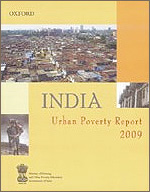
Urban Poverty Report 2009
Publisher: UNDP, 2009
The report brings together 16 prominent authors,
scholars and foremost civil society representatives
for throwing light on the nature and dynamics
of urban poverty in India. UNDP's India: Urban
Poverty Report 2009 says that sloppy city planning
and urban land management have left the slum dwellers
deprived of basic amenities and livelihood opportunities.
Exploring the dynamics of growing urbanisation
and poverty, the report aims to sensitise policymakers
on protecting the interests of unprivileged population. |
 |
It endeavours to fill
a lacuna in the poverty literature to understand
urban poverty as a phenomenon beyond the
overflow of rural poverty and is, therefore,
the first report of its kind that lays the
foundation for a robust strategy.
Apart from the realisation that urbanisation
will be at a rate of 50% in India by 2030,
the report finds that urban workers were
being increasingly pushed into informal
sector, even as the space for informal economic
activities was gradually shrinking.
So the urban poor was increasingly a street
vendor, a rickshaw puller, a rag picker,
a cleaner, a washerman, a load carrier or
a domestic servant.
The Report says while these workers contributed
to the growth of cities, there was growing
trend to push the poor to the urban periphery,
as they were increasingly seen as threat
to civic existence. |
|
This challenge should not only address
the present situation but should also foresee the
future influx of urbanisation. The urban poverty
alleviation strategy should also be aimed at the
poorest and most vulnerable.
The central concerns of this report include:
• trends and patterns of migration
• dynamics of urban land and capital market
• marginalisation of the poor to the urban
periphery
• changes in urban governance
• gender dimensions of urban poverty
•
unorganised workforce and the informal sector
• provision of and access to basic services
and amenities indicating quality of life
•
appalling conditions in slums
India's booming economy has helped marginalise the
growing number of impoverished city dwellers while
lifting millions out of poverty, a government report
said on Tuesday. |
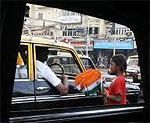 |
Urban workers are increasingly
being pushed into the informal sector/ Photo
credit: Reuters.
The proportion of India's urban poor halved
in the 30 years to 2005 but absolute numbers
rose from 60 to 81 million during the period,
said the report produced with the United
Nations Development Programme (UNDP).
The urban poor accounted for 25.7% of the
country's total urban population in 2004-5
compared with 49.01% in 1973-74, said the
report which defines urban poor as anyone
living on less than 20 rupees ($.41) a day. |
|
Mass slum clearances
have driven workers, such as those in domestic
service, away from their place of work and pushed
many into crime, the report said.
Combining data with case studies, it will be useful
for policymakers, civil society organisations,
urban planners, and researchers in the fields
of urbanization and development studies.
A new report jointly produced by the Indian government
and United Nations Development Programme says
economic growth in the country has further aggravated
urban poverty. Measures like relocating traditional
industries and mass slum clearances have meant
a total loss of livelihood for many city dwellers.
|
| Basics
and Beyond |
Published by
TARSHI (Talking About Reproductive and Sexual
Health Issues), New Delhi
Basics and Beyond: Integrating Sexuality, Sexual
and Reproductive Health and Rights, a Training
Manual provides the necessary tools and methods
to demonstrate and strengthen the connections
between sexuality, sexual health, reproductive
health and human rights. It has over 75 exercises
comprising more than 70 hours of training time,
and detailed message points and instructions for
each exercise. The exercises combine information
on sexuality, sexual health, reproductive health
and rights to elicit discussions and build clarity
and understanding for participants on a variety
of subjects and topics. The exercises also give
participants tools and ideas to implement these
issues in their day-to-day work. |
| Probus
Way to Healthy Ageing |
| Published by
Probus Club of Chennai.
October 2008. Pages 300 Price Rs 100.00.
The First part gives details of the Probus club.
The second part contains articles, stories and
papers on healthy ageing in particular and other
topics of interest to senior citizens. A few contributions
are in Tamil. Articles are on health, diet, nutrition,
exercises, cardiac problems, medical emergencies,
dementia, sleep disorders, obesity, longevity,
cancer. It includes law on senior citizens, music,
elder abuse, and travelogue. The third part is
a compendium of information such as: old age homes
in Chennai and districts in Tamil Nadu, Bangalore,
Ahmedabad, Kerala, Delhi ,Hyderabad and other
cities. It lists retirement homes, homes for disabled
adults. It also has important phone numbers in
Chennai of ambulances, hospitals, blood banks,
eye banks, police stations, death related service
providers, help lines. It also lists doctors who
do house calls and many doctors are geriatricians.
To order, contact:: E.R S Ranganatha Rao (044)24995290
or Sri K Venkatachary (044) 24981099). |
| Genetic
Engineering and its Health Hazards |
By Jeffrey Smith
Indian Edition published by the Deccan Development
Society, Hyderabad, South Against Genetic Engineering
and the Other India Press, Goa.
This book, written by Prof Jeffrey Smith of the
Institute for Responsible Technology, USA, documents
the health impacts of genetically engineered foods
on human health.
For instance, Bt-brinjal, a genetically engineered
form of vegetable, brinjal or baingan is manufactured
by inserting a gene from a soil bacteria Bacillus
Thurengiansis [Bt] l through a process called
genetic engineering (GE) to develop pest resistant
brinjals (Bt-brinjal) . This is supposed to reduce
pesticides in brinjal cultivation. In the process
of manufacturing Bt-brinjal, along with the Bt
gene, antibiotic resistant markers, and a promoter
(often a virus) are also inserted. This is extremely
dangerous. When we eat Bt Brinjal, the antibiotics
used in this process will affect us in such a
way that it will desensitise our body to them,
and deprive us of their benefits when required.
Thus we will have to resort to higher levels of
antibiotics to rid ourselves of infections. Contact:
Institute of Agricultural Technology, Queen's
Road, Bangalore Tel. (080) 2521 3104, 2528 3370. |
| Rights
of Women in Islam |
By Asghar Ali
Engineer
2008. 3rd edition,
ISBN 9788120739338
Hardback, Price: Rs. 500
This book covers various aspects relating to the
status of women in the pre-Islamic period - customs
and traditions, forms of marriage, divorce and
forms of divorce, dower, traditions regarding
slave-girls, and so on. It also deals with the
status of women in the post-Islamic period - the
Qur'anic concept of women's rights in marriage,
divorce, inheritance, custody of children, polygamy,
maintenance, property, right to earn, etc. It
quotes extensively from the Qur'an and Sunnah.
It also deals with the Arab adaat, that is, pre-Islamic
customs and traditions regarding women. Altogether,
it attempts to arm Muslim women with Islamic arguments
for their empowerment. The author, a renowned
scholar, has sought to set the record straight
by reinterpreting women's rights in the true Qur'anic
spirit. He argues that the Holy Book gives equal
rights to both the sexes, and it does not discriminate
between them as regards personal, democratic and
human rights. The question whether in a secular
society Muslim personal law needs any change,
and, if so, in which direction the reform should
be undertaken is dealt with in detail.
The third edition contains a chapter: On a Muslim
Woman Leading the Congregational Prayer, which
deals with the important aspect of Muslim women's
problems and also hopes to further enhance their
understanding of the Shari'ah issues. |
Playing
with Fire: Feminist Thought and Activism through
Seven Lives in India
by Sangtin Writers and Richa Nagar
Minneapolis: University of Minnesota, 2006.
This book is the story of a support collective
called Sangtin formed by eight rural activists
in UP in 1998.Their discussions in Hindi called
Sangtin Yatra was published in 2004. Their "Journey
of Sangtins," a word they loosely translate
from the regional language Awadhi to mean solidarity,
reciprocity, and enduring friendship among women,
was developed collectively through "a fractured
unity in voices" and written penned by their
ninth member, a U.S.-based academic Richa Nagar.
The eight rural activists recount their own stories
of oppression, prejudices of caste and class,
loneliness, courage, and fraught relationships
in the context of their jobs. Immediately they
felt the risks and consequences of communicating
so openly about their work as women who fought
for other women's rights. After the book was published
in Hindi, some were transferred,, others almost
lost their jobs, and most faced increased surveillance
and suspicion.
RESISTING REFORMS?
Water profits and democracy
By Kshithij Urs and Richard Whitell
RSVP Arul Selva Shameem Ramkumar
9480452037 9663376636 9880038040
'Ethical Concerns in Clinical Trials in
India: An Investigation' .
-Sandhya Srinivasan(co-author)
Clinical trials for MNCs 'killing the poor in
India'
Close on the heels of the controversy about an
alleged clinical trial death on one of Wyeth's
paediatric vaccines, there is more damning revelation
that could erupt into a bigger movement and upset
the proponents of liberal clinical trial legislations
in India.
According to a comprehensive report published
by Centre for Studies in Ethics and Rights, clinical
trials conducted on behalf of GlaxoSmithKline
Pharma, AstraZeneca and Johnson & Johnson
may have harmed economically vulnerable Indian
patients.
Sandhya Srinivasan, co-author of the report instituted
by the Centre for Research and Multinational Corporations
and Wemos, writes that trials which could not
be conducted in developed countries are being
conducted in India, taking advantage of people's
lack of access to affordable, good quality care.
"The benefits of research do not reach the
community as drugs found effective following these
trials may not be affordable to the community
in which they were tested. Such practices are
in violation of the Declaration of Helsinki as
well as the general principles laid down in the
Indian Council of Medical Research's ethical guidelines
for biomedical research," she states in the
report.
Srinivasan picks clinical trials done in India
on Tykerb (lapatinib), Seroquel (quetiapine) and
Risperdal (risperidone) for her study. Taking
each drug separately, she observes that the patients
in the placebo arms of these trials were harmed
by their participation.
The report says, "In the risperidone trial,
seriously ill patients -- worse than patients
in similar trials in the US -- were taken off
treatment to prove the efficacy of a drug when
an effective treatment was available. In the trial
of quetiapine XR for long-term maintenance for
schizophrenia, patients were put on placebo despite
the existence of an effective drug. More patients
on placebo suffered a relapse than patients on
the active drug of proven efficacy. Patients on
placebo suffered serious harm because of participation
in the trial."
The report brings down claims of an emerging flawless
regulatory setup in India. "The ruling on
whether a trial design violates ethical principles
is left to individual local ethics committees.
A trial refused permission by an ethics committee
at one trial site may be submitted to another
and approved," Srinivasan writes in her 70-page
investigative report.
Url.: http://www.dnaindia.com/report.asp?newsid=1232174
|
|
| Top
|
|
| |
|
Other stories |
Citizens rally in Mumbai
Their rally against banners, hoardings,
arches, flags, posters, for which MCGM permission
has not been taken and which are put up in public
spaces was initiated and supported by JNM as
a citizen-centric direct action movement in
Mumbai.
So far, Andheri West, JVPD, Bandra West, Khar
West, Chembur have seen local activists and
citizen groups there, supported by JNM, conducting
symbolic protest action against such eyesores.
At Bandra, ... some alleged party workers tried
to harass some of the activists, filed false
complaints against them at Bandra and Khar police
stations, used political muscle to browbeat
the police officers, got FIR issued against
some activists, threatened physical violence
and created an all night ruckus at the Khar
police station. Hawkers and goondas were instigated
by some politicians to do this.
Now higher authorities are contrite at this
gross and improper behaviour and the CM, Home
Minister, local MP, Mayor, Dy.Mayor, MCGM Licence
Dept, Ward Officials have said they supported
the fact that these banners are illegal. Yet
some alleged party workers were hard at work,
giving their own parties a bad name, probably
to settle scores with the activists over their
other citizen friendly activities.
Finally, the Citizen activism has prevailed.
Citizens are empowered and the Govt. and Administration
have acted to protect the citizen movements.
Praful VoraVolunteer & Convener, JNM 900
401 7654 http://groups.yahoo.com/group/juhuektaalm
|
| News (NGO
Connect April 2009) |
Health
Manifesto by NGOs
The 'Peoples Health Manifesto 2009' was released
by Jan Swasthya Abhiyaan (JSA) - the Peoples'
Health Movement, an association of over 1,000
organisations working in health care and policy.
Highlighting the situation of public health care
and emphasising that the current condition is
abysmal, especially for the poor, the manifesto
asks political parties to take effective measures
to achieve people's right to health.
"This, the manifesto stated, "not only
includes the right to timely and appropriate quality
health care but also to the underlying socio economic
and environmental determinants of health."
It also includes food security, the issue of malnutrition,
safe water, sanitation to all and a regulatory
framework to address health concerns of genetically
modified (GM) cropping and import of GM foods
as key factors.
The manifesto also called upon the government
to enact a National Health Act for ensuring "the
right to comprehensive, quality health care at
public expense in relevant health institutions
to all, where everyone is entitled to the full
range of guaranteed, free health services".
The manifesto also stresses the need to reform
and implement some existing policies on child
health and nutrition, gender and health urgently
as well as rework policy issues on drugs, medicines
and patents. The implementation of the National
Rural Health Mission (NRHM) has been criticised
in the manifesto, which calls for increased allocation
and effective expenditure of funds for the project.
Amit Sengupta of JSA called for the incorporation
of the recommendations by political parties in
their election manifestos for the upcoming general
election as a demonstration of their commitment
to public health.
Positive Habba.
MYSORE: Everything was positive about it. Called
the `Positive Habba', it was a celebration of
life for over 400 persons affected by AIDS at
the festival organized by Ashodaya and Ashraya
Samithi, the NGOs working for rehabilitation of
AIDS patients, on March 29.
Sex workers from Karnataka, Kerala, Andhra Pradesh,
Tamil Nadu, Maharashtra, Gujarat and West Bengal
will be part of the two-day festival which aims
at making them acceptable in society along with
an access to health facilities.
"We also intend to send a message that there
are people in the society who care for them,"
Fatima, an activist with Ashodaya, said claiming
this is the first of its kind programme in the
world. State health secretary Madangopal inaugurated
the habba by signaling a torchlight parade. Madangopal
said there is a need to integrate medical services
for HIV+ patients at the PHC level.
The event will also address a range of issues,
including marginalization, discrimination and
health problems faced by sex workers. Cultural
events were also organized in the evening.
World Social Forum 2009
Participants from 5808 organizations from 142
countries in five continents participated in the
IX World Social Forum at Belan city in Brazil
in January 2009. More than 2300 activities involving
over thousands of participants in panels, debates,
seminars, cultural events, marches, demonstrations,
and open spaces for direct interactions were held
in this WSF in the heart of the Amazon region.
The outcome included declarations of the thematic
assemblies, calls for action and mobilisation
which were announced in the final assembly: A
stronger convergence of social movements and civil
society networks emerged at the end, leading to
new alliances to face the multiple crisis and
global issues in the world.
WEBSITES
Medical Services -Mumbai
The Bombay Medical Aid Foundation provides the
following services: medical aid to needy, organizing
various free medical camps at various locations,
mobile medical van visiting various slums in and
around Mumbai, and a hospital.
Website: http://bombaymedicalaid.com
In line with nomenclature used by major NGOs worldwide,
Cancer Patients Aid Association's
website has now been renamed www.cancer.org. in
. You can access the website using both addresses
for the present.
The BMC Education Department has
it's own website at http://mcgmedu.in
The website has contact details of various officers,
budget estimates, details of computer labs in
BMC schools, details of the school mid-day meal
programme, etc.
A new session on how to file an FIR and what are
your rights when you are subject to police arrest
http://altlawforum.org/Training
or contact ByathaNJagadeesha,Advocate,Bangalore
< jagadeesh@altlawforum.org> |
|
The Wildlife
Crime Control Bureau (WCCB) recently launched
its website, www.wccb.gov.in Apart from encouraging
greater participation in checking wildlife crime,
the website also aims at increasing awareness
among law enforcers, developing links with all
WCCB stakeholders and at encouraging international
tourists to reduce the demand for wildlife products.
The portal also seeks to generate greater awareness
about banned wildlife products, purchase of which
can lead to imprisonment.
Following are websites which are useful for consumer
protection:
www.fcamin.nic.in,
www.corecentre.co.in,
www.ncdrc.nic.in,
www.consumerhelpline.in,
www.cgsiindia.Org,
www.consumeronline.Org,
www.icrpc.org,
www.consumer-voice.org,
www.cai-india.org,
www.cercindia.Org,
www.cccindia.net12,
www.ngpnet.org,
www.core.nic.in,
www.watchoutinvestor.com,
www.consumercom.nic.in,
www.pgportal.gov.in,
www.bankingombudsman-rbi.org.in,
www.confonet.nic.in,
www.cag.org.in,
www.investorhelpline.in,
www.iepf.gov.in,
www.sebi.gov.in,
www.nse-india.com.
Community centre for survivors of HR violence
U.P. On Feb. 17 A community center (Sushil Tripathi
School and community center) was jointly inaugurated
by Mr. Anil Kumar Parashar Deputy Registrar National
Human Rights Commission, New Delhi, Ms. Helma
Ritsher Chairwomen Indo - German Society Remscheid,
Germany and Ms. Inger Agger Phd. Consultant Rehabilitation
and Research Centre for Torture Victim (RCT),
Denmark at Raup village in Sonbhadra District,
Uttar Pradesh.
The inaugural session followed by honouring eight
survivors of Sonebhadra district who gave their
testimony on violation of human rights and their
fight with the joint endeavor of People's Vigilance
Committee on Human Rights (PVCHR), Varanasi and
Rehabilitation and Research Center for Torture
Victim (RCT), Denmark. A Hindi version of the
Manual "Giving Voice" --Using Testimony
as a Brief Therapy Intervention in Psychosocial
Community Work for Survivors of Torture and Organised
Violence in India by Dr. Lenin Raghuvanshi and
Ms. Inger Agger was also released. Due to intervention
of National Human Rights Commission, New Delhi
and Supreme Court commissioner on Right to food
a lot of changes took place.
Contact; Ms. Shruti Nagvanshi: +91- 9935599330,
Ms. Shabana: +91- 9453155296, Mr. Upendra +91
- 9935599338.
Observing International Women's Day
Mumbai: Women Networking organised a
programme at YWCA, Andheri to observe International
Women's Day on 5th March. Nearly 60 participants
from various women's and community-based organisations
and also some individuals from the suburbs of
Mumbai took part in a day-long programme which
included a workshop with discussions on domestic
violence, sexual harassment at work place, rape,
views on women in pubs and public places, sex
work and bar girls, and sex selective abortion.
The discussions in small groups were very rich
in the understanding of social and economic issues
and had a clear gender perspective. Cultural activities
songs, skits, mono acting, dance and quiz - all
related to gender themes were performed. The groups
which participated were Aakar Mumbai, Ashankur,
Centre for Legal Services, Jan Jagruti Kendra,
Mahila Takrar Nivaaran Kendra, Mukti Sadan, Prayatna,
Prayas Kendra, Sanmitra Trust, and YWCA. Contact:
Jaya Menon, Email: jaya11200@yahoo.co.in
Mahila Takrar Nivaaran Kendra
(Women's Grievances Redressal Cell) organised
a Dialogue between women's groups and the Police
on 7th March 2009 at Holy Family School Hall in
Andheri East, Mumbai. About 60 women participated
in this Dialogue face to face with K.L. Prasad,
Joint Commissioner of Police (Law & Order),
KM.N. Prasanna, DCP of Zone 10, Satish Sahney
Former Police Commissioner of Mumbai, Assistant
Commissioners of Police and Senior Police Inspectors
of Zone 10. Dr Vibhuti Patel, Head of the Department
of Economics, SNDT Women's University facilitated
the Several clarifications were sought regarding
issues such as, police role in Mohalla Committees,
the implementation of the Domestic Violation Act
(DVA), IPC 498 A, rape, abuses of young girls
in schools etc. A positive outcome of this Dialogue
was a police initiative to organise a meeting
with women activities to provide information on
the functioning of the DVA especially with regard
to Protection Officer at Ward offices. Contact:
Maria Ishwaran, Mob. (0) 9820983748.
Joint Women's Programme: On 8th March,
about 500 women from several women's groups participated
in a joint programme in Mumbai organised by the
All India Democratic Women's Association, Stree
Mukti Sanghatana, Forum against Oppression of
Women, Akshara, Maharashtra Mahila Parishad, Bharatiya
Mahila Federation. A rally was taken from Dadar
to Prabhadevi ending in a meeting at Bhupesh Gupta
Bhavan with speeches, slogans and songs. Leaflets
in Hindi and Marathi were distributed. Following
are the main points raised in the leaflet and
speeches.
• The erosion of economic rights due to
the economic policies of the state is therefore
an important issue for women in the current situation.
• Abhor. Sectarian politics targets women;
especially in view of the forthcoming elections,
no mobilisation in the name of caste, community,
region'
• violence and attacks on women and on young
couples belonging to different castes and communities.
sought to be socially sanctioned in the name of
enforcing 'Indian' culture and moral codes on
women; --demand severe action against those who
perpetrate such violence.
Contact: Sonya Gill, AIDWA sonyagill1@yahoo.co.in.
U.P.The Global Science Academy (GSA),
Basti (UP) observed International Women's Day
on March 08, 2009, at its headquarters in Basti
by focusing on gender equality including women's
access to education and information, sexual and
reproductive health services, female-controlled
prevention methods like female condom and vaginal
microbicide, and prevention of mother- to -child
transmission. Contact: Dr. Anil Pratap Singh,
Global Science Academy, Basti (UP) India.Tele-fax
No.: +91 5542 247186,Mob. (0) 9336785696 website:
www.gsa.org.in.
H.P.:From Darkness to Light - was the
theme of the HIV/AIDS awareness procession in
the small hill town of Palampur of Himachal Pradesh.
The rally was flagged off by the Chief Medical
Officer, Dr A. K. Mahajan from Indo German Hall
Palampur and concluded at bus stand in the form
of a red ribbon shape, which signified commitment
to the fight against HIV. The Mashaal Rally attracted
wide community participation and over 600 working
women, anganwadi workers, health workers, Tibetan
women, women lawyers and students from CSKHPKV
Palampur and ITI Palampur participated in the
silent event. Prior to this, artistes form the
Nitika Kala Sangam, Sirmour, gave a captivating
performance on various aspects of HIV transmission
and prevention.The event was conducted in the
evening to protect women's livelihood concerns,
as most of the rural womenfolk are employed under
NAREGA. A training workshop for 45 Female Health
Supervisors from across the district was also
conducted on 8th March 2009, to sensitise them
and these will in turn train female health workers
and female health supervisors, which will further
raise awareness and generate demand for services.
Contact: Dr RK Sood, Mob.(0) 9418064077, 9445157327.
Email: drrksood@gmail.com.
Retirement Home for Sex Workers
Chennai: As part of its anti- trafficking initiative
ICWO along with KKSS "Lighthouse" a
home for retired women sex workers was inaugurated
on March 7 in Chennai in connection with International
Women's Day 2009 The Home is supported by APAC,
VHS-USAID. Contact: .A.J .Hariharan, Founder Secretary,
Indian Community Welfare Organisation - I.C.W.O.
AP-216, 18th Main Road, 'I' Block, 6th Street,
Vallalar Colony, Anna Nagar West, Chennai-600
040. Tel. ( 044) -26184392, 65515742, Mob (0)
: 98401-88821
Email: fieldmaster@mail.com,
fieldmaster2000@hotmail.com.
Website: www.icwoindia.org.
Bangalore: Half day Seminar on History of Women's
Movement and the challenges ahead:
'Tracing the history of the women's movement:
Dr. R. Indira- Director, International Centre,
Mysore University and Challenges faced by women's
organisations and the way forward:
Dr. M.Ashadevi- Lecturer and feminist thinker,
at Granthangana, Govt Library, Vijayanagar, Bangalore.
Contact: Sushma(9448046254) , Mallige(9945516296)
, Gowri(9449972147) and others, Samanatha Mahila
Vedike.
-----------------------------END OF WOMEN'S DAY
NEWS----------------------------
Celebrating Sex Workers Day- Mar. 3
Kolkata: The Durbar Mahila Samanwaya Committee
(DMSC), the Sex Workers Collective of West Bengal,
representing 65,000 sex workers (male, female
and transgender) celebrated the International
Day of Sex Workers (3rd March) at Kolkata, India.
The five-day program starting from Feb. 27- Mar.3
included several parallel sessions in addition
to cultural programs. All the issues and strategies
addressed social discrimination, violence etc.
focusing marginalized community with special reference
to sex workers. through debates, seminars, workshops
etc. which will be held during these days in partnership
with different Educational Institutions in Kolkata.
Contact: Ms.Dolly Das (Joint Convenor), 12/5 Nilmoni
Mitra Street, Kolkata-700 006, West Bengal, India,
Tel.(033) 2543 7451 / 7560 E-mail: sexworkersday.durbar@gmail.com
Web site: www.durbar.org.
New Delhi: Jan Manch on Employment
Guarantee and the Right to Information was held
in New Delhi on 21 March 2009 prior to the forthcoming
Lok Sabha elections where representatives of all
political parties were invited to present their
party's position on these two crucial issues,
and to respond to public demands or queries. This
event was convened under the joint banner of People's
Action for Employment Guarantee (PAEG) and the
National Campaign for People's Right to Information
(NCPRI). A draft charter of basic demands on employment
guarantee was prepared. Contact: Secretariat-Right
to Food Campaign, New Delhi, Email: righttofood@gmail.com
Email janmanch09@gmail.com.
Sunfeast 10K Run-Bangalore
Bangalore Sunfeast will sponsor the World 10K
Run at Bangalore. in Bangalore on 17 May 2009.
ITC Bangalore Cares has been appointed the official
charity partner for the Sunfeast from 2008. This
is a great opportunity to represent your cause
and fundraise from individuals and companies for
your cause and create public awareness of your
good work. Contact: Ram Sundher, Bangalore Cares
Team (0) 9845294096 Email: bangalorecares.sunfeastw10krun@gmail.com,
website: www.bangalorecares.in
ESG is 10
Bangalore; Environment Support Group, one of India's
most active environment groups celebrated a decade
of involvement with the release of a Decadal Report
by Dr. B. K. Chandrashekar, former Chairman of
the Karnataka Legislative Council. At a function
on Jan 10 the reease of the report was followed
by two cultural performances - of Kalaripayattu
by the Vallabhatta Kalari Sangam, Chavakkad (Kerala)
and an Odissi performance by Diya Sen and troupe.
A decade of working with various local communities
in Karnataka, across India, and with many organisations
and networks across the world, has been reviewed
in the decadal report which will be available
on ESG's website ( www.esgindia.org)
Contact: esg@esgindia.org.
Leo Saldanha ESG" leo@esgindia.org.
United action to end child labour in Karnataka
Bangalore: The Campaign Against Child Labour (CACL),
a nation-wide network to eliminate child labour,
took the lead in launching the initiative in which
90 civil society organisations across Karnataka
have joined hands to end rampant child labour
in the state. The Civil Society Initiatives for
Elimination of Child Labour was launched in August
2008. Some of the civil society groups which have
joined hands with CACL are Bangalore Hotel Owners'
Association, Federation of Karnataka State Lorry
Owners' Association, Karnataka Truck Owners' Association,
and various trade unions including the Karnataka
Beedi Workers' Union. The CACL initiative has
the support of the International Labour Organisation
(ILO) and the Karnataka Child Labour Project.
According to a recent CACL survey, Karnataka has
400,000 child labourers, whereas the state government's
labour department puts the figure at just 85,000.
Child rights activists estimate that currently
there are 50 million child labourers in India,
though it was banned more than two years ago.
The notification on prohibition of employment
of children as domestic help and in restaurants
or roadside 'dhabas' (eateries) came into effect
on Oct 10, 2006. Violators face jail for up to
two years and a fine of Rs.20,000.
'Operation masoom' launched
Ghaziabad :The Ghaziabad police
in UP launched the Operation Masoom (Innocent)
and 'freed" 250 children who were working
in dhabas, sundry factories and other places,
and arrested four persons under the Child Labour
Act. The Ghaziabad police said, "this is
an ongoing programme to try to prevent child labour,
as well as identify any gangs which may be involved
in kidnapping children and making them work."
It is hoped that the operation will help the police
to also identify child trafficking that may be
going on. Apart from this, police add, it is,
after all, a crime to have children below 14 years
working.
Spin a yarn
Mumbai: In connection with Sarvodaya Day, the
Aseema Trust organised the Spin-a-Yarn project
with the aim of reviving spinning and the charka
V. R. Devika, a former school teacher and now
the Managing Trustee, Aseema Trust, has introduced
the Spin-a-Yarn project in ten primary schools
with a grant from the Sir Dorabji Tata Trust.
This is in keeping with Gandhiji's emphasis on
learning by doing - through art and craft. The
aim of the project is to revive spinning and the
charka, that was once the symbol of India's freedom
movement and teach children lessons from Gandhi's
life and teachings. The Trust visits the ten schools
once every month and teaches them spinning, and
have group discussion on self and society.
12th Anniversary of Maher
Pune: i: 1st. Feb.2009 at Vadu Budruk
The Inter NGO Cricket Tournament "Innocent
Hero's Trophy 2009" was a concept which turned
into reality on the ground of Deccan Gymkhana
pitch... The winner of this Trophy was " Deep
Gruha Society",and the runner up
was " Surajya Sarvangin Vikas Prakalp"
both working for street and slum children.
Maharashtra Cricket Association , hadselected
11 + 2 players from various NGO's for screening
.to play in the League Matches of Maharashtra
of Under 14, under 16 and under 18 group matches.
Mr. Ajay Shrike, President of Maharashtra Cricket
Association, Mr. Riyaz Bagwan, Chairman Selection
Committee , Mr. Ahbijit Kale - Cricketer Indian
Team were present at this moment along with few
Ex and current Ranji Trophy Players. Mr.
Arun Bhatia IAS.
Retd, was the chief guest.
Maher's new phone Nos.
Pune: Maher has changed its phone numbers:
Administrative office: +91 09011086134 / 09325313280/
020 - 27033421
Vadu, the main centre: +91 09011086131, +91 09422006065(Ms.Hirabegum),
+91 09011086132 (Ms. Mini), +91 09763809327 (Ms.Athena
Nair),
Vatslayadham: +91 0020 - 20260788 (Ms. Yvonne)
Home for Mentally Disturbed: +91 09850519094 (
Raju Chavan) and +91 09890302135 ( Sachin Pise);
Production: +91 09011086133 (Shirly Antony)
Contact Maher to Share your time, sponsor a meal,
donate clothes. MAHER, Pune.
maher@pn3.vsnl.net.in
, maherpune@gmail.com
Website: www.maherashram.org
-------------------------------------------------------------------
Save Children Movement
Jharkhand: The Bachpan Bachao Andolan (BBA) (Save
the Childhood Movement) in its ongoing campaign
India Action Month 2009 conducted a raid conducted
in 58 roadside eateries in Jharkand and Delhi
and rescued 120 bonded child labouers. The children
were of age 7-15 years old. The youngest child
Raju (name changed ) 7 years old was working in
the Dhaba for one and half year "I wanted
to go home but whenever I used to tell this to
my owner he used to beat me and made me work double
from my normal chores. Therefore I stopped complaining."
Bachpan Bachao Andolan has emerged as an organisation
of thousands of individual supporters under the
banner of 'Bachpan Bachao Andolan' as well as
network of over 780 NGOs, trade unions, human
rights organisation etc. dedicated towards the
total elimination of child labour and quality
education for all in India. BBA has released over
76,000 child and bonded labourers since 1980.
In reaction to BBA's petition on Feb. 4 the state
government of Delhi submitted before the High
Court of Delhi, that to curb the instances of
trafficking, especially domestic child labour,
and to reign in the placement agencies mushrooming
in the capital, the government will make a high
level committee to draft guidelines for prevention
of the crime of trafficking for forced labour
and child labour in the capital.
Hearing a petition filed Bachpan Bachao Andolan
(BBA), the court accepted the government's submission
and has granted the government 4 weeks to draft
the above said guidelines.
Contact: Bachpan Bachao Andolan (Save the Childhood
Movement), L-6, Kalkaji, New Delhi 110019. Tel:
(0 11) 2622 4899, 2647 5481, Fax: (011) 2623 6818,
Email: info@bba.org.in.
Website: www.bba.org.in
Umesh Gupta, Coordinator Campaigns and Communication,
(Mob.) 92120 89894 Email: advocacy@bba.org.in.
-------------------------------------------------------------------
Changing lives in Pune
Pune: 19-year-old Anjana Damraji who is currently
a first year student of a degree course in science.
She stays in Pune in a girl's hostel, manages
to pay her fees through a government scholarship
and also provides tuitions to five children during
her spare hours to earn an extra bit of money.
Anjana's parents work on a construction site as
labourers and have been doing so for the past
24 years. Anjana wants to a course in computer
technology and find a job as she wants her parents
to retire. She pointed out that the crèche
has changed the lives and fortunes of many children
of construction site labourers.
|
 |
Children learning at
the day-care centre/ Photo credit: Tara
Mobile Creches.
Ravinder Kadam who has recently found a
job with a BPO and hopes to acquire a post-graduation
in commerce. "I would have become a
labourer like my father had it not been
for the mobile creche where I went as a
child. I got interested in learning new
things and became desperate to be able to
speak and write in English. Therefore, despite
my father's opposition, I continued to study.
I am now planning to invest in a house so
that we don't have to live on construction
sites any longer," he states. |
|
There
are many such people today who have been able
to carve out a future for themselves, credit for
which must go to Meera Mahadevan who first conceptualised
the idea of mobile creches in 1969.Now, Tara Mobile
Creches has taken roots in many cities across
India. In Pune, it has 15 centres and caters to
the needs of 1,300 children.
Today, for any big construction project that comes
up, Tara Mobile Creches (TMC) comes in as the
care provider. The builders arrange for a place
on the site, and TMC provides well-trained, committed
staff. From the age of two months onwards, children
have to be left with the creche workers. Initially
the staff has to sometimes round up the children.
Blue Cross of India in international environmental
history
Chennai: The Blue Cross of India has been included
in a list of major environmental achievements
of the world on the website of Radford University
in Virginia in the United States. Link here :
https://php.radford.edu/~wkovarik/
drupal/?q=node/19.
The Blue Cross of India was formed in 1959. Co-founder,
Chinny Krishna introduced the first neuter/return
program for street dogs in the world in 1964,
which he called "ABC," short for "Animal
Birth Control." In 1997 the Indian goverment
accepted the recommendation of the Animal Welfare
Board of India that ABC should become national
policy, and endorsed the goal of abolishing animal
control killing throughout India by 2005.
CSR
_____________________________________________________________
-------------------------------------------------------------------
NASSCOM Foundation carries out
software, hardware and services donation program
called ' BiG Tech' for Indian
non-profits and non-governmental organizations
through its website www.bigtech.in.
Currently, BiG Tech is offering Microsoft Products
- Microsoft Windows XP Professional Upgrade,
Vista upgrade, Office Professional 2003 &
2007 ; Bytes of Learning that offers
a Keyboard tutorial. UltraKey systematically teaches
touch typing and safe keyboarding using voice,
3-D animation, video, and virtual reality. It
provides many options that adapt to a broad range
of age groups and special needs;. Eagle Audio
Conferencing Service facilitates organization
connects Conference calls on an unlimited basis.
Using which one can get the entire team to have
a discussion /meeting over the phone, there is
no requirement to inform the service provider/or
reserve the conference calls, as your dedicated
conference room is open 24/7 , as such you can
conference at anytime and however long you desire;
BUSY, an integrated Accounting and Inventory Management
Software targeted at Micro, Small & Medium
Businesses (MSMBs)-- extremely user-friendly,
flexible & powerful is also available free.
For donation of the above:
1. Your Organization needs to register
for free on the website http://www.bigtech.in/user/register.
2. Once your Organization Qualifies for the Service
select the desired software and place
an order (one week)
3. We charge a small administrative reimbursement
for our services. This is usually less than 4%
of the software's retail price. You make
this payment at the bank of your convenience in
cash/cheque.
4. Your Organization will receive the
software by courier and licenses can
be downloaded from the Internet. (Delivery
within two weeks subject to Payment Clearance)
If you have queries write to bigtech@nasscomfoundation.org
or contact me on the number: +91-22-28234851.-Manasi
This program is brought to you by NASSCOM Foundation
in partnership with TechSoup, San Francisco based
organization.
_____________________________________________________________
Senior Citizens care in Mumbai
Mumbai: 'Aastha', a project for overall care of
the senior citizens at Aarogyamm exhibition in
Lokhandwala in Andheri West, Mumbai. Aastha will
provide the necessary support required from regular
health check up to counseling and recreational
activities will be taken care by Aastha. The programme
will extend its facilities and care to elderly
who are unable to support themselves as their
children are preoccupied in their hectic lives.
I am no lab rat
New Delhi: A campaign against GM foods has begun
with concerned citizens urged to o say "I
AM NO LAB RAT" to the Government of India,
if they don't want to be a guinea pig in this
experiment by profit-hungry corporations.
A rally was held at Jantar Mantar in Delhi 20
March 2009 and planned to continue, especially
on April 7th, which is World Health Day, for a
sustained direct action until the Government of
India at the highest level steps in to say that
our right to know what we are eating, our right
to informed choices and our right to safe food
will not violated through GM foods entering our
plates. In other words, we want the government
to stop Bt Brinjal. Contact: Kavitha Kuruganti,
Kheti Virasat Mission, Street No 1, Baba Farid
Nagar, JAITU-151202, District-Faridkot, Punjab.
Tel. +91-9393001550 Website: www.indiagminfo.org,
www.iamnolabrat.com.
|
|
Right
Livelihood College
The Right Livelihood College (RLC), a global capacity
building initiative of the Right Livelihood Award
Foundation based in Sweden, was established in
January 2009 .The College is hosted by the Universiti
Sains Malaysia (USM) and the global secretariat
is located at the Centre for Policy Research and
International Studies (CenPRIS) at USM on the
island of Penang in Malaysia. RLC aims to harness
and spread the knowledge and experience of Laureates
of the Right Livelihood Award, popularly known
as the "Alternative Nobel Prize". It
does this through promotion of education, research,
public understanding and practical activities.
The main goals of RLC is to make the knowledge
of Laureates accessible to all, the general public
as well as individuals and selected groups with
the potential to make the "winning ideas"
of Laureates succeed and multiply, and to provide
a 'hub' for promoting and multiplying the most
successful solutions to urgent global problems
through the development of information, communications
and education activities including web-based learning
materials, meetings, networking and an internship
and research scholarship programme. There are
some 133 Laureates from 57 countries. Website:
www.rightlivelihood.org.
NREGS Irregularity
U.P.:The Gram Pradhan of Aira Kake Mau Village
Panchayat of Bharawan Block of Hardoi District
in UP agreed to show the documents related to
implementation of NREGS in her panchayat in the
wake of complaints from labourers that they have
been paid less wages than what has been shown
on their job cards. The people had assembled at
the Pradhan's place on 8th January, 2009 but since
the husband of the Pradhan, Ghanshyam, who actually
runs the show was not there, they were told to
come again on 14th January, 2009.
The labourers of the panchayat went to the Gram
Pradhan's house with their job cards and Ghanshyam
has agreed to redress their grievances.(So much
for women's empowerment!!!!!). Contact: Rambabu,
9452144454,Ram Sagar Verma, 9451209863 Neelkamal,
9453898067, Sandeep Pandey, 0522 2347365, Asha
Parivar and National Alliance of People's Movements,
Hardoi.
Free Para Medical College, Nursing Course
Mumbai: The Aayush Mamta group of paramedical
colleges is offering free preliminary nursing
training course with 100% job guarantee (discounted
rates for ayurvedic panchkarma therapy course)
contact Dr. Hemlata Jadhav, Aayush Mamta group
of charitable hospital,K-6, Sector 4, Airoli ,
Navi Mumbai. Mob. 09321221000, 09322222102, 9004354000
between 11am-8pm. Email: aayushmsh@yahoo.com,
tulas_h@yahoo.com
Website: tulasayurveda.com.
Women Without Borders
Mumbai: SAVE workshop was organised by Women Without
Borders on Feb.3 at the Press Club. SAVE --Sisters
Against Violent Extremism-- was formed during
an International Conference during Nov. 28 to
30 2008 in Vienna in which delegates from all
over the world spoke in dialogue about the importance
of mobilizing women against violent extremism.
The workshop participants were survivors of the
attacks on 26/11 at the Taj Hotel, Nariman house,
Leopold Restaurant, Cama Hospital, V.T. station
and Dockyard Road Taxi blast. Narratives of the
Nurses of Cama hospital brought out their work
ethics and secular humanism. All of them wanted
to work towards a Culture of Peace in a Climate
of Fear. The documentary film made by SAVE not
only gave a collage of terrorist attacks all over
the world but also expressed courageous peoples'
determination to bring peace and harmony. Contact:
Prof. Vibhuti Patel, Director, PGSR, SNDT Women's
University, Mumbai Email: vibhuti.np@gmail.com.
National Policy on Voluntary Sector
Chennai: VANI in collaboration with Rejuvenate
India Movement-(RIM) organised a state level consultation
workshop on 28-29 January, 2009 in Chennai to
enable the participants to understand the various
aspects of the National Policy on Voluntary sector,
its implications for the voluntary sector and
promote production of a policy for the state.
Contact: VANI, Asha Nivas, 9, Rutland Gate V Street,
Chennai - 600 006. Tel. 28333311, 28330772, 28331601.
Condemn torture and malnutrition
Uttar Pradesh: Ghasia ghetto of Raup village is
icon against the police torture and its consequences.
After the police torture, 18 children of Ghasia
tribe died due to hunger and malnutrition situations.
The community and the People's Vigilance Committee
on Human Rights (PVCHR), Varanasi took action.
National Human Rights Commission, New Delhi and
Supreme Court Commissioner on Right to Food also
intervened. At the inauguration programme of the
Sushil Tripathi School and community centre at
Raup village in Sonbhadra District, Uttar Pradesh,
a ceremony was held to honour eight survivors
of Sonebhadra district who gave their testimony
on this violation of human rights. The programme
was organized by PVCHR and Rehabilitation and
Research Center for Torture Victim (RCT), Denmark,
and a Hindi version of Manual "Giving Voice"
Using Testimony as a Brief Therapy Intervention
in Psychosocial Community Work for Survivors of
Torture and Organised Violence in India developed
by Dr. Lenin Raghuvanshi and Ms. Inger Agger was
launched. The organizers have urged people to
write a letter to Government of Uttar Pradesh
to open a primary school with mid day meal scheme
in above mention building and write an appeal
to Government of India for the ratification of
UNCAT.
Contact: Ms. Shruti Nagvanshi: +91- 9935599330,
Ms. Shabana: +91- 9453155296, Mr. Upendra +91
– 9935599338.
Friends Society
(PIX) Friends Society (FS) campus in Vadodara,
Gujarat and the adjoining Hill Memorial School
were buzz with activities on eve of Uttarayan
as the Youth Club children engaged themselves
in flying kites along with FS volunteers Republic
Day was celebrated at FS campus The Chief Guest
was Sohiniben Thakkur, Municipal Councillor, Fatehgunj
Region, Vadodara Mahanagar Seva Sadan & Guest
of Honour was Abdulbhai Patel, Jt. Secretary,
Vadodara Zilla Samajik Nyaya Samiti. Various cultural
programmes were put up by the Balwadi children,
Sunday School children and FS Youth club volunteers.
The Chief Guest honoured Draupadiben Bhagya for
her many years of services to empower the Balwadi
teachers and volunteers. Other activities of FS
included a picnic for 50 Cheer Up children (from
Home for the Crippled, Pensionpura) Kavi Kamboi,
where the Mahi river meets the Arabian Sea. Several
voluntary Blood donation camps were also organized
at the Office of Central Excise & Customs,
Race Course, Vadodara with the support of the
Indian Revenue Officers Ladies Association, held
at "Sanskrit Mahavidyalaya, M.S. University
of Baroda, at Polytechnic College , M.S. University
of Baroda, at the ABB Limited, and in the 2008-09,
578 blood units were donated to Blood Bank, S.S.G.
Hospital , Baroda Contact: Anuj Agrawal"
jaya.anuj1@gmail.com.
UDAYAN GHAR PROGRAMME : New Delhi: The
3rd Adi Dassler Udayan Care Annual Sports Event
was held on Jan. 11 with Mr. Kapil Dev as Guest
of Honor and Mr. Andreas Gellner, Adidas, as Chief
Guest for the occasion.
With involvement of NCPCR and the QICAC group,
the first workshop on 'Mental health care for
homeless children living in residential homes:
Reflecting on the present, innovating for the
future' was held on Feb 6/ 7. This is the first
in the series of three innovative workshops (local,
national and international) being organized, to
share experiences and knowledge on various methods
and good practices of fostering mental health
in children living in residential care.
Contact: Udayan Care, New Delhi-Tel.: 011-29840151/
32603837, www.udayancare.org.
Festival of Folkarts - Urban Regeneration
Initiative by EMPOWER
EMPOWER a leading civil society organization in
Tuticorin is carrying out work for promotion of
healthy lifestyle for the development of children
and youth. In this connection, EMPOWER has identified
about 500 children in the age of 9 to 18 years
in the slums and has been imparting training in
Tamilnadu traditional folkarts at free of cost
for the last 10 months. The strategy is to engage
them constructively and creatively to channelise
their time and energy, otherwise spent in high
risk behaviors. The main objective is to instill
in them values of respecting traditions and culture
by learning and appreciating otherwise Tamil traditional
folkarts which are receiving lesser recognition
in this part of Tamil Nadu.
On the occasion of Pongal a "Festival of
Folkarts" was organized at the open stage
at Roche Park, Tutiocrin beach and 150 children
performed Oyilaattam , Pariattam , Thevarattam,
, Kollattam, Kummiatam , Kaliyalalttam, , Karagaattam
, Samiyattam etc. for about 3 hours. Contact:
A.Sankar, Executive Director - EMPOWER.TUTICORIN
- 628 008, TN. Telefax: 91 461 2310151 Mobile:
91 94431 48599 Email: ttn_empower@sancharnet.in
Website: www.empowerindia.org.
Transgender Foundation
Mumbai: DARPAN FOUNDATION, a trust was established
recently in Kamathipura, by the Mumbai based transgender
community in the country especially for the benefit
of the downtrodden in the society. Transgender
community in India is totally neglected by the
society and by the Government since several decades
and according to the latest international findings
published on the Internet, around eleven percent
of the population of the world is from this segment.
DARPAN FOUNDATION shall not only look after the
wellbeing of transgender but also shall look after
various problems faced by sex workers, their children
and widows and old aged persons. HIV AIDS infected
persons and other who need a helping hand shall
also be taken care of. The population of transgender
community in the Mumbai city is over 2,00,000
and there are seven different sects headed by
the Nayak of each cult. Most of these are living
a nomadic life and are below poverty line. There
is no provision for their employment and welfare
and hence there was a urgent need to act in this
direction. Over 80 percent of the TGs are said
to have been tested positive for dreaded disease
like HIV AIDS and the efforts by existing NGOs
is not up to the mark. There are a few NGOs working
in red light areas of the city but they are just
trying to bring about awareness of disease. Preventive
measures and education is also looked after these
NGOs. Contact Sharmila Shalini Asha. Managing
Trustee, Tel. 09324601581.
Email 1: amma.shatmila@yahoo.com
Email 2: sharmila.chandni@gmail.com.
OBIT
Noted scholar, author and activist Smitu Kothari
passed away on 23rd March at 6 a.m. of a cardiac
attack after having undergone a heart surgery
yesterday at AIIMS in Delhi. The cremation was
held at Lodi Road electric Crematorium in South
Delhi the same day. *Smithu was attending a Delhi
Solidarity Group meeting with Himalaya Niti Abhiyan
friends and others to discuss strategies and support
for the people's struggles in Himachal Pradesh
against displacement, mining and environmental
destruction on the 20th afternoon, when he had
a cardiac attack.
Smitu Kothari is one of the founders of Lokayan
("Dialogue of the People"), and Intercultural
Resources, two centres in Delhi, India promoting
exchange between non-party political formations
and concerned scholars and other citizens from
India and the rest of the world. Trained in physics,
communications and sociology, he is involved in
ecological, cultural and human rights issues striving
to collectively forge a national and global alternative
that is socially just and ecologically sane. He
has been a visiting Professor at Cornell and Princeton
Universities. He is President of the International
Group for Grassroots Initiatives and a Contributing
Editor of The Ecologist and of Development. He
has published extensively on critiques of contemporary
economic and cultural development, the relationship
of nature, culture and democracy, developmental
displacement, people's governance and social movements.
Smitu was always a source of inspiration and support
to not just people's movements and struggles in
India, but also to voices of dissent and alternatives
across the globe.
He was currently working on a new book, Ecological
Justice: Nature, Culture and Democracy. Contact
Delhi Forum, F-10/12, Malviya Nagar, New Delhi
- 110017 Ph: + 91-11-26680883 / 26680914
Email: delhiforum@gmail.com
/ delhiforum@delhiforum.net
/ dforum@bol.net.in.
WATER DAY-March 22
Ahmedabad: The Institution of Engineers (India),
Ahmednagar Local Centre in association with Sinchan
Sahayog and other government organizations celebrated
World Water Day on 22 March 2009 at CQA(V) Auditorium,
Ahmednagar. Programmes like "JAL-PUJANA"
(water worship) with prayer to water of seven
main rivers in the district, chanting of Jalasukta,
water pledge to the participants, essay competition,
presentations by eminent organisations were organized
to mark the occasion. Shri A D Bharadwaj, Director
General, National Water Development Agency, New
Delhi graced the function as Chief Guest and delivered
Key Note address on the theme "Transboundary
Water - River linking projects in India."
You can also learn more at: www.indiawaterportal.org,
www.water.org,
www.worldwaterday.net,
www.wateraid.org,
www.globalwaterchallenge.org,
www.tarunbharatsangh.org,
www.idc-america.org.
Building the capacity of women to cope
with 'peak water'
United Nations: At the fifth World Water
Forum (WWF) in Istanbul on March 23 experts from
international organisations expressed concern
on the severity of the water crisis. Women's group
highlighted the need for equal access to safe
drinking water and greater participation of female
community leaders in the management of world's
supplies.
As more than 20,000 people meet in Istanbul for
a major week-long conference on future management
of the world's water supplies, women's groups
are working to ensure that policy decisions about
this critical natural resource take their concerns
into account. |
 |
Women filling water
from tap / Photo credit: UNESCO.
About a billion people currently lack safe
drinking water, and another two and a half
billion have no access to sanitation.
Experts note that women and girls carry
the burden of the water crisis since they
bear more household responsibilities, such
as hygiene, cooking, gathering water, and
taking care of children and the sick. Those
tasks expose them to many risks, like contamination
by water-related diseases and violence in
conflict zones, and often prevent them from
going to school or having a job.
According to the UN children's agency UNICEF,
in developing countries women and girls
walk an average of six kilometres a day
carrying 20 litres of water.Many experts
say the world has now reached "peak
water" - meaning that available resources
are eclipsed by massive, and growing, demand."Innovations
and numerous tools have to be in the hands
of women to help them to be more efficient".
|
|
In addition
to the waste and inefficiency of current water
use models - particularly in the agricultural
sector, where 40% of production comes from non-renewable
resources - they also have dramatic environmental
impacts.- Nastassja Hoffet
Paryavaran', an Environmental Film Fest
By Celin T Chacko
Thane, 28th December: Thane Municipal
Corporation (TMC) and Envirovigil organised a
three day Environmental film festival - 'Paryavaran'
at the Narendra Balla Sabhagruha in TMC itself.
Around 40 films with subjects revolving around
environment and nature were selected for the participants
to view during the three days at the festival.
Vatavaran-a Delhi based NGO that assisted Envirovigil
with its film collections. The film festival was
supported by TMS and Maharashtra Pollution Control
Board (MPCB) jointly with an intention to generate
civic awareness and to mobilise citizen participation
in bringing about environmental reforms. Mr. Vidyadhar
Valawalkar, Coordinator of the film fest said
that, "This is a new culture for Thane residents".
Mr. Valawalkar had also organised a similar event
in June 2008 in Mumbai and has plans to continue
this culture every year. On the last day, selected
short films were shown to the participants of
the festival, which were a part of competition
wherein local citizens were encouraged to send
in their entries (films). "Local film makers
will initiate more action on a local level",
says Mr. Valawalkar. Envirovigil has been actively
functioning for the last 10 years by working across
1000 hospitals along with TMC to manage Bio-Medical
Waste in Thane district. They are also into organising
environment awareness campaigns in schools annually.
LEGAL
section 22A of LSA 1987 wherein some
of the public issues relating to sanitation, hospital
services, transport, postal services can effectively
be resolved and that too amicably being the very
nature of Lok Adalats.
By virtue of section 22A of Legal Services Authorities
Act 1987, some of the pressing civic problems
as stated hereinafter in section 22B can effectively
be resolved in Permanent Lok Adalats constituted
for the purposes. The addresses of Lok Adalats
can be obtained from District Legal services Authority
or High Court Legal Services Authority.
THE LEGAL SERVICES AUTHORITIES ACT, 1987
An Act to constitute legal services authorities
to provide free and competent legal Service to
the weaker sections of the society to ensure that
opportunities for securing justice are not denied
to any citizen by reason of economic or other
disabilities, and to organize Lok Adalats to secure
that the operation of the legal system promotes
justice on a basis of equal opportunity. |
| HIV/AIDS |
Rickshaw
Run
US-based social worker Karen McCready and UK-based
student Tim Lloyd, under the team name of Pune
Rebels', will be embarking on the 3,500-kilometre-long
Rickshaw Run' from Shillong to Goa, to raise funds
for Indian AIDS charities. The team will cover
this distance in an autorickshaw in 15 days starting
April 11 in Shillong.
The Rickshaw Run is an event held by an organisation
called "The Adventurists" and started
in December 2006 with an aim to mix adventure
with fund-raising. All participating teams raise
funds for their favourite charities through this
drive."In partnership with Wake Up Pune,
which is a coalition of NGOs working to raise
awareness about HIV in Pune, we will be designing
an HIV-positive' rickshaw (the mobile will be
covered with information on HIV/AIDS in Hindi).
It will also have messages about promoting love
and support for those living with the disease,"
says McCready. The duo will also hand out educational
material in Hindi along theirroute. McCready and
Lloyd will spread awareness on HIV/ AIDS and raise
funds for Deep Groha Society in Pune and the Frank
Water Projects in Andhra Pradesh.
xTANSACS is supporting five Legal Aid Clinics
(LACs) in Namakkal, Dindigul, Madurai , Tirunelveli
and Cuddalore districts. These LACs are situated
in the Government hospitals. The District Collector
selected one positive network in their respective
district to run the LAC. The LACs is supported
with one Social Worker and two Out Reach Workers
as staff. One advocate is deputed by the District
Legal Services Authority. The Advocate visits
the LAC thrice in a week for two hours on each
of those days of visit. The Social Worker will
coordinate work with various departments to settle
the non legal cases. The Out Reach Workers will
do the field work/ activities to render the service
to PLHA. Once the case is filed, the follow-up
action will be taken by the advocate and Social
Worker together. So far 280 legal cases were filed
and 100 disposed off; while over 200o non-legal
cases were registered and over half dealt with.
contact. Mr. V. Palani, Consultant (Civil Society
& Mainstreaming) who is the nodal person for
the project at TANSACS or Joevalan Niranjan ,TANSAC
Campus, Chennai Mobile: +91 9444060597
New ART centre-Orissa
Orissa: A new ART centre was inaugurated at district
Headquarter Hospital Koraput on Mar.11 and now
patients from surrounding area can take advantage
of the facilities. The centre is the first under
the PPP model in Orissa, and has been started
in collaboration with Ballarpur Industries Limited,
NACO and the district administration. Contact:
Dr.Lalita Mahajan, e-mail: harshnil61@yahoo.co.in.
PLHA Micro Insurance
Chennai: Project Concern International (PCI) supported
by CARE-INDIA is implementing a pilot program-
Insuring Lives and Livelihoods of PLHA (ILAL)
through a micro insurance program with a mutual
model-JEEVODHYAM. It offers two plans: Plan A
- Rs.5,000 for which the annual premium would
be Rs.400/annum, and Plan B - Rs.10,000, annual
premium would be Rs.750/annum.There would be a
waiting period of One year- during which the PLHA
beneficiaries would be paid Rs.2000 and Rs 3000
for their respective plans in case of any eventuality.
All PLHA, adults and children are eligible. Terminally
ill PLHA will be observed for 3 months and latter
on can be enrolled. This micro-insurance innovation
is expected to enroll 2000 PLHA in the pilot phase.
Contact: S.Ramkumar, Program Manager, Project
Concern International, Salem(TN). Mob. (0) 9244561178,
Email: pciramkumar@gmail.com.
Website: www.pciindia.org.
HIV Welfare scheme in Goa
The Goa Minister for Social Welfare, Mr Ramkrishna
Dhavalikar on Jan. 19 said that his department
has cleared the proposal for monthly payment of
Rs 1,000 under the Dayanand Social Security Scheme
to HIV infected persons from Goa, and the same
is now before the finance department for its approval.
The department of social welfare has already decided
that the directorate of health services would
be the implementing agency for the payment of
the sum to the HIV patients, he told The Navhind
Times, adding that all the modalities for the
same, including maintaining secrecy about the
list of such beneficiaries, have been worked out
by the DHS.
The project director of the Goa State AIDS Control
Society, Dr Pradeep Padwal, pointed out that the
scheme would not be open for each and every person
infected with the HIV, but for only those HIV
patients identified to be living under the below
poverty line (BPL) and fulfilling the 15-year
domicile clause, as regards their period of residence
in the state. The government has decided to set
up two new community care centres for the HIV
infected persons, and further invited proposals
from the NGOs for the same. Presently, there are
two such centres existing at Girvadem, in North
Goa as well another one in South Goa. Source:
The Navhind Tmes,Goa edition.
Kerala's HIV Action Plan
The Social Welfare Department of Kerala has chalked
out a plan of action as part of its efforts to
integrate HIV/AIDS prevention, care and support
activities into various programmes of the department.
The department has taken the first step by taking
up an issue central to the well-being of HIV-positive
persons, that of nutrition. A scheme to give nutrition
supplements to HIV-positive women and children
has been approved by the government. The department
has designated a nodal person, in the rank of
Joint Director, to coordinate its HIV-related
activities.
The draft plan prepared at recent workshop organised
to draw up the action plan for sensitising people
on HIV will incorporate a module on HIV in all
training programmes. The department will also
develop a core group of trainers.to train the
staff to be more sensitive to the issues of HIV-positive
persons. Another novel suggestion that the department
has put forth is the development of `HIV-positive-
friendly' ICDS (Integrated Child Development Scheme)
villages, at least one in every district. It will
involve educating each ICDS village so that the
community gets a clear understanding of HIV. This
approach could encourage people to adopt a non-discriminatory
attitude to HIV-positive persons. The Kerala State
AIDS Control Society is pursuing its HIV-mainstreaming
efforts with other departments too. Next in line
for sensitisation are the Tourism and Local Self
Government departments. Contact: Jaffer Inamdar,
President, "Positive Lives Foundation, PLF-GOA"
Mob. 09765328986, Email: plf@rediffmail.com.
Education programme for HIV+ children
Manipur: The Manipur Network of Positive People
(MNP+) has launched a programme in association
with donors with the objective to provide education
support to 40 children living with HIV. In his
keynote address at the launch of the programme,
the MNP+ vice-president Ajitshwar said that according
to an epidemiological report compiled by MACS,
the number of people living with HIV in the age
group of 0 to 20 years till May 2008 was 2974.
Around 6500 children in the State have been affected/infected
by HIV/AIDS. However, a large number of them are
facing great hurdles in pursuing their education
due to poverty. It is in the backdrop of such
grim situation that the MNP+ and NGOs with support
from local donors take up the initiative to provide
education support to 40 such children during 2009-10,
he said.
HIV Awareness in UP
Allahabad(UP): An HIV awareness campaign was organized
in the Mela area in Allahabad to build the capacity
of PLHAs and motivate them for effective participation
in prevention of HIV roll-out program in India.
"UPNP+ Sewa Dal" started awareness activities
from 13th January, 09 to 29th January, 09 at Khakh
Chowk, Sangam Lower Marg, Sector-3, (Near Dadda
Ji Camp.), Allahabad, Uttar Pradesh. The UPNP+
Sewa Dal also organised a silent rally on the
theme of "We live a healthier life, we prevent
new HIV infections" from our camp to Sangam
on 18th January, 09. |
| Conferences
Held |
In a recent
held workshop on implementation of Forest
Rights Act in Maharashtra, organised
by Tribal Research and Training Institute (Maharashtra)
and NCAS in Pune, the women activists from across
the state working on Forest rights Act implementation
came together and discussed the idea of looking
at FRA from women's rights perspective.A two-day
workshop " Strengthening Women's Rights
in Scheduled Tribes and Other Traditional Forest
Dwelling Communities with Respect to Forest Rights
Act" was held on Mar. 13/14 in New Delhi.
The women activists have emphasised the need to
understand the processes of implementation of
Forest Rights Act with reference to women's participation
and role given in the legislation. Conatct: National
Centre for Advocacy Studies (NCAS), N-13 A, 2nd
Floor, Green Park Extension,New Delhi-110016 .
Email: pune-21ncas@vsnl.com,
ncasdelhi@vsnl.net. |
|
VANI in collaboration
with *Rejuvenate India Movement-(RIM) organised
a state level consultation Workshop on
policy for voluntary sector on Jan. 28/29
in Chennai, to increase awareness on various aspects
of the policy, its implications for the voluntary
sector and promote production of a policy for
the state. Contact: Mr. A.L. Rangarajan, National
Coordinator, Rejuvenate India Movement,# 6, Nelson
Mandela Street, Chittlapakkam, Chennai - 600 064,Ph:
2223 5133, Mobile: 94449 71268, alrangarajan@rejuvenateindiamovement.org.
IFA convened five one-day workshops on " Capacity
Building of Senior Citizens Organisations"
in five cities in January 2009:
Bangalore -Regulatory Body for
Institutional Care for Elders
Chennai - Successful and Graceful
Ageing
Hyderabad - Ageing in Place
New Delhi -Advocacy for Rights
of Older Persons
Mumbai -Asserting Rights of Older
Persons
Contact National Coordinator K R Gangadharan :
Vice President Asia IFA gangadharankr@gmail.com
or the Secretariat: Mrs. Suma Prasad : suma.sprasad@gmail.com
Ph: 9866078244.
The Indian Merchant's Chamber's (IMC) three Expert
Committees-Corporate Governance & Governance
Forum & Corporate Social Responsibility jointly
organised a full day 2nd NGO Conference
on the theme, " Challenges of Social
Sector & Role of NGOs" on Saturday,
21st March 2009 in Mumbai. The conference was
aimed at addressing the problem of duplication
of efforts by NGOs, who are not aware of other
NGO's work, and sought to impart management skills
to most of the NGOs.
Over 100 participants from the NGO and the corporate
sector as well as comp participated in this conference.
It was an opportunity for NGOs and companies to
interact and get a first hand feel of the good
work being done by different NGOs in social sector.
As a result, companies will be able to focus refocus
their CSR initiatives in a better manner. The
programme included an inspiring keynote address
by S.Giridhar on Azim Premji Foundation's experiences
in the field of elementary education. Other topics
included credibility in NGO sector, experiences
of NGO activities with the corporate sector, national
and local governments - private public partnerships.
Karmayog presented its Corporate Social Responsibility
(CSR) ratings of 1000 top companies in India.
Other presentations included experiences of social
entrepreneurship by Venture, Ashoka India and
Grassroots Trading Network for Women. Success
stories of NGOs, Ambuja Foundation and Helen Keler
Institute for Deaf and Deafblind were showcased.
The final session was on challenges faced by NGOs
in terms of HR, finance and marketing practices.
The conference participants signed up to become
official members of the IMC's future activities
related to CSR. Contact: Varun Miglani tel.(022):
22046633 Ext.151; Email: varun@imcnet.org.
RTI - Proactive Disclosure for Corporates
Mumbai: Shailesh Gandhi, the Central Information
Commissioner urged corporates to take pro-active
measures to bring transparency into the system.
Although access to information held by corporates
under the Right to Information Act is limited,
corporates could give a big push in favour of
public accountability by voluntarily putting documents
of all their dealings with the government -- such
as the terms of their MOUs and contracts -- on
the interne. In his address at a meeting on "Corporate
Governance and Right to Information Act"
organised by the Indian Merchants Chamber's Young
Leader's Forum
Gandhi sharply criticised corporates who, despite
being the main instigators and beneficiaries of
large-scale corruption, criticized the government
and acted holier-than-thou. He named a number
of prominent corporates that were currently fleecing
the public exchequer of several hundred crores
per year, and asked the gathering what steps would
be taken for self-examination and self-correction.
Atul Desai, Senior Partner, Kanga & Co., spoke
on various provisions of the Companies Act that
shareholders could use for forcing corporates
to be transparent and clean. "The current
perception among those who run companies is that
they have the first right to enjoy as much as
possible, and only pass on residual benefits to
individual shareholders," he pointed out,
adding that a sense of trusteeship needed to be
imbibed in company managements. Contact IMC.
Mumbai: Taking advantage of the presence of Shri
Shailesh Gandhi in Mumbai a programme "PENDENCY
HATAO, RTI BACHAO" a Performance Audit of
Information Commission was organized by. Mahiti
Adhikar Manch.: Bombay Catholic Sabha, BCAS Foundation,
PCGT,Forum Of Free Enterprise, M.R.Pai Foundation,
Tarun Mitra Mandal and Mahadhikar,H/West Ward
Citizens Trust Shailesh Gandhi share his experiences
as a Central Information Commissioner and his
methodology of tackling the issue of appeal pendency
in commission, Dr. Suresh Joshi will give his
plan and strategy for reducing pendency in Maharashtra.
The meeting held on Mar. 8 at at St.Joseph High
School Grounds, , Wadala led to the Mahasrastra
Commissioner of RtI, Mr Joshi to formulate plans
for immediate pronouncements and plans to PIOs
in the government departments.
Seminar on custodial torture & violence
Mumbai; The Justice and Peace Commission, Mumbai,
'Justice & Accountability Matters', programme
of the Women's Research & Action Group (WRAG),
Mumbai and the International Human Rights Education
Consortium (IHREC) convened a three day Seminar
on Torture on Custodial Torture and Violence in
Mumbai, India on Feb.17-19. The seminar topics
included concept & contexts of torture, Indian
legal framework to prevent and punish torture,
draconian laws, 'Institutional Impunity' and their
impact on custodial violence, medico-legal perspectives
on torture, non-custodial torture, torture: a
gender perspective and torture in South Asia.
Contact: Allwyn D'Silva (JPC) Tel. (022) 28852281,
email: icor@mtnl.net.in.
World Consumers Day
Consumer Guidance Society of India in collaboration
with Values & Perception Improvement Colloquium
(VPIC)of R.D. National College, Mumbai organized
a Seminar on `Awareness and Action - the only
way forward," as part of World Consumer Day
Celebrations on Mar. 14. 'The topics included:
saving electricity & energy, boom or doom
in stock market: mobile phone services, milk supply,
safe eating, genuine and fake of . silk. Dr. M.S.
Kamath., Hon. Secretary, CGSI moderated the seminar.
Contact: CGSI, t.el. No 22621612; Telefax: 22659715.
Save the Mithi river
Mumbai: the Mithi nadi sansad was formed on Jan.
11 with the inspiration and guidance of Rajendra
Singh (Rashtriya jal biradari), with the express
task of reviving the Mithi river. TO mobilize
volunteers and plan actions a meeting was held
at chhabildas boys school, on Feb 16 to motivate
others to participate, and fulfil our social (and
environmental) duties. Contact : mithinadisansad-subscribe@jalsangrah.org
or Anant Belgaonkar, FIRST IMPRESSION, Mumbai
Tel.: 9819064462, 24326274.
Women against violence
Mumbai: Sisters Against Violent Extremism (SAVE)
formed during an International Conference in Vienna
in which delegates from all over the world discussed
the importance of mobilizing women against violent
extremism. A SAVE workshop was organised by Women
Without Borders on Feb.3 at the Press Club to
discuss the vital role that women can play in
rejecting violent extremism, by building political,
religious, and emotional bridges.
The workshop participants were survivors of the
attacks in Mumbai on 26/11. Narratives of the
Nurses of Cama hospital brought out their work
ethics and secular humanism. All of them wanted
to work towards a Culture of Peace in a Climate
of Fear. The documentary film made by SAVE was
screened and a declaration formulated. Contact:
-Prof. Vibhuti Patel, Director, PGSR, SNDt women's
university, Mumbai < vibhuti.np@gmail.com>
An International Conference on Energy
and Environment, EnviroEnergy 2009, was
conducted from March 19-21 at Chandigarh, by the
National Institute of Technology, Kurukshetra,
India. The Conference aimed to address the challenges
in the emerging areas of energy and environment
to achieve sustainable development. Website: http://www.enviroenergy2009.org.
Earth 09: International Conference on Green
Management in a Warming World: Challenges and
Opportunities was held on 20-21 March
2009 at Cochin, Kerala to address the present
and future challenges of global environmental
change and their implications on businesses and
the society at large. It was organized by the
Global Environmental Change, SCMS COCHIN and UNESCO
Peace Chair, Manipal University Contact: Dr.Sunil
D Santha. Website: http://scmsgroup.org/php/show_newsdetails.php?newsid=49.
Centre for Social Initiative and Management (CSIM)
in partnership with Social Audit Network (UK)
organised a two-day Master Class on " Social
Accounting and Audit" to orient
the professionals on the methods used for processing
and preparing the social accounts, report the
accounts in a standardized format and understand
the process of getting it audited from Jan.22-23
in Chennai. Contact shilpa@csimhyd.com
/ csimchennai@gmail.com.
CDL organised a 3-day Training programme in Kannada
on " Working With Newspapers"
in Bangalore on 10-12 Feb. 2009. It was designed
to build capacity in NGOs to develop relationships
with the newspapers and using the print media
for awareness building and advocacy of their issues.
Contact: Communication for Development and Learning,
11/A, 7th Cross, 17th Main, Koramangala 6th Block,
Bangalore - 560095. Tel: (0 80) 25503481, Fax:
91 80 25524192, Mob: 99020 72155. Email: cdlproject15@gmail.com.
A National Consultative Meeting of experts to
develop a National Dementia Strategy
was held at Jamia Millia Islamia, New Delhi on
30-31 Jan. 2009. This meeting was organized by
Alzheimer's and Related Disorders Society of India
(ARDSI) in association with the Centre for Physiotherapy
and Rehabilitation Sciences, Jamia Milia. ARDSI
is a national voluntary organization dedicated
to the care, support, and research of dementia.
Contact: ailesh2000_2000@yahoo.co.uk.
VISION (NGOs Network) organized the National
Seminar on Social Reforms in Slums -
Role of NGOs on14-16 March ,2009, at
Titupathi at Chittoor District in Andhra Pradesh.
The seminar covered the Need for NGOs Network
& Workshop on Preparation of Action plan for
the Next 3 Years and strategies for its implementation.
to discuss the various panel themes dealing with
the underlying causes of slums poor multiple miseries
rather than in symptoms; National Seminar on Social
Reforms in Slums "narla prakasam". Contact:
vision_ngosnetkadapa@yahoo.com.
A national seminar was organized on Climate
Change issues and mitigation priorities
during 28 Feb-3 March at NM Institute of Engg.and
Technology, Bhubaneswar. It had six technical
sessions to cover almost all aspects of climate
change, repercussions and mitigation options.
Contact: Prof. Dr. Sanjay Samantarai, Chairman
Cum MD, Satyasai Charitabke & Educational
Trust, 1041 Mhanandi Vihar, Cuttack 4, Orissa.
Tel. (0671) 2444239 Mobile: 9438126994. Email
1. sanjay_ouat@sify.com,
2. sanjay_ouat@in.com.
National Convention on Communal Harmony
was organised on 30- 31t January, 2009 at Kabir
Math, Jiyanpur, Ayodhya, District Faizabad, U.P.
The programme included "Strategy, Suggestions
for Future Action; Politics and Communalism".
It was Ayodhya ki Awaz, Asha Parivar, National
Alliance of People's Movements, Anhad, All India
Secular Forum, Communalism Combat Contact: Faisal
Khan, 09313106745, 09968828230, Jugal Kishore
Shashtri, 09451730269, Kabir Math, Mob.09415404471.
Action Plus a coalition of 15 organizations in
India organised a series of People's Panchayats
in five cities in India. The first one in Bangalore
was anchored by INSA India in coordination with
YRG-Care and CASAM on 28 Jan. 2009. This is part
of their advocacy towards enabling all people
to live with dignity. The theme of the People's
Panchayat was " Addressing Stigma
and Homophobia". The programme included
sharing of their life's testimonies by five people
from sexual minority groups, briefly highlighting
the discrimination they faced within cultural,educational,
legal, religious, health and home settings. The
Bangalore Panch consists of religious leaders.
Contact: INSAINDIA Email: insaind@airtelmail.in.
A national workshop on 'Social dimensions
of Marine Protected Area implementation in India:
Do fishing communities benefit?' was
held in Chennai on January 21 & 22, 2009.
It was organized by the International Collective
in Support of Fishworkers (ICSF) and was attended
by representatives of artisanal and small-scale
fishworker organizations, organizations in support
of fishworkers, environmental groups, and the
scientific community from around the country.
ICSF, 27 College Road, Chennai
- 600006. Tel: 044-28275303, Email: icsf@icsf.net;
icsf@vsnl.com
Web: www.icsf.net;
www.icsf.org.
iVolunteer Institute of Volunteer Management
(IIVM) in partnership with Meenakshi Mission Hospital,
Madurai facilitated a 2 day Conference from April
14-15 "Volunteer Management 2009", for
the first time in Madurai. The conference exclusively
focused on "Volunteer Management" for
Non-profit organisations and Educational Institutions. |
| |
| Top
|
|
| |
|
|
|